网下打新

Search documents
公募机构上周网下“打新”获配总额超10亿元
Zheng Quan Ri Bao· 2026-02-09 16:15
Group 1 - Public institutions have actively participated in offline subscription for new stocks, with 104 institutions involved in three A-share market new stocks, acquiring a total of 68.73 million shares worth 1.02 billion yuan, accounting for 59.15% of the final issuance volume after the callback mechanism was activated [1] - China Electronics Technology Blue Sky Technology Co., Ltd. attracted significant public funding due to its scarcity and high growth in the aerospace sector, with public institutions acquiring shares worth 568 million yuan, representing 59.96% of the final issuance volume [2] - Yisiwei (Hangzhou) Technology Co., Ltd. also received attention from public institutions, with a total acquisition amount of 381 million yuan, accounting for 54.56% of the final issuance volume [2] Group 2 - Anhui Linping Circular Development Co., Ltd. was favored by public institutions, with a total acquisition amount of 74 million yuan, representing 52.76% of the final issuance volume [3] - Public institutions' active participation in offline subscriptions signals multiple positive trends, including more reasonable new stock pricing and a focus on "hard technology" and advanced manufacturing sectors, supporting the real economy and guiding long-term funds towards quality growth enterprises [3] - Among the participating public institutions, 19 institutions received over 10 million yuan, with E Fund, Southern Fund, and ICBC Credit Suisse Fund each surpassing 100 million yuan in allocations [4] Group 3 - Public institutions are shifting their offline subscription strategy from broad participation to precise selection, focusing on fundamental research and dynamic adjustments based on market conditions and risk preferences [5] - To enhance the accuracy of offline subscription pricing, five areas of focus have been identified: deepening industry chain research, establishing a dynamic valuation system, monitoring market sentiment, promoting cross-institution collaboration, and improving risk management frameworks [6] - The improvement in pricing accuracy is seen as a systematic enhancement of public institutions' research depth, data breadth, and rational decision-making [6]
单周斥资超10亿元 104家公募机构参与网下“打新”
Xin Hua Cai Jing· 2026-02-09 11:43
Group 1 - Public institutions are actively participating in the offline allocation market for new A-shares, with 104 institutions involved in three new stock allocations from February 2 to 8, 2026, resulting in a total allocation of 68.73 million shares and an investment amount of 1.023 billion yuan [1] - The stock "Electric Science Blue Sky" has attracted significant attention from public institutions, with a total allocation amount of 568 million yuan and 59.96% of the final offline issuance [1] - "Easy Thinking" follows closely, with public institutions receiving 38.1 million yuan and 54.56% of the final offline issuance [1] Group 2 - The active participation of public institutions in offline new stock allocations signals multiple positive market indicators, including more reasonable new stock pricing and relatively certain returns, which can enhance portfolio returns and control volatility in a fluctuating market [2] - Public institutions are focusing on hard technology and advanced manufacturing sectors, reflecting their recognition of the real economy and industrial upgrading, which helps guide long-term capital towards quality growth enterprises [2] - Concentrated and rational participation by institutions is beneficial for optimizing the new stock pricing mechanism, suppressing irrational speculation, and improving overall pricing efficiency in the capital market [2]
【广发金工】2026年A股打新展望与策略
广发金融工程研究· 2026-01-08 08:30
Summary of Key Points Core Viewpoint - The article provides a comprehensive review of the new stock issuance and offline subscription performance in 2025, highlighting a trend of increasing issuance despite a generally low volume and scale. It emphasizes the strong performance of new stocks on their first trading day and offers predictions for 2026 based on historical data and market conditions. Group 1: 2025 New Stock Issuance Overview - In 2025, a total of 112 new stocks were issued across the Shanghai, Shenzhen, and Beijing stock exchanges, raising approximately 1308.35 billion yuan [9] - The main board led in both the number of new stocks (38) and the total amount raised (616 billion yuan), followed by the ChiNext (31 stocks, 241 billion yuan) and the Sci-Tech Innovation Board (18 stocks, 378 billion yuan) [12][14] - The overall issuance showed signs of acceleration despite being at a low level, indicating a potential recovery in the market [11] Group 2: Offline Subscription Data Characteristics - The average acceptance rate for offline subscriptions in 2025 was 94.4%, with a notable dip in May and June [19] - The median effective bid width for offline subscriptions was 5.1%, indicating a trend towards more concentrated bidding [21] - The average winning rate for subscriptions was 3.44%, with a median of 2.63%, reflecting a relatively low level compared to previous years [27] Group 3: First Day Performance of New Stocks - In 2025, there were no instances of new stocks breaking below their issue price on the first day, with an average price increase of 222.5% and a median of 200.6% [3][30] - The average turnover rate on the first trading day was approximately 79%, indicating strong trading activity [33] - Post-listing, new stocks generally experienced a trend of decline in the following trading days, suggesting a strategy for investors to consider selling on the first day [39] Group 4: Offline Subscription Yield Statistics - For accounts with a scale of 1.5 billion yuan, the annual yield for Class A investors was approximately 4.1%, while Class B investors saw a yield of about 3.0% [4][41] - As account size increased to 3 billion yuan, yields for both classes dropped significantly to 3.2% and 2.2%, respectively [41] - The dual innovation board contributed the most to subscription yields among various boards [41] Group 5: Beijing Stock Exchange Subscription Overview - In 2025, the Beijing Stock Exchange saw 26 new stocks listed, with a noticeable acceleration in issuance in the second half of the year [42] - The average first-day price increase for these stocks was 368.1%, indicating strong market interest [43] - The estimated yield for a 10 million yuan account in the Beijing Stock Exchange was approximately 2.64% [51] Group 6: First Day Selling Strategies - The report suggests optimizing selling strategies based on fixed time, fixed price increase, and turnover rate, with specific recommendations for offline and Beijing Stock Exchange stocks [54][60] - For offline subscription investors, selling when the turnover rate reaches 40%-70% is considered optimal, while for Beijing Stock Exchange stocks, holding until the end of the trading day is recommended [68] Group 7: 2026 Offline Subscription Yield Outlook - The predicted yield for offline subscriptions in 2026 is influenced by the scale of new stock listings, expected price increases, and the number of participating investors [69] - Based on historical data, the estimated yields for a 1.5 billion yuan Class A account under pessimistic, neutral, and optimistic scenarios are 2.1%, 3.3%, and 4.4%, respectively [75]


参与科创板网下打新,上周两家理财公司9只产品获配摩尔线程
Cai Jing Wang· 2025-12-05 00:00
Group 1 - The core viewpoint of the articles highlights the active participation of wealth management companies in offline IPO subscriptions, with notable success in acquiring shares of the high-performance GPU chip company, Moore Threads [1][2][3] - From November 24 to November 30, the bank wealth management market saw the issuance of 1,166 new RMB wealth management products, a decrease of 46 products compared to the previous week, with 877 closed-end products and 289 open-end products [1] - Wealth management subsidiaries are the main players in the current bank wealth management market, with 31 companies issuing 997 products, accounting for over 85% of the total [1] Group 2 - Ningyin Wealth Management successfully acquired shares of Moore Threads through six products, with a total allocation of 34,400 shares and a total investment amount of 3.9288 million yuan, leading among bank wealth management companies [2] - Ningyin Wealth Management has participated in 25 IPO subscriptions this year, achieving a success rate of 96% with total allocations exceeding 10 million yuan [3] - The company emphasizes its commitment to supporting technological innovation and the real economy, issuing various themed wealth management products focused on smart manufacturing and technology innovation [3]

理财新势力亮相科创板打新入场者为何仅为少数派
Zhong Guo Zheng Quan Bao· 2025-12-01 20:25
Core Viewpoint - The article discusses the increasing participation of bank wealth management companies in IPO offline subscription, particularly highlighting the successful allocation of shares in the domestic GPU company, Moore Threads, marking a significant step in equity investment for these firms [1][2]. Group 1: Bank Wealth Management Participation - Bank wealth management companies, such as Ningyin Wealth Management and Xingyin Wealth Management, have successfully participated in the offline subscription of Moore Threads, indicating a growing trend in equity investments [1][2]. - The participation of these companies in IPO offline subscriptions is seen as a strategy to enhance the returns of their wealth management products, although only a few firms have actively engaged in this practice [1][3]. Group 2: Investment Strategy and Market Response - The AI chip industry is experiencing rapid growth, and bank wealth management companies are aligning their investment strategies with national policies to support the real economy and technological innovation [2][3]. - The implementation of policies granting bank wealth management companies equal status as Class A investors in offline subscriptions has led to a swift market response, with several firms beginning to participate in IPOs [2][3]. Group 3: Research and Capability Challenges - Many bank wealth management companies face challenges in participating in IPO offline subscriptions due to limitations in research capabilities and personnel allocation [3][4]. - Establishing a robust research mechanism and investment decision-making process is essential for these companies to effectively engage in new stock subscriptions [3][4]. Group 4: Future Directions and Recommendations - To enhance their participation in IPO offline subscriptions, bank wealth management companies are advised to strengthen their industry research and valuation modeling capabilities, design differentiated product structures, and improve investor engagement [4]. - The high premium characteristics of A-share new stocks provide an opportunity for bank wealth management products to achieve excess returns, making participation in IPOs a valuable strategy [3][4].
“成立新股研究定价小组” 科创板打新“理财新势力”登场
Zhong Guo Zheng Quan Bao· 2025-12-01 14:46
Core Viewpoint - The successful allocation of shares in the domestic GPU leader, Moore Threads, to Ningyin Wealth Management and Xingyin Wealth Management has drawn market attention, highlighting the challenges and potential of bank wealth management companies in participating in offline IPO subscriptions [1][2]. Group 1: Participation in IPOs - Ningyin Wealth Management and Xingyin Wealth Management were allocated shares as A1 class investors, indicating their confidence in Moore Threads' long-term growth prospects [2][3]. - The products from Ningyin Wealth Management include various mixed open-end wealth management products with different holding periods, while Xingyin Wealth Management's products also feature mixed types with specific holding requirements [2]. Group 2: Challenges in Participation - Despite the regulatory framework allowing bank wealth management companies to participate in offline IPOs, only a few have actively engaged, primarily due to funding requirements and the need for robust research capabilities [4]. - Internal factors such as investment research capabilities, personnel allocation, and product costs are significant constraints for wealth management products in participating in IPOs [4][5]. Group 3: Recommendations for Improvement - Industry insiders suggest that bank wealth management companies should enhance their industry research and valuation modeling capabilities to improve pricing accuracy [6]. - There is a need for differentiated product structures to meet diverse client needs and to guide investors in understanding the volatility of IPO returns [6].
年内最贵新股诞生!多家理财公司积极布局
Zhong Guo Jing Ying Bao· 2025-11-27 05:08
Group 1 - Moole Technology (688795.SH) officially issued on the Sci-Tech Innovation Board at an issuance price of 114.28 yuan per share, making it the most expensive new stock of the year [1] - Ningyin Wealth Management successfully allocated shares of Moole Technology, with six of its products making the cut, ranking first among bank wealth management companies in terms of both the number of products and allocated amount [1] - Ningyin Wealth Management has actively engaged in new stock subscription, participating in 25 new stock applications this year, with a success rate of 96%, and has accumulated allocations exceeding 10 million yuan [1] Group 2 - In January 2025, a joint issuance of the "Implementation Plan for Promoting Long-term Funds to Enter the Market" will grant bank wealth management the same offline subscription status as public funds [1] - Ningyin Wealth Management is one of the few institutions deeply involved in equity investments, leveraging the favorable policy environment to enhance its new stock subscription business [1] - Earlier in 2023, Beiyin Wealth Management issued the Jinghua Runze Winter series of wealth management products to participate in Moole Technology's Series B financing through private equity fund investments [1]
最低仅获配39股!摩尔线程网下初配结果出炉
Sou Hu Cai Jing· 2025-11-26 04:42
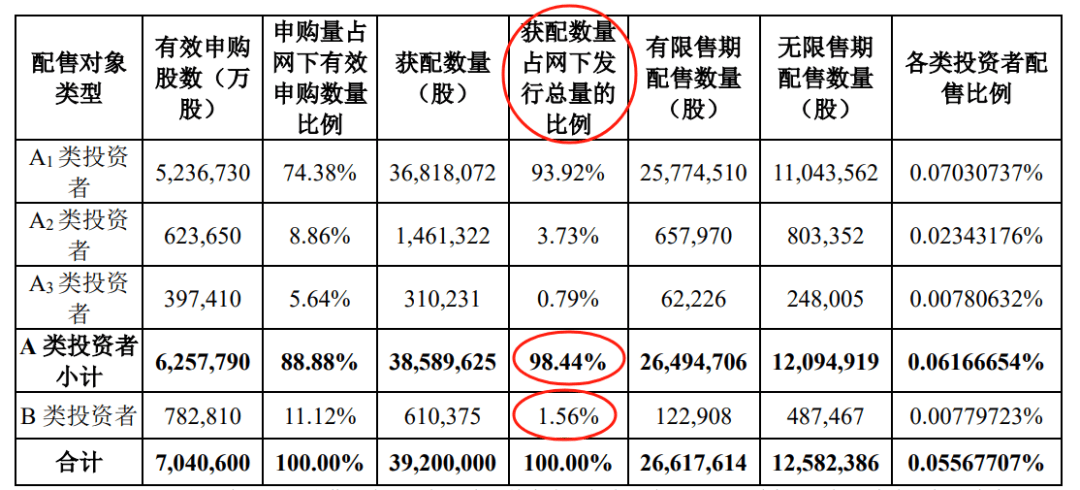
Core Viewpoint - The allocation results of offline subscription for Moer Thread indicate a significant shift in the distribution of shares, with A-class investors receiving 98.44% of the allocation and B-class investors only 1.56%, reflecting changes in the issuance and underwriting system for the Sci-Tech Innovation Board [1][3][9] Group 1: Allocation Results - A-class investors, which include public funds, social security funds, pension funds, and qualified foreign investors, received 98.44% of the shares allocated, while B-class investors received only 1.56% [1][3] - The specific allocation numbers show that some B-class investors received as few as 39 shares, highlighting the disparity in allocation [1] - Previous new stocks on the Sci-Tech Innovation Board also exhibited similar trends, with B-class investors typically receiving less than 5% of the allocation [4][5] Group 2: Subscription Rules - The reduction in B-class investor allocation is attributed to adjustments in the offline subscription rules, which now implement a new subscription method called "agreed lock-up" [7] - Under the agreed lock-up method, different lock-up periods and ratios are set for various investor classes, with A-class investors having the option to choose higher lock-up tiers [7][8] - For instance, the lock-up tiers for Moer Thread were set at three levels, with the first tier requiring a 9-month lock-up and a 70% lock-up ratio, while B-class investors could only subscribe at the lowest tier [7] Group 3: Impact on Investment Returns - The disparity in allocation ratios has led to a significant decrease in the share of B-class investors, which may affect their potential returns from new stock subscriptions [9] - Research indicates that the average return contribution from new stocks for A-class investors is significantly higher than for B-class investors, with A1-class investors potentially seeing returns of 0.116% compared to 0.014% for B-class investors [12] - The adjustments in the subscription rules aim to favor long-term investors, thereby increasing the allocation for those with a commitment to holding shares [11]
最低仅获配39股!摩尔线程网下初配结果出炉
证券时报· 2025-11-26 04:24
Core Viewpoint - The offline subscription for new shares is undergoing a significant change, with a marked reduction in the allocation for B-class investors compared to A-class investors, primarily due to the new subscription rules implemented for the Sci-Tech Innovation Board [2][8]. Summary by Sections Allocation Results - On November 25, the preliminary allocation results for Moer Thread showed that A-class investors received 98.44% of the shares, while B-class investors received only 1.56%. Some B-class investors received as few as 39 shares [2][4]. Investor Categories - A-class investors include public funds, social security funds, pension funds, bank wealth management products, insurance funds, and qualified foreign investors. B-class investors consist of private equity, securities asset management, and proprietary trading [2]. Subscription Rules - The new subscription rules for the Sci-Tech Innovation Board involve a "contractual lock-up" method, where different lock-up periods and ratios are set for various investor categories. A-class investors can choose from multiple lock-up tiers, while B-class investors are limited to the lowest tier [8][9]. Allocation Disparity - The allocation ratio for A-class investors is designed to be at least nine times that of B-class investors. For instance, the allocation ratio for A1-class investors was 0.07%, while for B-class investors, it was 0.0078%, indicating a significant disparity [9][10]. Historical Context - In previous subscriptions for Sci-Tech Innovation Board stocks, the allocation ratios between A and B-class investors were relatively close. However, recent changes have led to a substantial tilt towards A-class investors, with B-class allocations dropping below 5% in many cases [10][11]. Impact on Returns - The new rules are expected to affect the potential returns for B-class investors. For example, under the new allocation method, the average return contribution for A1-class investors is estimated at 0.116%, while B-class investors see a contribution of only 0.014% [12].

最低仅获配39股!摩尔线程打新出炉,B类投资者几乎被“忽视”
券商中国· 2025-11-25 23:22
Core Viewpoint - The offline subscription for new shares in the Sci-Tech Innovation Board is experiencing a significant shift, with A-class investors receiving a dominant allocation compared to B-class investors due to new subscription rules [1][5][9]. Group 1: Allocation Results - A-class investors received 98.44% of the allocation, while B-class investors only received 1.56% in the recent subscription by Moer Thread [2][3]. - The allocation for A-class investors in other recent Sci-Tech Innovation Board subscriptions also showed a similar trend, with A-class allocations ranging from 94.66% to 97.48% [3][4]. Group 2: Subscription Rules - The reduction in B-class investor allocations is attributed to the adjustment of offline subscription rules, which now implement a "contractual lock-up" method [5][6]. - The new rules allow A-class investors to choose from different lock-up periods and ratios, significantly favoring them over B-class investors [6][9]. Group 3: Impact on Investors - The disparity in allocation ratios has raised concerns about the potential impact on the returns for B-class investors, such as private equity firms [8]. - Research indicates that under the new subscription rules, the average return contribution for A-class investors is significantly higher than that for B-class investors, with A1 class potentially contributing 0.116% compared to B-class's 0.014% [9].