经济混沌式演化

Search documents
程实︱2026年全球经济展望:在混沌中构建秩序
Di Yi Cai Jing· 2025-11-23 12:14
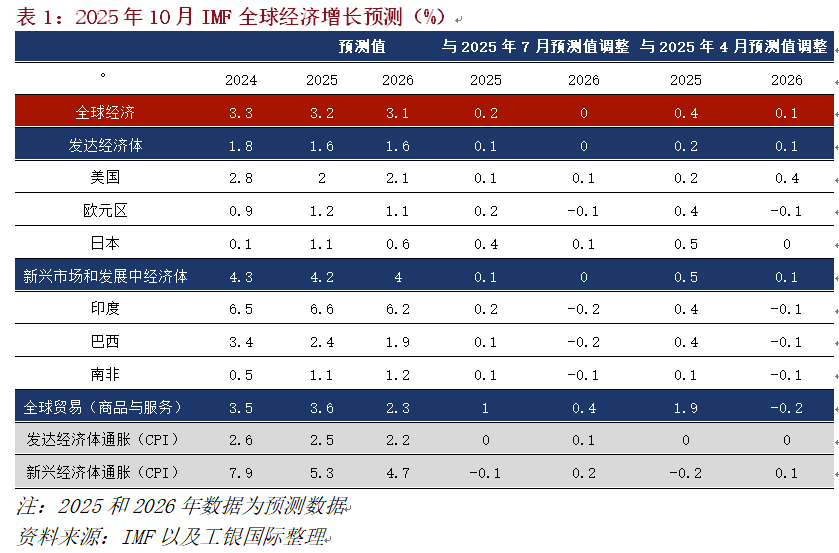
Group 1 - The global economy is transitioning from a linear trajectory to a complex system shaped by non-linearity, path dependence, and adaptability, driven by structural reforms, supply chain restructuring, and technological innovation under fiscal leadership [1][2][5] - The International Monetary Fund (IMF) forecasts global economic growth rates of 3.2% for 2025 and 3.1% for 2026, reflecting an improvement from previous predictions but still indicating a phase of moderate growth intertwined with high uncertainty [2][3] - The current chaotic non-linear evolution is attributed to three main factors: ongoing external shocks, structural differentiation disrupting economic rhythms, and reflexive cycles exacerbating instability [5][6] Group 2 - The global economy is expected to exhibit four key characteristics in 2026: adaptability, non-linearity, high sensitivity, and bidirectionality, indicating a complex interplay of upward potential and downward risks [6][7] - Fiscal policies are becoming increasingly central to economic management as monetary policy faces limitations due to high debt levels and persistent inflation, with major economies expected to rely on fiscal expansion to counteract downward pressures [10][11] - The economic outlook for major regions in 2026 includes a projected GDP growth of 1.8% for the US, 1.1% for the Eurozone, and 0.7% for Japan, with inflation rates expected to stabilize around 2.9%, 1.8%, and 1.8% respectively [13][14]