全球经济非线性演化

Search documents
工银国际-2026全球经济展望及投资策略
2025-12-15 02:13
Summary of Key Points from the Conference Call Industry Overview - The global economy is experiencing critical inflection points due to various factors including the Federal Reserve's interest rate cut cycle, geopolitical tensions, and supply chain restructuring. This has led to increased volatility in risk assets, particularly in high valuation ranges [10][11] - China's economy is navigating through complex challenges while achieving steady growth, successfully meeting the high-quality development targets set under the "14th Five-Year Plan" [10][11] - Hong Kong's capital market has shown robust recovery, with the Hang Seng Index outperforming global indices and IPO fundraising reclaiming the top position worldwide [10][11] Core Insights and Arguments - Looking ahead to 2026, the global economic landscape is characterized by short-term resilience and medium-to-long-term structural risks, which will significantly influence global investment flows [11] - The "15th Five-Year Plan" is expected to further unleash China's economic potential through industrial upgrades, technological innovation, and domestic demand stimulation, enhancing its strategic advantage in value investing [11] - Hong Kong is positioned as a key "super-connector" and "super value-adder" in the global capital market, with ongoing reforms and expansion of interconnection programs solidifying its status as the premier offshore Renminbi hub [11] Additional Important Points - The ongoing AI revolution and the reconfiguration of East-West dynamics are seen as significant factors influencing investment strategies and opportunities [12] - ICBC International Research emphasizes its commitment to providing high-quality, differentiated research to guide global investors through technological disruptions and macroeconomic transformations [12] - The research team at ICBC International is recognized for its strong professional reputation and aims to expand the breadth and depth of its research services to better serve clients [15][16] Conclusion - The conference highlighted the interplay between global economic trends and China's strategic initiatives, positioning Hong Kong as a vital hub for investment in Chinese assets. The insights provided by ICBC International Research reflect a deep understanding of the current market dynamics and future opportunities.
程实︱2026年全球经济展望:在混沌中构建秩序
Di Yi Cai Jing· 2025-11-23 12:14
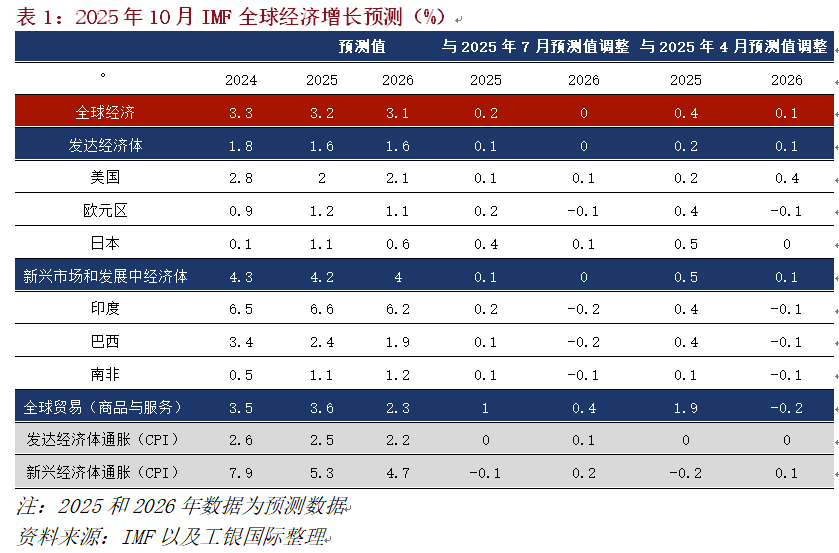
Group 1 - The global economy is transitioning from a linear trajectory to a complex system shaped by non-linearity, path dependence, and adaptability, driven by structural reforms, supply chain restructuring, and technological innovation under fiscal leadership [1][2][5] - The International Monetary Fund (IMF) forecasts global economic growth rates of 3.2% for 2025 and 3.1% for 2026, reflecting an improvement from previous predictions but still indicating a phase of moderate growth intertwined with high uncertainty [2][3] - The current chaotic non-linear evolution is attributed to three main factors: ongoing external shocks, structural differentiation disrupting economic rhythms, and reflexive cycles exacerbating instability [5][6] Group 2 - The global economy is expected to exhibit four key characteristics in 2026: adaptability, non-linearity, high sensitivity, and bidirectionality, indicating a complex interplay of upward potential and downward risks [6][7] - Fiscal policies are becoming increasingly central to economic management as monetary policy faces limitations due to high debt levels and persistent inflation, with major economies expected to rely on fiscal expansion to counteract downward pressures [10][11] - The economic outlook for major regions in 2026 includes a projected GDP growth of 1.8% for the US, 1.1% for the Eurozone, and 0.7% for Japan, with inflation rates expected to stabilize around 2.9%, 1.8%, and 1.8% respectively [13][14]