经济结构性分化

Search documents
程实︱2026年全球经济展望:在混沌中构建秩序
Di Yi Cai Jing· 2025-11-23 12:14
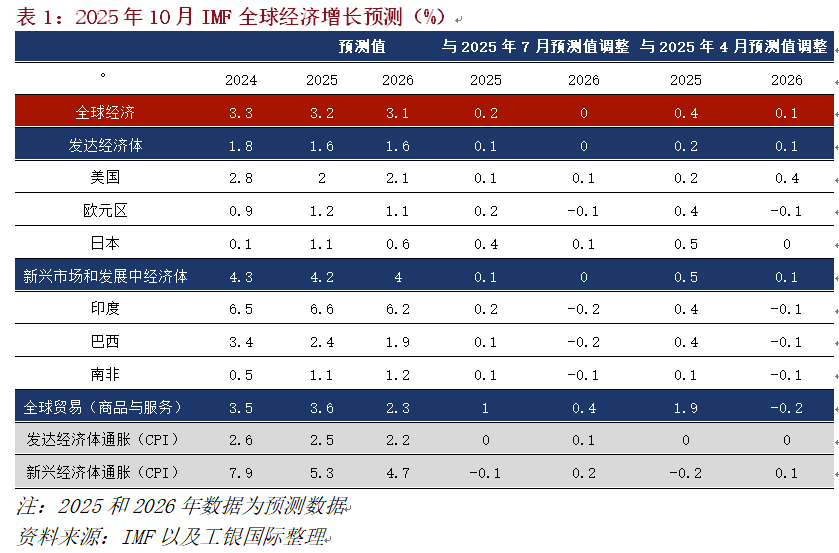
Group 1 - The global economy is transitioning from a linear trajectory to a complex system shaped by non-linearity, path dependence, and adaptability, driven by structural reforms, supply chain restructuring, and technological innovation under fiscal leadership [1][2][5] - The International Monetary Fund (IMF) forecasts global economic growth rates of 3.2% for 2025 and 3.1% for 2026, reflecting an improvement from previous predictions but still indicating a phase of moderate growth intertwined with high uncertainty [2][3] - The current chaotic non-linear evolution is attributed to three main factors: ongoing external shocks, structural differentiation disrupting economic rhythms, and reflexive cycles exacerbating instability [5][6] Group 2 - The global economy is expected to exhibit four key characteristics in 2026: adaptability, non-linearity, high sensitivity, and bidirectionality, indicating a complex interplay of upward potential and downward risks [6][7] - Fiscal policies are becoming increasingly central to economic management as monetary policy faces limitations due to high debt levels and persistent inflation, with major economies expected to rely on fiscal expansion to counteract downward pressures [10][11] - The economic outlook for major regions in 2026 includes a projected GDP growth of 1.8% for the US, 1.1% for the Eurozone, and 0.7% for Japan, with inflation rates expected to stabilize around 2.9%, 1.8%, and 1.8% respectively [13][14]

为经济新旧动能转换护好航
第一财经· 2025-08-29 00:44
Core Viewpoint - The article emphasizes the resilience and growth potential of China's high-tech manufacturing sector, highlighting its role in driving overall industrial profits despite challenges faced by other industries [2][3]. Group 1: Industrial Profit Trends - In the first seven months, profits of large-scale industrial enterprises in China decreased by 1.7% year-on-year, with a slight improvement in the decline rate compared to the first half of the year [2]. - In July, profits fell by 1.5% year-on-year, but this marked a 2.8% improvement from June, indicating a narrowing of the contraction [2]. - High-tech manufacturing showed a significant turnaround, with profits growing by 18.9% in July, compared to a decline of 0.9% in June, contributing to an overall acceleration in profit growth for large-scale industrial enterprises [2]. Group 2: Emerging Industries - The biopharmaceutical industry has developed strong international competitiveness through years of resilience, while the artificial intelligence sector has maintained its leading position in international competition by seeking differentiated advantages [2]. - The article illustrates that Chinese enterprises possess the drive and innovation capabilities necessary for growth, provided they are given the appropriate space to operate freely [2]. Group 3: Market Support for Innovation - The rise of domestic AI chip company Cambricon, which surpassed Kweichow Moutai in stock price, reflects a market consensus supporting companies focused on technological advancement [3]. - Investors are willing to take risks on companies that demonstrate potential for upward technological breakthroughs, indicating a collaborative effort among market participants to drive growth [3]. Group 4: Structural Challenges - The performance of high-tech manufacturing highlights a growing structural divide in the economy, with upstream raw materials and consumer services still facing significant challenges [4]. - Industries that have not yet recovered from negative growth pose risks that need to be addressed through effective support mechanisms, including legal and institutional preparations for market exits and restructuring [4]. Group 5: State-Owned Enterprises and Market Reforms - Data shows that profits for state-owned enterprises have declined, while foreign and private enterprises have seen positive growth, underscoring the need for reform in state-owned enterprises [5]. - The article advocates for market-oriented reforms as essential for the modernization and profitability of state-owned enterprises, emphasizing the importance of maintaining a balance between power and rights in economic governance [5].