
绿色种养循环农业

Search documents
【新时代陇原先锋】将汗水洒在陇原大地——记甘肃省耕地质量建设保护总站站长郭世乾
Xin Lang Cai Jing· 2026-01-17 01:15
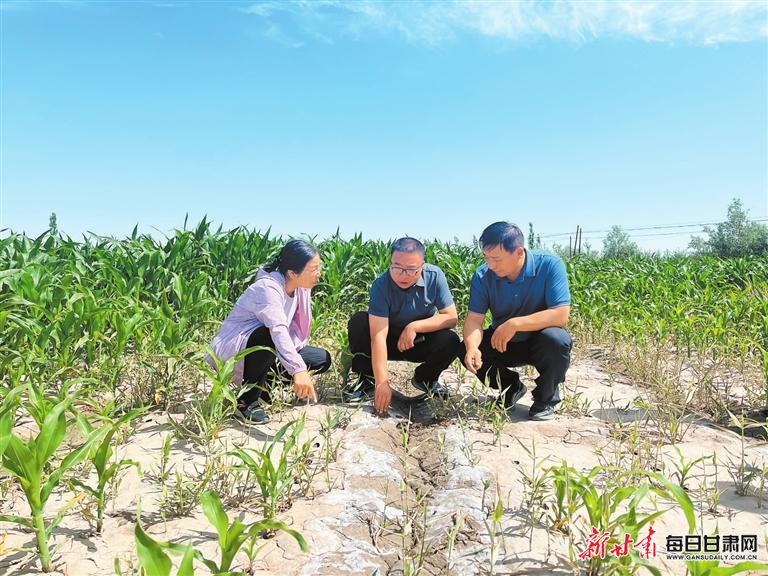
Core Viewpoint - The article highlights the dedication and contributions of Guo Shiqian, the head of the Gansu Provincial Soil Quality Construction and Protection Station, in improving agricultural practices and soil quality in Gansu Province through hands-on efforts and innovative techniques [1][5]. Group 1: Professional Background and Contributions - Guo Shiqian has over 20 years of experience in agricultural technology, focusing on soil quality and agricultural development in Gansu Province [1][5]. - He has been actively involved in fieldwork, including measuring soil conditions and managing agricultural practices throughout the seasons [1]. - His commitment to understanding local agricultural challenges led him to visit all households in Gushan Village, covering over 300 kilometers and gathering extensive data on soil and farming conditions [2]. Group 2: Innovative Techniques and Achievements - Guo established a technical team to address the challenges of saline-alkali land, conducting experiments and monitoring soil conditions to develop effective improvement strategies [4]. - He has successfully improved 240,000 acres of saline-alkali land using four major technical models, including "fertilizer enhancement and salt control" [4]. - Under his leadership, the application area of organic fertilizers reached 36 million acres, with a reduction rate of chemical fertilizers in core areas of about 10% [4]. Group 3: Recognition and Future Goals - Guo has received multiple awards for his outstanding work, including the "Gansu Province May Day Labor Medal" and recognition as a "National Special Allowance Expert" [5]. - He continues to lead efforts in promoting sustainable agricultural practices, focusing on soil quality improvement, scientific fertilization, and efficient water use to ensure food security and promote high-quality agricultural development in Gansu [5].

变废为宝,点“叶”成金!看怀集如何玩转农业生态经济学
Nan Fang Nong Cun Bao· 2026-01-08 14:35
Core Viewpoint - The article discusses how Huai Ji County is transforming agricultural waste, specifically sugarcane leaves, into valuable resources through innovative ecological economic practices, thereby promoting sustainable agricultural development [1]. Group 1: Agricultural Innovation - Huai Ji County Dongsheng Agricultural Technology Co., Ltd. was established in 2024 and has integrated fallow land for large-scale cultivation of quality sugarcane varieties "Yue Tang 159" and "Liu Cheng 136," with a planting area reaching 3,500 acres [11][12]. - The first harvest season yielded an average wet weight of 7.5 tons per acre, with a total output exceeding 26,000 tons [14][15]. Group 2: Waste Management Challenges - The company faced a challenge with over 8,500 tons of sugarcane leaves generated, which were previously burned or discarded, leading to environmental pollution and resource wastage [15][16]. - Traditional burning methods do not meet environmental standards, and the accumulation of waste affects future farming [17][18]. Group 3: Government Support and Collaboration - The Huai Ji County Agricultural Technology Promotion Center is implementing projects for comprehensive utilization of agricultural straw and green cyclical agriculture to meet "dual carbon" goals, supported by national policies and central financial resources [24][25][30]. - The government facilitated collaboration between Dongsheng Agricultural and Guangdong Di Sheng Ecological Agricultural Technology Co., Ltd. to create an ecological cycle model involving straw, manure, and earthworm farming [31][32]. Group 4: Circular Economy Implementation - In the sugarcane recycling processing site, sugarcane leaves are processed into feed for earthworms, which then produce high-quality organic fertilizer [38][41]. - This complete green industrial chain includes sugarcane cultivation, leaf processing, earthworm feeding, and returning organic fertilizer to the soil, enhancing soil quality and reducing chemical fertilizer usage [44][46]. Group 5: Economic Benefits and Future Plans - The innovative model resolves straw disposal issues, reduces processing costs, and provides high-quality organic fertilizer for the company [51]. - The partnership with Di Sheng Ecological Technology ensures a stable supply of raw materials and expands earthworm farming, while farmers benefit from increased income through participation in the industrial chain [52][53]. - Plans are in place to further expand the planting area, aiming to exceed 50,000 acres by 2030, enhancing the value of this green circular model [53][54]. Group 6: Sustainable Development Goals - The sugarcane industry is a vital part of Huai Ji County's agricultural industrialization, moving towards a unique green development path [56]. - The county aims to promote this successful experience and encourage more agricultural entities to participate in green cyclical farming, transitioning from a linear model to a circular resource model [58][59].

截至2024年四川化肥用量八连降,粮食产量却创新高 四川的“减肥术”
Si Chuan Ri Bao· 2025-07-07 00:55
Core Viewpoint - Sichuan province is under significant pressure to reduce fertilizer use while ensuring food security, as it is one of the 13 major grain-producing provinces in China and the largest producer of rapeseed [1][4]. Group 1: Agricultural Practices - Sichuan has initiated a green cycle agriculture pilot program focusing on organic materials for fertilizers, technological improvements for quality, and effective mechanisms for implementation [1][5]. - The province has successfully reduced chemical fertilizer usage by 2 pounds per acre compared to ten years ago, without affecting grain yields, which have consistently increased, reaching a historical high of 72.68 billion pounds last year [1][2]. Group 2: Challenges and Policies - The dual mission of promoting green agricultural development while ensuring food security presents a significant challenge for Sichuan, necessitating a balance between reducing fertilizer use and maintaining stable crop yields [3][4]. - National policies initiated in 2015 aimed at zero growth in fertilizer usage have placed additional pressure on provinces like Sichuan to meet environmental and agricultural standards [3][4]. Group 3: Innovative Approaches - The green cycle agriculture pilot program emphasizes the use of organic waste, such as livestock manure and straw, to enhance soil fertility and reduce reliance on chemical fertilizers [5][6]. - Technological innovations in fertilizer application, including new fertilization techniques and products, have been implemented in major grain-producing counties, leading to a zero growth in fertilizer usage for three consecutive years in some areas [6][8]. Group 4: Future Directions - Moving forward, Sichuan's agricultural strategy will focus on improving fertilizer efficiency rather than merely reducing quantities, with an emphasis on scientific fertilization practices [8][9]. - The province plans to enhance the utilization of organic fertilizers and expand the coverage of soil testing and tailored fertilization techniques to ensure sustainable agricultural practices [8][9].