绿色能源变革

Search documents
“十万亿”山东掀起了绿色能源变革
经济观察报· 2026-02-02 05:53
Core Viewpoint - Shandong Province has made significant strides in transitioning to green energy, with non-fossil energy power generation capacity reaching 139 million kilowatts by 2025, increasing its share from 31% to 54%, surpassing coal power for the first time [2][3]. Group 1: Energy Transition Achievements - During the "14th Five-Year Plan" period, Shandong's energy consumption intensity decreased by 22%, and carbon emission intensity fell by 20.5% [2][3]. - The proportion of days with good air quality reached 77.8%, and Shandong has consistently received high marks in central pollution prevention assessments [2][3]. - The province has closed 10.9427 million kilowatts of small coal-fired power units, with over 87% of operational coal power units being large-scale [6][5]. Group 2: Industrial Transformation - Shandong's industrial focus has shifted from heavy industries like steel and petrochemicals, which heavily relied on coal, to cleaner energy sources [5][6]. - The province has implemented measures to reduce carbon emissions in high-energy-consuming industries, including relocating steel production to coastal areas and closing high-energy-consuming production capacities [5][6]. - The integration of smaller refineries and the establishment of world-class refining and chemical projects have improved energy efficiency and product value [6] . Group 3: Green Energy Development - Shandong has actively expanded external green electricity supply channels and coordinated the construction of new energy stations within the province [10][11]. - The "External Electricity into Shandong" strategy has successfully delivered over 1 trillion kilowatt-hours of external power to the province over the past 20 years [10][11]. - By 2025, Shandong's distributed photovoltaic projects have become a major force in new energy station construction, with a total installed capacity of over 115 million kilowatts, accounting for 48.3% of total power generation capacity [11][12]. Group 4: Policy and Market Innovations - Shandong has pioneered several market reforms in the electricity sector, including the introduction of capacity compensation systems and retail price caps to stabilize electricity prices [14][15]. - The province is also a leader in the development of an electricity spot market, which enhances resource allocation and price signals [13][14]. - New energy mechanism price bidding results have indicated a shift towards wind power and energy storage development, with significant investments expected in these areas [15][16]. Group 5: Future Goals and Initiatives - The Shandong government aims to establish 20 provincial-level zero-carbon parks and explore integrated models for energy sources, networks, loads, and storage [18][19]. - The zero-carbon parks are designed to achieve net-zero carbon emissions through various technological and management measures, promoting sustainable development [19][20]. - The province plans to continue optimizing its energy structure by advancing nuclear power and large-scale clean coal projects [16][20].


“十万亿”山东掀起了绿色能源变革
Jing Ji Guan Cha Wang· 2026-01-31 03:02
Core Viewpoint - Shandong province has undergone a significant transformation over the past five years, shifting from a coal-dominated energy structure to a green power model, with non-fossil energy generation capacity expected to reach 139 million kilowatts by 2025, surpassing coal power for the first time [1][2] Group 1: Energy Transition - By 2025, non-fossil energy generation capacity in Shandong will account for 54% of total capacity, up from 31%, marking a historic shift away from coal [1][2] - The province has implemented measures such as "one enterprise, one policy" to reduce carbon emissions in high-energy-consuming industries [1][3] - Shandong's energy consumption intensity has decreased by 22% over five years, and carbon emission intensity has dropped by 20.5% [1] Group 2: Industrial Adjustments - The industrial focus has shifted from heavy industries like steel and petrochemicals, which previously accounted for 70% of the industrial output, to cleaner energy sources [3][4] - Shandong has closed 23.56 million tons of high-energy-consuming steel production capacity and increased the share of coastal steel production to 53% [3] - The province has also shut down 10.94 million kilowatts of small coal-fired power units during the 14th Five-Year Plan [4] Group 3: Renewable Energy Development - Shandong is actively expanding external green electricity supply channels and has implemented the "External Electricity into Shandong" strategy, which has delivered over 1 trillion kilowatt-hours of external power [6][7] - The province's distributed photovoltaic projects have established a model that emphasizes household and village-level development, leading to a cumulative installed capacity of over 115 million kilowatts [7][8] - By 2025, Shandong's new energy and renewable energy installed capacity will account for 48.3% of total power generation, with a utilization rate of 97.6% [7] Group 4: Market Reforms - Shandong has pioneered reforms in the electricity market, including the introduction of a capacity compensation system and a price cap for retail electricity [9][10] - The province is a leader in the construction of a power spot market, which helps balance supply and demand while promoting the transition to cleaner energy [8][10] - The first auction for new energy mechanism prices in 2025 resulted in competitive pricing for wind and solar projects, encouraging further investment in these areas [10] Group 5: Zero Carbon Initiatives - Shandong aims to establish 20 provincial-level zero-carbon parks and explore integrated models for energy supply, grid, load, and storage [12][13] - The zero-carbon parks are designed to achieve net-zero carbon emissions through various technologies and management measures [12][14] - The integration of renewable energy projects with energy storage systems is expected to enhance the efficiency and reliability of energy supply [13][14]
我国“绿电答卷”成绩亮眼:每3度电就有1度绿电
Yang Shi Xin Wen· 2025-10-21 04:29
Core Insights - China's energy production and consumption patterns are undergoing a significant transformation, with a focus on green energy development since the "14th Five-Year Plan" [1] Group 1: Renewable Energy Development - The annual electricity generation in China exceeds 10 trillion kilowatt-hours, accounting for one-third of global production [5] - The "14th Five-Year Plan" has established nine major clean energy bases, with seven located in the western regions of China [7] - The transformation of previously barren lands into vast solar energy fields demonstrates the scale of renewable energy expansion [7] Group 2: Infrastructure and Energy Transmission - The construction of 19 ultra-high voltage transmission lines over five years has created a super network for electricity delivery [10] - Clean energy transmission from the west to the east has increased by 70%, meeting one-fifth of the electricity demand in the eastern and central regions [10] Group 3: Energy Storage Innovations - New energy storage technologies, including gravity and compressed air storage, have been integrated into the energy system, marking their first appearance in the "Five-Year Plan" [12] - The completion of the target for non-fossil energy consumption, which is set at 20% for the "14th Five-Year Plan," has been achieved on schedule [12]
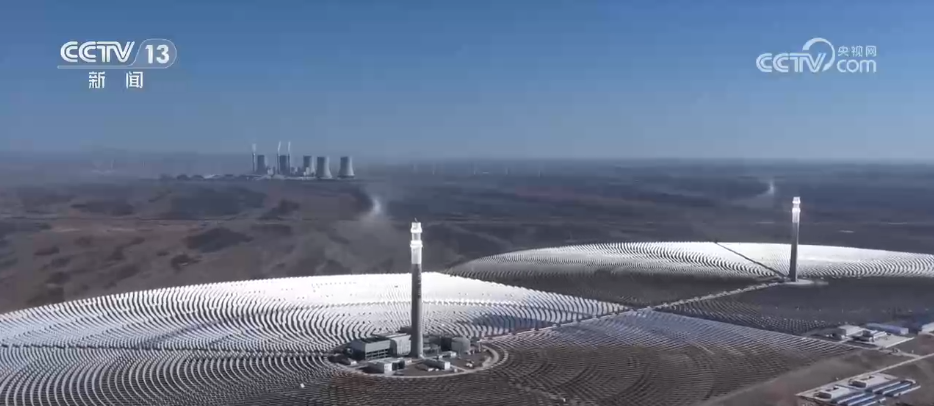
硬核“十四五”丨逐光驭风 澎湃绿能点亮万家灯火
国家能源局· 2025-10-20 02:55
Core Viewpoint - China is undergoing a significant transformation in its energy production and consumption landscape, focusing on green energy development and infrastructure expansion, particularly in the context of the "14th Five-Year Plan" [2][12]. Group 1: Renewable Energy Generation - The deployment of solar energy has led to the establishment of vast solar power plants in previously barren areas, with an annual generation capacity equivalent to replacing 560,000 tons of coal [4]. - Wind energy is also being harnessed effectively, with 93-meter-long blades generating enough electricity for three households for two days with each rotation [6]. - In total, China generates over 10 trillion kilowatt-hours of electricity annually, accounting for one-third of global production, with one-third of its electricity coming from renewable sources [8]. Group 2: Infrastructure Development - The construction of six large hydropower stations along the Yangtze River has created the world's largest clean energy corridor, while new energy bases in the western regions are rapidly expanding [10]. - The "14th Five-Year Plan" has seen the initiation of 19 ultra-high voltage power transmission lines, creating a super network for electricity delivery that spans over 50,000 kilometers [12]. Group 3: Energy Storage Solutions - New energy storage solutions have emerged prominently in the "Five-Year Plan," with capacity increasing nearly 30 times to 95 million kilowatts, addressing the intermittency of renewable energy [14]. - These storage systems have played a crucial role during peak demand periods, particularly during extreme summer heat, by storing energy during low demand and discharging it during peak times [14]. Group 4: Achievements and Goals - China has established the world's largest and most complete renewable energy industry chain, achieving the target of 20% non-fossil energy consumption as set in the "14th Five-Year Plan" [16].