网络安全软件

Search documents
人工智能深度融入企业运营 中国财会复合型人才需求激增
Huan Qiu Wang Zi Xun· 2025-11-24 06:19
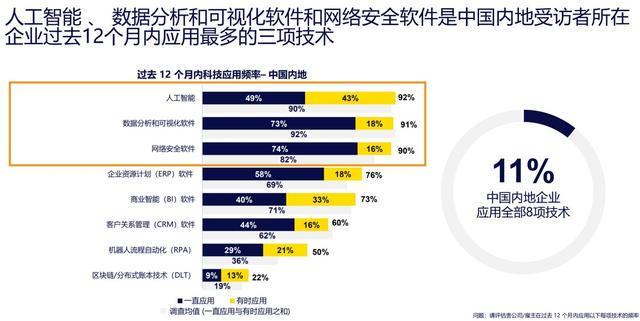
Core Insights - The widespread adoption of generative artificial intelligence (AI) has significantly lowered the application barriers for businesses, providing mature and reliable technology options that accelerate the intelligent upgrade across various industries [1][4] - A recent survey by the Australian Accounting Association revealed that 92% of surveyed companies in mainland China have deployed AI tools, a substantial increase from 72% the previous year, with 21% fully integrating AI into their business processes, leading the Asia-Pacific region [1][4] - The rapid development of AI is reshaping corporate technology strategies and fundamentally altering the core competencies required in finance and accounting roles, pushing human resource structures towards a more "composite and intelligent" direction [1][4] AI Application Trends - The survey covered 1,117 finance, accounting, and financial professionals across nine major Asia-Pacific markets, with 244 valid samples from mainland China, indicating a high level of representation [4] - AI, data analytics, and cybersecurity software emerged as the three most widely used technologies in mainland China over the past year, with 49% of respondents indicating their companies have been consistently using AI [4] - The depth of AI application in mainland China is notable, with the highest percentage in the Asia-Pacific region of respondents indicating that AI technology is fully integrated into their business processes [4] Future Investment Outlook - 65% of respondents from mainland China expect their companies to increase AI investments in the next 12 months, a 17 percentage point increase from 2024 [5] Talent Structure Changes - The penetration of AI is restructuring the talent composition within finance and accounting teams, with 32% of respondents indicating a reduction in hiring entry-level accounting staff due to AI adoption, significantly higher than the Asia-Pacific average of 17% [7] - 18% of companies are actively recruiting composite accounting talents with AI expertise, far exceeding the regional average of 8% [7] - Traditional repetitive tasks in accounting are being automated by technologies like RPA and intelligent agents, shifting the focus towards strategic analysis, risk management, and data insights [7] Challenges for SMEs - Despite the enthusiasm for AI applications, about 40% of respondents noted low returns on technology investments, particularly among resource-constrained SMEs, which cite financial costs and low ROI as primary challenges [8] - SMEs are advised to adopt lightweight third-party tools and phased investment strategies to enhance core business capabilities while leveraging local policy support to alleviate financial pressures [8] Security Concerns - The deepening AI application has introduced new security challenges, with 74% of respondents indicating ongoing use of cybersecurity software, and 61% reporting no losses from cybersecurity incidents in the past year [9] - 35% of companies have fully integrated cybersecurity into their corporate strategy and operations, surpassing the Asia-Pacific average of 28%, indicating a high level of data protection maturity [9] Strategic Recommendations - Companies are encouraged to build data-centric, AI-driven organizational structures to enhance core operational management competencies for future competitiveness [10]