美国货币政策稳定性

Search documents
市场陷入“休眠”!10年期美债收益率波动性创纪录新低,投资者焦虑“破位”时刻
智通财经网· 2026-01-16 02:43
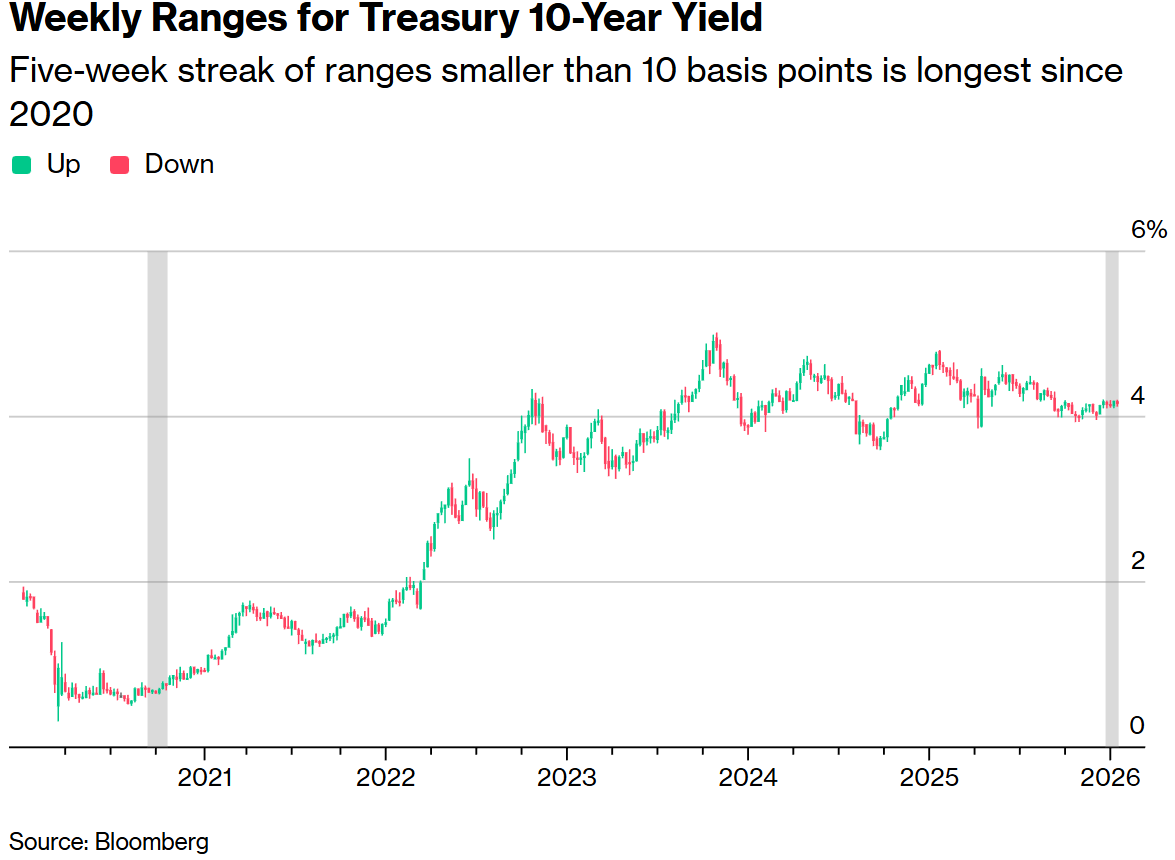
Group 1 - The 10-year U.S. Treasury yield is approaching its fifth consecutive week of minimal fluctuations, nearing the longest "inertia period" in the past two decades [1] - Since 2006, the median weekly fluctuation range for the 10-year Treasury yield has been 16 basis points, while the past five weeks have seen a range of less than 10 basis points, marking the longest such period since 2020 [1] - This trend is primarily driven by market expectations of stability in U.S. monetary policy, causing anxiety among bond market investors due to the historical tendency for narrow yield fluctuations to precede sell-offs [1] Group 2 - Since mid-December, the 10-year Treasury yield has hovered between 4.1% and 4.2%, enduring various risk events including employment data and geopolitical tensions [4] - The benchmark yield was maintained at 4.16% during early Asian trading on Friday, with investors questioning what would drive the yield above 4.25% or below 4.05% [4] - Historical patterns indicate that when such a narrow range is eventually breached, it often leads to bearish events in the bond market [4] Group 3 - Despite volatility in commodities and equities, interest rate futures remain stagnant, with a short-term interest rate futures contract reflecting a volatility range of about 100 basis points during the Fed's rate hike cycle in 2023, compared to only half of that currently [5]

特朗普强硬施压美联储!要求掌控利率决策权,白宫博弈升级
Sou Hu Cai Jing· 2025-12-16 02:13
Core Viewpoint - Trump is pressuring the Federal Reserve Chairman Powell regarding interest rate policy, aiming to influence rates to align with his economic and political goals, which raises concerns about the independence of the Fed [2][3][4] Group 1: Economic Impact - Summers expresses concern that Trump's actions could undermine the foundation of the U.S. economy and market confidence, citing the negative impact of high interest rates on manufacturing PMI [2][3] - The U.S. Labor Department reported that non-farm payrolls have fallen below expectations for three consecutive months due to high interest rates, with manufacturing orders decreasing by 2.1% month-over-month [3] - The IMF President emphasizes the importance of central bank independence for economic stability, urging respect for the Fed's professional decision-making [3][5] Group 2: Federal Reserve Independence - Trump's attempts to exert pressure on the Fed are seen as a violation of economic principles, potentially leading to negative chain reactions in the economy [4] - The Peterson Institute for International Economics highlights that the Fed's independence is crucial for maintaining market stability and guiding economic expectations [4][5] - Historical lessons from the Nixon administration's interference with the Fed's policies illustrate the risks associated with undermining central bank independence [4][5]