
职场边界

Search documents
我不干了,不跳舞就开除?这届年会到底谁在爽?
3 6 Ke· 2026-01-21 10:03
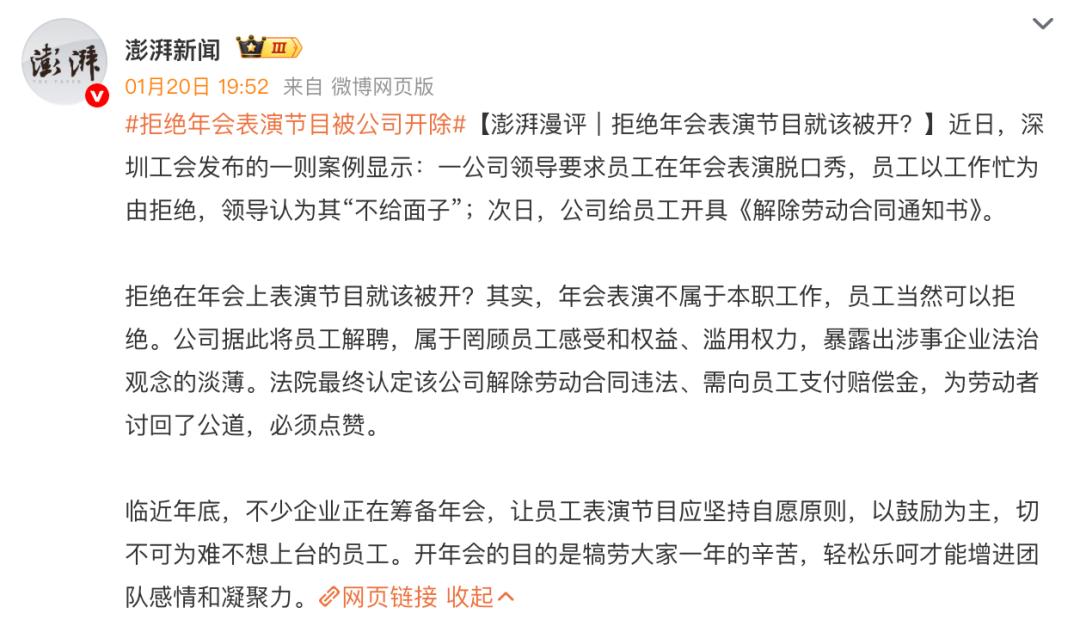
Core Viewpoint - The article highlights a labor dispute case in Shenzhen, where an employee was dismissed for refusing to perform at a company annual meeting, raising questions about workplace boundaries and employee rights [1][3][5]. Group 1: Case Summary - An employee, referred to as Xiao Ming, was required to perform a stand-up comedy act at a company annual meeting despite his busy work schedule, leading to his dismissal for "not cooperating" [3][5]. - The company justified the termination by labeling the refusal as "serious misconduct," which was later deemed illegal by the court, ordering the company to pay compensation [5][6]. Group 2: Workplace Dynamics - The article discusses the shift in perception of annual meetings from a reward for employees to a platform for management to exert control and test loyalty [3][7]. - It emphasizes that annual meeting performances are not part of an employee's job description unless explicitly stated in their contract, and companies cannot impose such requirements [6][10]. Group 3: Employee Rights and Management Practices - The article outlines the legal principles that protect employees, including the right to refuse participation in non-work-related activities and the need for companies to respect personal time [6][10]. - It critiques the outdated management style that equates participation in such events with loyalty and dedication, particularly in the context of younger generations who prioritize their rights and self-respect [10][14]. Group 4: Strategies for Employees - The article provides strategies for employees to navigate forced participation in workplace events, such as using diplomatic language to decline and documenting any coercive communications [13][14]. - It advises against impulsively resigning in response to workplace pressure, emphasizing the importance of securing legal rights and compensation [13][14].

信“心”心理问答|职场遇到“功劳全抢、黑锅全甩”的同事怎么办
Jing Ji Guan Cha Bao· 2025-05-22 01:12
Core Viewpoint - The article addresses the challenges faced by employees dealing with colleagues who take credit for work and shift blame, emphasizing the importance of setting boundaries and finding ways to assert oneself without damaging relationships [1][2][4]. Group 1: Employee Challenges - Employees often feel overwhelmed by workplace dynamics, especially when colleagues engage in "performative work" and take undue credit for successes [1]. - The emotional toll of being undermined by colleagues can lead to feelings of frustration and helplessness, particularly for those who are more introverted and conflict-averse [1][2]. Group 2: Strategies for Response - It is suggested that employees can start by using facts instead of emotions to address credit-stealing behavior, thereby subtly highlighting their contributions without confrontation [2][3]. - Proactive communication with supervisors about project progress can help ensure that efforts are recognized, shifting from a passive to an active role in showcasing one's work [3]. - Building alliances with reliable colleagues can create a support network, allowing for shared recognition of contributions during discussions and meetings [3]. Group 3: Personal Development - Employees are encouraged to view the process of establishing boundaries as a gradual learning experience, akin to learning a new skill, allowing for mistakes and adjustments along the way [3][4]. - The article posits that true strength lies in the ability to protect oneself while maintaining a sense of kindness and empathy, rather than resorting to aggressive tactics [4].