肽类药物

Search documents
AI仅用两周便研发出超长效降糖肽,疗效全面超越司美格鲁肽
GLP1减重宝典· 2025-11-05 05:00
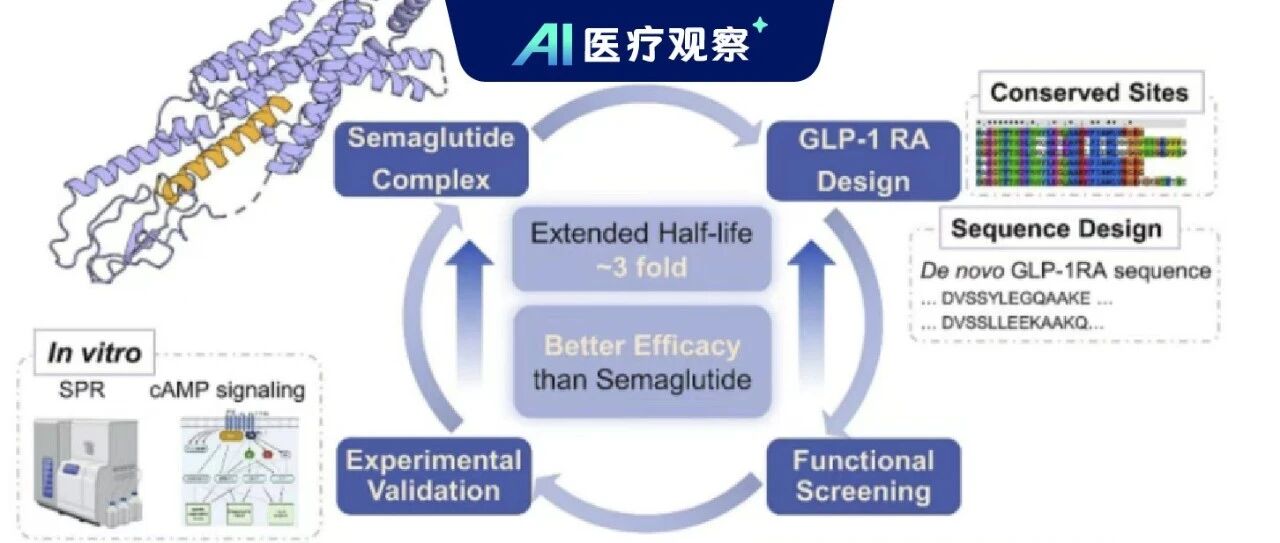
Core Viewpoint - The article highlights the transformative potential of artificial intelligence (AI) in the medical field, particularly in drug development, showcasing a recent study that demonstrates significant advancements in peptide drug design using deep learning techniques [4][6]. Group 1: AI in Drug Development - A recent study published in "Advanced Science" reveals that a research team from Shanghai Jiao Tong University successfully designed a long-acting GLP-1 receptor agonist (GLP-1 RAs) with a half-life three times that of the existing drug Semaglutide, completing the process in just two weeks [4]. - The traditional drug development process is time-consuming and costly, often taking years to identify clinical candidates, whereas AI can streamline this process significantly [6]. Group 2: Peptide Drug Market - The global peptide drug market is projected to grow from $49.13 billion in 2024 to $83.75 billion by 2034, indicating a robust market opportunity despite existing challenges such as metabolic stability and short plasma half-lives [6]. - Peptide drugs face limitations in clinical application due to issues like susceptibility to proteolytic degradation, which hinders their widespread use [6]. Group 3: AI Design Methodology - The research team utilized the ProteinMPNN deep learning tool to design new GLP-1 receptor agonists, generating 10,000 novel sequences based on the crystal structure of Semaglutide and the GLP-1 receptor [8]. - Key conserved sites critical for receptor recognition and activation were identified, allowing AI to optimize the remaining positions, leading to a selection of 60 promising peptide sequences for further testing [8][10]. Group 4: Experimental Validation - The study achieved a remarkable 52% success rate in identifying GLP-1 RAs that bind effectively to the GLP-1 receptor, with some candidates showing binding affinities comparable to Semaglutide [11]. - Notably, two candidates, D41 and D44, demonstrated half-maximal effective concentrations (EC50) of 0.011 nM and 0.012 nM, respectively, outperforming Semaglutide's EC50 of 0.019 nM [12]. Group 5: Pharmacokinetics and Efficacy - The pharmacokinetic profiles of candidates D13 and D41 showed significantly extended half-lives, with D13 at 19.86 hours and D41 at 23.16 hours, both exceeding Semaglutide's half-life of 8.17 hours [12]. - In diabetic mouse models, D13 exhibited a sustained hypoglycemic effect lasting up to 96 hours after a single injection, compared to Semaglutide's 24 hours [14]. Group 6: Additional Findings - D13 also demonstrated protective effects on kidney function, significantly reducing markers of kidney damage in diabetic mice, indicating its potential for broader therapeutic applications [16].