船舶特别港务费政策

Search documents
交通运输部,凌晨发布!
Sou Hu Cai Jing· 2025-10-14 00:51
Core Points - The new regulations outline the collection of special port fees for vessels owned or operated by U.S. entities, effective immediately upon publication [2][3] - The regulations specify exemptions for certain vessels, including those built in China and empty vessels entering Chinese shipyards for repairs [4] - The fee structure is set to increase over the years, starting at 400 RMB per net ton in 2025 and escalating to 1120 RMB per net ton by 2028 [5][10] Summary by Sections Regulations Overview - The regulations consist of ten articles detailing the basis for implementation, scope of collection, standards, responsible parties, payment requirements, and penalties for non-compliance [2][9] Fee Collection Criteria - Vessels subject to the special port fee include those owned or operated by U.S. entities, those with 25% or more U.S. ownership, U.S.-flagged vessels, and vessels built in the U.S. [3] Exemptions - Vessels built in China, empty vessels entering Chinese shipyards for repairs, and other recognized exemptions are not required to pay the fee [4] Fee Structure - The special port fee will be charged at 400 RMB per net ton starting October 14, 2025, with a maximum of five charges per vessel per year [5] - The fee will increase to 640 RMB in 2026, 880 RMB in 2027, and 1120 RMB in 2028 [10] Compliance Requirements - Shipowners or agents must report vessel information to maritime authorities seven days prior to arrival at Chinese ports and pay the special port fee [6] - Non-compliance will result in the inability to process import/export procedures for the vessel [7][8]

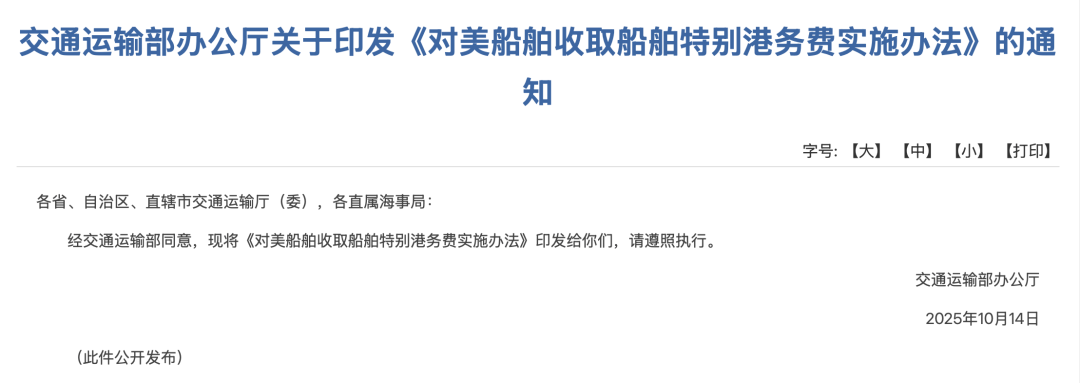
交通运输部,凌晨发布!
券商中国· 2025-10-13 23:38
Core Viewpoint - The Ministry of Transport has issued a new regulation regarding the collection of special port fees for vessels from the United States, which aims to protect the interests of China's shipping industry and outlines specific conditions and fees for compliance [1][2]. Summary by Sections Regulation Overview - The regulation consists of ten articles detailing the basis for implementation, scope of collection, standards, responsible parties, payment requirements, information verification, penalties for violations, dynamic adjustments, interpretation authority, and effective date [1][2]. Scope and Exemptions - The special port fee applies to vessels owned or operated by U.S. entities, those with 25% or more U.S. ownership, U.S.-flagged vessels, and vessels built in the U.S. However, vessels built in China, empty vessels entering Chinese shipyards for repairs, and other exempted vessels are not required to pay [2][3]. Fee Structure - The fee structure is as follows: - From October 14, 2025: 400 RMB per net ton - From April 17, 2026: 640 RMB per net ton - From April 17, 2027: 880 RMB per net ton - From April 17, 2028: 1120 RMB per net ton - A maximum of five voyages per year will incur the fee, with the billing cycle starting on April 17 each year [4][5]. Payment and Reporting Requirements - Shipowners or agents must report vessel information to maritime authorities at least seven days before arrival at Chinese ports and pay the special port fee [5][6]. Compliance and Penalties - Maritime authorities will verify the information of incoming vessels. Non-compliance, such as failure to pay the fee, will result in the inability to process import/export procedures for the vessel [5][6]. Dynamic Adjustments - The collection scope, standards, and effective dates of the special port fee may be adjusted based on circumstances [5][6].