
良性市场竞争

Search documents
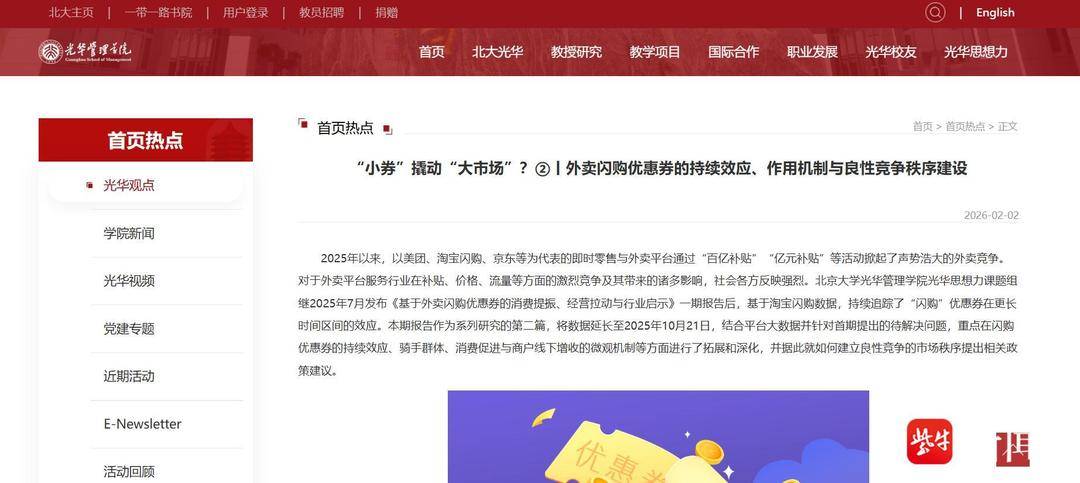
北大光华研究报告:高强度外卖补贴竞争引各方关注,打造多目标协同治理体系推动形成良性市场竞争
Yang Zi Wan Bao Wang· 2026-02-03 11:41
Core Insights - The report from Peking University's Guanghua School of Management highlights the significant impact of "flash purchase" coupons on consumer spending and merchant revenue in the food delivery sector, particularly in the context of intense competition driven by substantial subsidies from platforms like Meituan and Taobao [1][2][3] Group 1: Impact on Consumer Spending - Flash purchase coupons have shown a sustained and significant effect on consumer spending, lasting approximately six months, which has positively influenced the online revenue of participating merchants [1][3] - The study tracked 5,271 merchants, revealing that both large and small merchants experienced increased weekly revenue and order volume due to the use of flash purchase coupons [3][4] Group 2: Effects on Merchants - For small merchants, flash purchase coupons significantly boosted both online and offline revenue, with an average increase of 1,468 yuan in weekly online revenue and 164.8 yuan in offline revenue, leading to a total weekly revenue increase of 1,633 yuan [3][4] - The positive impact of flash purchase coupons was more pronounced for small merchants operating below the 50th percentile in terms of business scale [3] Group 3: Impact on Delivery Riders - As the penetration rate of flash purchases increased, delivery riders saw significant growth in their income and order completion rates, with the rise in average daily income outpacing the increase in completed orders [4] - The report indicates that the income growth for riders may be attributed to higher average earnings per order or increased incentives, rather than just an increase in the number of deliveries [4] Group 4: Market Competition and Recommendations - The ongoing high-intensity subsidy competition in the food delivery sector, involving 300 million users, millions of merchants, and riders, has garnered widespread attention and has shown to have a lasting effect on consumer spending [4] - The research suggests that fostering a healthy competitive market can provide consumers, riders, and merchants with more choices, while also encouraging platforms to enhance operational management and service quality for long-term customer retention and growth [4]

马上评|京东VS美团,消费者希望看到的不是“口水仗”
Sou Hu Cai Jing· 2025-04-21 10:47
Core Viewpoint - JD Group has announced a series of countermeasures against competitors allegedly forcing delivery riders to choose between platforms, highlighting the competitive dynamics in the food delivery industry [1][2]. Group 1: JD Group's Actions - JD Group has committed to ensuring order volumes for riders who have been allegedly blacklisted, expanding full-time rider recruitment, prioritizing employment for riders' family members, and offering free delivery for orders delayed by over 20 minutes [1]. - The announcement included a warning to a competitor, urging them to reconsider their practices, although the competitor was not explicitly named [1]. Group 2: Market Competition Dynamics - The issue of whether Meituan is indeed forcing riders to choose platforms remains unclear, complicating the assessment of competitive fairness in the market [2]. - Healthy market competition benefits all parties involved, as evidenced by JD's initial focus on social security measures for riders, which has prompted other platforms to explore better social protections for their workforce [2]. Group 3: Industry Landscape - The food delivery industry has been dominated by Meituan and Ele.me, leading to concerns about stagnation among these platforms [3]. - There is a public expectation for JD to enhance delivery efficiency and reduce operational costs, rather than engaging in unproductive disputes [3]. - The emphasis should be on improving product and service quality to create genuine benefits for consumers, rather than relying on competitive rhetoric [3].

