
花名文化

Search documents
冰箱都叫“鼠名”,三只松鼠的花名文化有多上头?
3 6 Ke· 2025-11-25 08:17
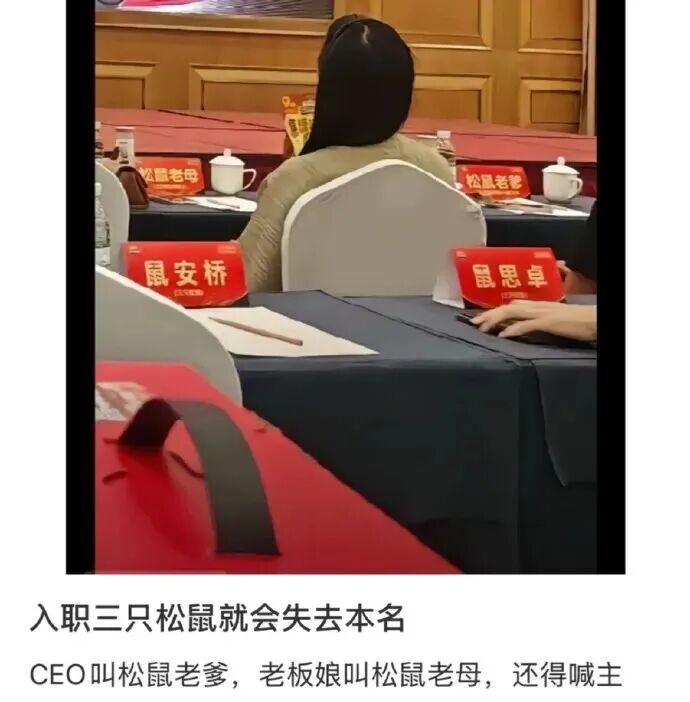
Core Viewpoint - The recent "mouse name" culture at Three Squirrels has sparked widespread discussion, with nearly every employee adopting a name containing the character "鼠" (mouse), including the CEO and the founder [1][21]. Group 1: Company Culture - The company has creatively integrated the mouse theme into various aspects of its culture, such as naming the office building "mouse nest" and using terms like "mouse fridge" for their appliances [7][8]. - Employees have adopted playful names like "mouse invoice" and "mouse wealth" for different roles, showcasing a humorous and engaging workplace environment [9][14]. - The founder and CEO, Zhang Liaoyuan, emphasized that the adoption of mouse names is voluntary and aims to foster a fun and collaborative corporate culture [21]. Group 2: Public Reception - The public response to the mouse name culture has been largely positive, with many finding it entertaining and engaging, reflecting a trend seen in other tech companies that utilize nickname cultures [23]. - However, there are concerns regarding the implications of using "鼠" (mouse) in names, as it may evoke negative connotations associated with rats, and some names could be misinterpreted [24][25]. - The company has taken steps to leverage this cultural phenomenon by promoting activities that allow the public to engage with their headquarters and learn more about their unique mouse culture [22].

员工入职要改成“鼠”姓?公司回应……网友炒翻
Huan Qiu Wang· 2025-11-25 06:10
Core Viewpoint - The recent social media discussion regarding the practice at Three Squirrels Co., Ltd. where employees adopt names starting with "Shu" (鼠) has sparked significant public interest and debate about corporate culture and employee identity [1][9]. Group 1: Company Culture - Three Squirrels has a cultural practice where employees are encouraged to use names prefixed with "Shu," which the company believes fosters a sense of closeness and brand identity [9]. - The company's founder and CEO, Zhang Liaoyuan, stated that if employees willingly accept this naming convention and it aligns with the company's values, it contributes positively to the corporate culture [9]. - This is not the first time the company's naming culture has attracted attention; a recent incident involved a customer questioning the name "Tuihuo Shu" (退货鼠) used for returns, which was perceived negatively [11]. Group 2: Employee Perspectives - Some employees and commentators find the practice amusing and engaging, while others express discomfort with the idea of losing their original names [5][7]. - Concerns have been raised about the potential for this naming convention to become a form of "soft coercion," despite the company's assertion that participation is voluntary [6][12]. - Legal experts indicate that as long as the practice is not enforced and does not infringe on employees' rights, it is generally considered lawful [12]. Group 3: Broader Implications - The implementation of such naming conventions is not unique to Three Squirrels; other companies like Alibaba and Pinduoduo have similar practices, reflecting a trend in corporate culture [13]. - There is a need for companies to balance internal cultural initiatives with external perceptions, as societal understanding may not always align with internal practices [13][14]. - Companies should be cautious to avoid misinterpretations and ensure that such cultural practices do not create inequality among employees [14].
