茶饮内卷

Search documents
“内卷”指数居首,广东成全国茶饮最“卷”之地
Nan Fang Nong Cun Bao· 2026-01-29 11:30
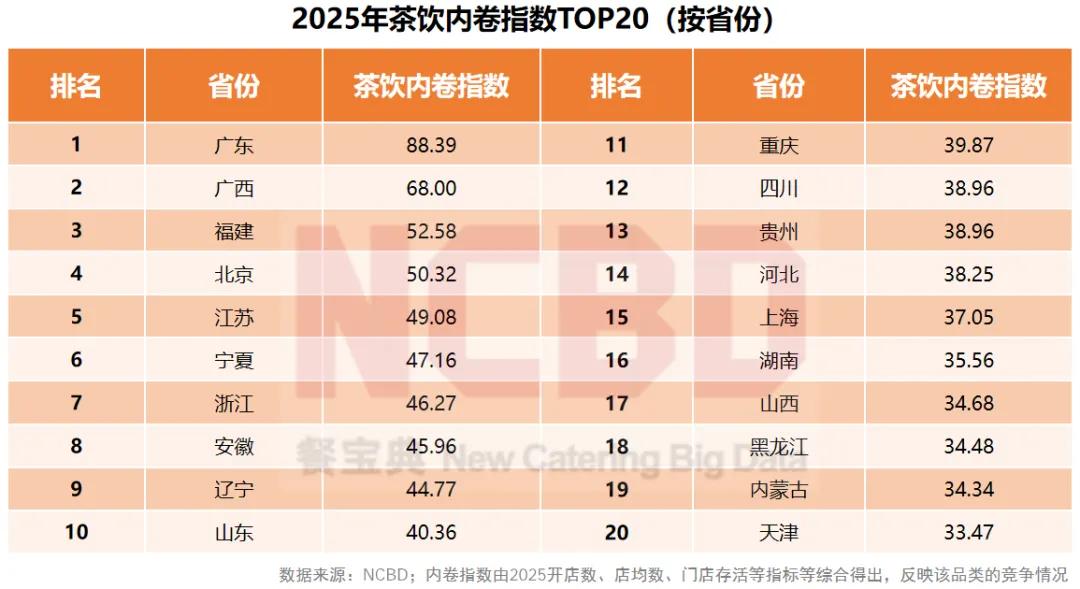
Core Insights - Guangdong has the highest "involution" index in the tea beverage industry, reaching 88.39, indicating severe market competition [6][4] - The tea beverage market in Guangdong is characterized by a high rate of new business formation, with 14.9% of new tea companies established in 2025 [12][11] - Despite intense competition, Guangdong's tea industry is innovating in product development and health-oriented offerings, moving away from homogenization [20][21] Market Overview - Guangdong is the largest province for tea beverage consumption in China, with a significant presence of major brands in cities like Guangzhou, Shenzhen, and Dongguan [3][8] - The national chain rate for tea beverages has surpassed 55% as of 2025, indicating a trend towards consolidation in the market [7] Competitive Landscape - The survival rate of tea beverage stores in Guangdong is low, with a 1.1% decrease in the number of stores in Guangzhou, highlighting the challenges faced by businesses [18][17] - The "involution" index reflects the competitive pressure within the industry, with Guangdong leading the rankings [5][6] Innovation and Trends - The focus on local ingredients and health upgrades is driving product differentiation, with brands like Heytea launching new products based on local teas [24][22] - Health standards are becoming quantifiable, with brands promoting transparency in nutritional information [27][30] Global Expansion - The new Chinese tea beverage market is projected to reach 241.6 billion yuan in 2025, growing by 10.6% year-on-year, although the growth rate is slowing [35] - Leading brands are accelerating their international presence, with Heytea opening over 100 stores in 32 cities abroad, and Nayuki also expanding into international markets [40][41]


一边疯狂开店,一边加速倒闭:广东成全国茶饮最“卷”之地
3 6 Ke· 2026-01-22 00:10
Core Insights - The NCBD released the "2026 China Tea Beverage Development White Paper," highlighting the competitive landscape of the tea beverage industry in China, with Guangdong identified as the province with the highest level of market saturation [1][25]. Provincial Rankings - Guangdong leads the tea beverage market with an internal competition index of 88.39, followed by Guangxi (68.00) and Fujian (52.58) [2][4]. - The top five provinces in terms of new tea beverage enterprises established in 2025 are Guangdong (14.9%), Guangxi (13.5%), Zhejiang (8.2%), Anhui (7.6%), and Jiangsu (6.8%) [6]. Characteristics of High Competition Provinces - Provinces with high internal competition indices generally have a large number of tea beverage stores, with Guangzhou being the city with the most stores in 2025 [4][10]. - The survival rate of tea beverage stores is low in provinces like Guangdong, Fujian, and others, indicating a challenging market environment [7][10]. Causes of Market Saturation - The tea beverage market is experiencing oversupply, leading to fierce competition for existing customers, with the market size projected to reach 241.6 billion yuan in 2025, growing at 10.6% [12]. - Capital-driven expansion is intensifying competition, as major brands are rapidly entering the market, particularly in key cities like Guangzhou and Shenzhen [14]. - Consumer demand is shifting towards higher quality and innovative products, pushing brands to continuously innovate, which can lead to internal competition [15]. - The regional industrial foundation supports this saturation, with both Guangdong and Guangxi being significant players in tea beverage consumption and supply [16]. Strategies for Overcoming Saturation - Brands should optimize their regional expansion strategies to avoid over-concentration in saturated cities like Guangzhou and Nanning, focusing instead on enhancing individual store quality [18]. - Emphasizing local characteristics and creating differentiated products can help brands build a unique competitive edge [21]. - Improving operational efficiency in key cities is crucial, shifting focus from merely increasing store numbers to enhancing the quality of operations [22]. - Identifying and catering to niche market demands in key cities can open new growth avenues, particularly in health-oriented and functional beverages [23].