行为模拟

Search documents
ICLR 2026 | Shop-R1: 给AI补上「内心戏」,在RL博弈中复刻人类网购脑
机器之心· 2026-03-21 01:09
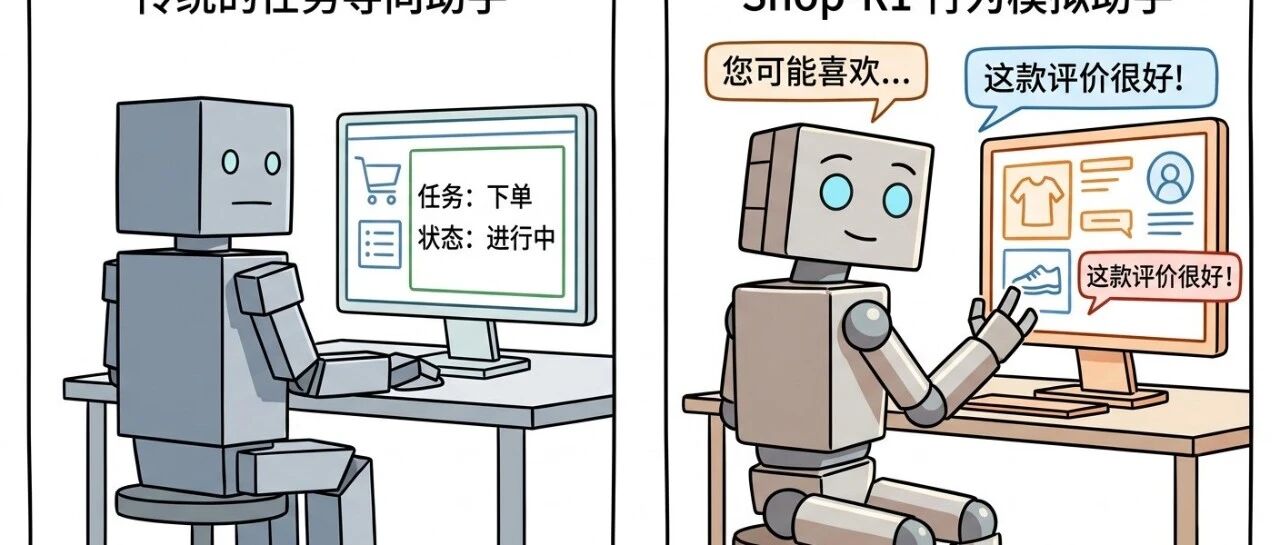
Core Insights - The article discusses the evolution of AI shopping agents, highlighting the transition from task-oriented models to simulation-oriented models, specifically through the introduction of the Shop-R1 framework by Amazon's research team [2][4]. Group 1: Shop-R1 Framework - Shop-R1 aims to replicate human shopping behavior by predicting user actions based on historical browsing data and current interactions, moving beyond simple task completion to behavior simulation [5][9]. - The framework categorizes shopping actions into three types: typing, clicking, and terminating, allowing for a more nuanced understanding of user behavior [10][12]. Group 2: Training Methodology - Shop-R1 employs a two-phase training approach: the first phase involves supervised fine-tuning (SFT) to establish a baseline for behavior, while the second phase utilizes reinforcement learning (RL) with a hierarchical rewards system to enhance logical reasoning and generalization in complex environments [9][12]. - The SFT phase helps the model internalize the structural dependencies between context, rationale, and actions, significantly improving stability and sample efficiency in subsequent RL training [12][13]. Group 3: Reward Mechanisms - The model incorporates multiple reward mechanisms, including binary format rewards for structured output, rationale rewards based on self-certainty scores, and hierarchical action rewards that incentivize both coarse and fine-grained actions [14][16]. - A difficulty-aware reward scaling factor is introduced to amplify rewards for predicting complex sub-actions, addressing common issues in reward hacking and ensuring a richer reward landscape [18][19]. Group 4: Experimental Results - Experimental results indicate that Shop-R1 significantly outperforms traditional models, achieving an exact action accuracy of 27.72%, which is a 65% improvement over the SFT-only approach [22][23]. - The model's ability to accurately predict user intentions and generate relevant long-text parameters, such as button names and search queries, is also enhanced [22][23]. Group 5: Future Prospects - The article suggests that future advancements in AI shopping agents will focus on sensory enhancement and personalized simulations, potentially incorporating visual language models (VLM) to better understand user emotions and preferences [25][26]. - The concept of "character injection" is proposed, allowing AI to adopt diverse consumer profiles, thereby simulating the varied psychological aspects of real-world shopping behavior [26]. Group 6: Conclusion - Shop-R1 represents a significant step forward in creating a low-cost, high-fidelity virtual A/B testing environment for e-commerce platforms, enabling them to experiment with new algorithms and layouts without the need for real traffic [28].