
规模焦虑

Search documents
一边狂开13店,一边被骂“卖大路货”:山姆的严选去哪了?
Sou Hu Cai Jing· 2026-02-04 02:41
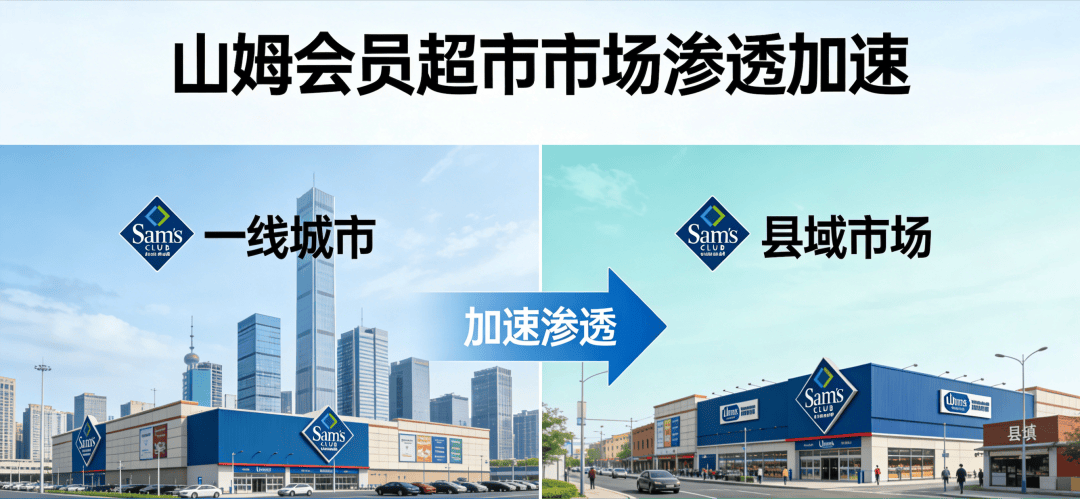
Core Viewpoint - Sam's Club is accelerating its expansion in China, planning to open 13 new stores by 2026, indicating a shift from first-tier cities to county markets [1][6] Group 1: Expansion Strategy - Sam's Club recently held a grand opening in Kunshan, Shanghai, as part of its aggressive expansion strategy [1] - The company aims to achieve a sales target of 200 billion yuan by 2026, necessitating rapid new store openings and customer acquisition [6] Group 2: Customer Sentiment - There has been a noticeable shift in customer sentiment, with many members expressing dissatisfaction over the increasing presence of common brands in stores, questioning the value of their membership [3][5] - Long-time members feel that the unique "selection spirit" of Sam's Club has diminished, as they now see products that are widely available in convenience stores [5][9] Group 3: Supply Chain and Product Selection - The rapid expansion has led to supply chain pressures, causing Sam's Club to relax its product selection standards, which previously focused on exclusive and high-quality items [7] - The introduction of more standardized and easily replicable brands has raised concerns about the loss of the original value proposition that attracted loyal customers [7] Group 4: Marketing and Brand Identity - Sam's Club has started adopting internet marketing strategies, such as promotional pop-ups and live-streaming sales, which may undermine its core value of providing a hassle-free shopping experience [9] - The company needs to regain the trust of its members by focusing on high-quality product offerings rather than merely expanding its store count [10]


100亿的“神迹”,100%的讽刺:德邦基金为何在大V的“喊麦”中窒息?
Xin Lang Cai Jing· 2026-01-30 06:43
Core Viewpoint - The regulatory announcement on January 30 halted the significant fundraising efforts of Debon Fund, which had attracted 12 billion in a single day through unconventional marketing strategies, highlighting the absurdity of the financial industry's scale obsession [1][10]. Group 1: Fundraising Strategy - Debon Fund, in collaboration with an internet influencer, demonstrated a new fundraising approach that relies on social media hype rather than traditional investment research and risk assessment, resulting in over 100 billion flowing into a previously small fund in just one day [3][12]. - This method contrasts with conventional asset management practices, resembling a financial version of influencer marketing, where the focus is on rapid capital inflow rather than sustainable growth [3][12]. Group 2: Impact on Existing Investors - The influx of new capital significantly affected existing investors, as fund managers were forced to rapidly build positions, leading to increased transaction costs and potential dilution of returns for long-term holders [4][13]. - The prioritization of new investors over existing ones reflects a troubling trend in the industry, where the interests of loyal clients are overlooked in favor of quick gains [4][13]. Group 3: Internal Controls and Compliance - The situation revealed severe lapses in internal controls, with indications of insider trading and a lack of oversight from compliance departments, which had become mere rubber stamps for marketing initiatives [5][15]. - The regulatory response pointed to a broader issue of compliance failure within Debon Fund, suggesting that risk management practices had effectively disappeared [5][15]. Group 4: Regulatory Response - The swift regulatory action sent a clear message that the financial industry cannot rely on influencer-driven strategies for growth, emphasizing the need for compliance and ethical practices [6][16]. - The suspension of new product registrations and accountability measures against senior management indicate that Debon Fund's attempt to gain scale through non-compliance has backfired, damaging both its reputation and operational viability [6][16]. Group 5: Industry Reflection - The incident serves as a reflection of the industry's long-standing "scale anxiety," where firms prioritize growth over compliance, risking the integrity of financial products [8][17]. - Ultimately, the reliance on influencer marketing to drive fund performance is unsustainable, as it cannot mask the underlying performance issues reflected in net asset values [8][17].