
计算光学

Search documents
我科学家革新3D打印关键技术
Xin Lang Cai Jing· 2026-02-12 20:34
Core Viewpoint - The article discusses the breakthrough in 3D printing technology through the development of "Digital Holographic Field" (DISH) technology by Tsinghua University's team, which significantly enhances both speed and precision in 3D printing, addressing the existing limitations in traditional methods [1][2]. Group 1: Technology Advancements - DISH technology improves the exposure speed of traditional volumetric 3D printing by several times, achieving a record exposure time of 0.6 seconds for complex structures at the millimeter scale, compared to the 30 seconds typical of traditional methods [2][3]. - The technology allows for the use of a wide range of materials, from low-viscosity solutions to high-viscosity resins, due to its short exposure time that minimizes the effects of material flow [2][3]. Group 2: Applications and Implications - DISH technology is expected to revolutionize various fields, including biomedical applications where it can print vascular models and in situ structures using biocompatible materials, thus opening new avenues for tissue engineering and high-throughput drug screening [3]. - In engineering manufacturing, DISH technology could be integrated into production lines for mass production of photonic devices and complex components, enabling the printing of parts with sharp angles and intricate surfaces [3].
0.6秒可完成毫米尺寸物体打印
Xin Lang Cai Jing· 2026-02-12 19:36
Core Viewpoint - Chinese scientists have made a breakthrough in 3D printing technology, achieving a new record speed of 0.6 seconds for high-resolution printing of complex millimeter-sized objects, which is published in the journal Nature [2][3]. Group 1: Technology Breakthrough - The new 3D printing technology allows for the generation of complex structures in just 0.6 seconds, with the capability to print structures as fine as 12 micrometers [3]. - The printing speed can reach 333 cubic millimeters per second, marking it as the highest known speed in 3D printing to date [3]. - The technology, named "Digital Incoherent Synthetic Holographic Light Field (DISH)," overcomes the speed limitations of traditional point-by-point or layer-by-layer scanning methods [3]. Group 2: Applications and Advantages - The DISH technology simplifies the requirements for printing containers, needing only an optical plane, allowing for stationary containers during the printing process [3]. - This advancement significantly expands the potential applications, enabling direct printing within ordinary fluid pipelines for batch and continuous printing [3]. - Potential applications include mass production of photonic computing devices, smartphone camera modules, and complex parts with sharp angles and curves, with future prospects in flexible electronics, micro-robots, and high-resolution tissue models [3].

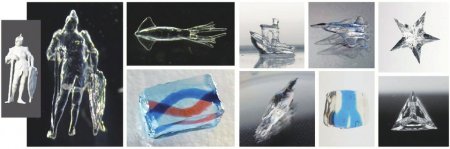
我国科学家在3D打印领域有新突破
Xin Lang Cai Jing· 2026-02-12 17:28
Core Insights - A new 3D printing technology has been developed by Chinese scientists, achieving a record speed of 0.6 seconds for high-resolution printing of complex millimeter-sized objects, which addresses the long-standing issues of speed and precision in 3D printing [1][2] Group 1: Technology Breakthrough - The new technology, named "Digital Incoherent Synthetic Holographic Light Field (DISH)," allows for the rapid projection of complex three-dimensional light intensity distributions, overcoming the speed limitations of traditional point-by-point or layer-by-layer scanning methods [2] - The DISH technology can print structures with a minimum size of 12 micrometers and a printing speed of 333 cubic millimeters per second, marking it as the fastest known 3D printing method to date [2] Group 2: Applications and Advantages - The technology simplifies the requirements for printing containers, needing only an optical plane and allowing for stationary containers during the printing process, which broadens the potential applications, including direct printing within ordinary fluid pipelines [2] - Potential applications of DISH technology include mass production of photonic devices, smartphone camera modules, and complex components with sharp angles and intricate surfaces, with future prospects in flexible electronics, micro-robots, and high-resolution tissue models [2]
深圳市创业服务协会会长、乐其创新SmallRig联合创始人高海燕: 新质影像正成为深圳“超级产业”
Shen Zhen Shang Bao· 2026-01-29 17:38
Group 1 - The core viewpoint is that Shenzhen's new imaging industry is becoming a "super industry" and is leading globally in terms of industrial clustering and scale [1] - Shenzhen has a complete value chain for the imaging industry, including content publishing platforms, shooting devices, imaging scene products, and software processing, making it the city with the largest hardware industry scale globally [1] - Shenzhen is the largest production city for new imaging shooting devices such as smartphones, drones, and action cameras, holding a significant share of the global market [1] Group 2 - The imaging equipment accessory industry in Shenzhen is characterized by extreme segmentation and comprehensive offerings, making it a pioneer and the largest market share holder in the global arena [1] - The development of new media and the videoization trend is identified as a core driving force for the industry, lowering the barriers for professional imaging creation [1] - In the next 3-5 years, technologies such as AI large models, computational optics, and new display types are expected to reshape the imaging production and application chain, leading to a consumer-level explosion in imaging tools [2]
