证券投资咨询机构监管

Search documents
3家证券投资咨询机构被暂停新增客户
Zheng Quan Ri Bao· 2026-01-18 16:54
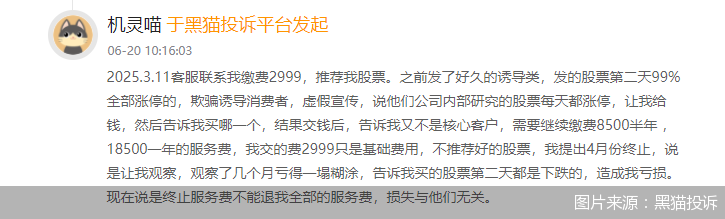
Core Viewpoint - Regulatory authorities are intensifying oversight of securities investment consulting firms to maintain market order and protect investors' rights, with a focus on eliminating false advertising and inadequate risk warnings [1][3] Group 1: Regulatory Actions - Three securities investment consulting firms have been penalized by local securities regulatory bureaus in early 2026, with measures including suspension of new client acquisition for varying periods [1] - As of the end of 2025, there were 76 securities investment consulting firms in China, with 17 subjected to client acquisition suspension measures [1] - In 2025, a total of 46 securities investment consulting firms faced 56 regulatory penalties, marking a year-on-year increase of 36.59% [3] Group 2: Common Violations - Common issues among penalized firms include false and misleading advertising, non-compliance in new media operations, lack of reasonable basis for investment advice, inadequate management of personnel qualifications, and insufficient internal controls [2][5] - Specific examples of violations include a firm being penalized for misleading marketing, unauthorized stock recommendations during live broadcasts, and inadequate management of investor suitability [2] Group 3: Industry Trends - The number of securities investment consulting firms has decreased from 83 at the end of 2021 to 76 by the end of 2025, primarily due to issues like false advertising and data fabrication [4] - Regulatory actions are seen as a necessary response to industry chaos, aiming to protect investors and ensure a fair competitive environment for compliant firms [3][5] Group 4: Recommendations for Improvement - Suggestions for enhancing regulation include refining rules for new media operations, improving record-keeping and information reporting requirements, and strengthening internal compliance systems within firms [6] - There is a call for stricter penalties for firms that repeatedly violate regulations, including suspension of operations and revocation of licenses [6]
证监会出手,又一家被撤销牌照
Zhong Guo Ji Jin Bao· 2025-12-19 14:59
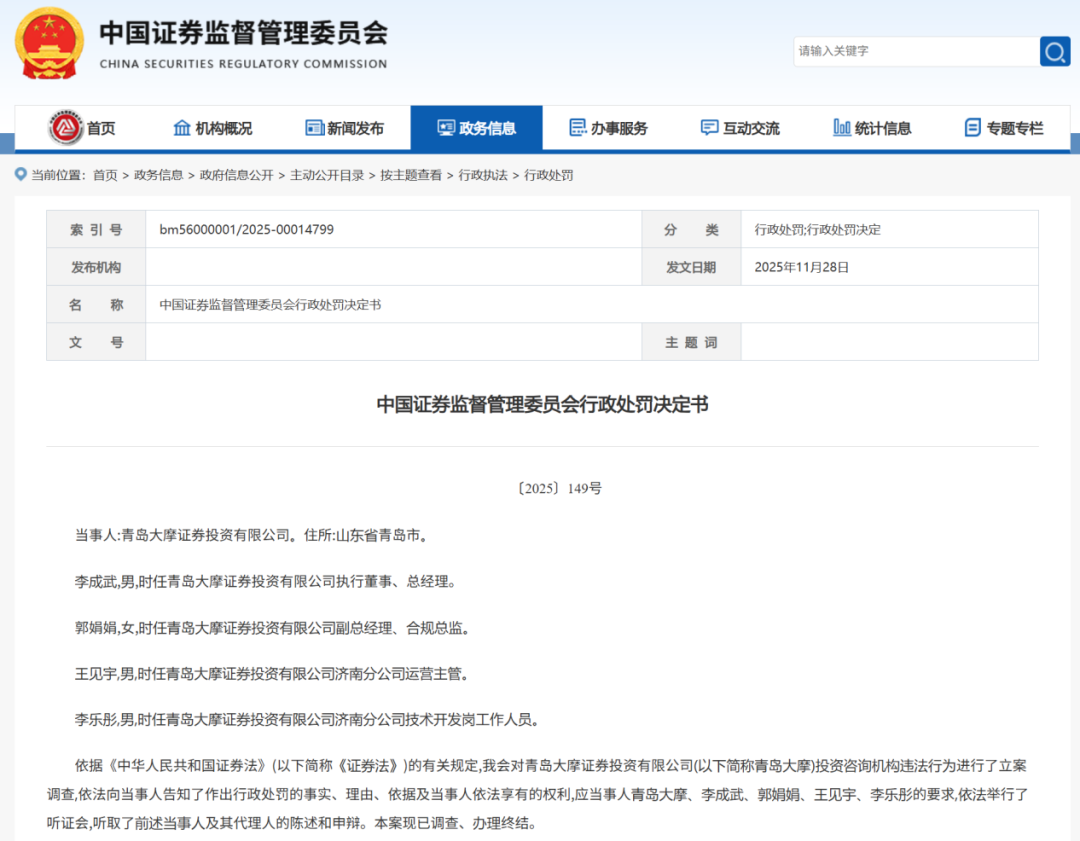
Core Viewpoint - The China Securities Regulatory Commission (CSRC) has imposed a fine of 3 million yuan on Qingdao Damo Securities Investment Co., Ltd. and revoked its securities investment consulting business license due to serious violations of regulations [1][6]. Group 1: Violations and Penalties - Damo Investment failed to properly maintain and destroyed relevant documents and materials, leading to significant omissions in reports submitted to the securities regulatory authority [3][5]. - The company reported a cumulative omission of operating income amounting to 485 million yuan from September 2022 to August 2024, involving multiple clients and significant amounts [4][5]. - Four responsible individuals received penalties, including fines of 600,000 yuan, 500,000 yuan, 400,000 yuan, and 300,000 yuan, along with warnings [6]. Group 2: Company Background and Previous Issues - Qingdao Damo Securities Investment Co., Ltd. was established in 1997 with a registered capital of 52 million yuan and holds qualifications for securities investment consulting [6]. - The company faced previous regulatory actions, including a six-month suspension of new client acquisition due to various compliance failures, such as not publicizing complaint hotlines and inadequate data governance [7]. - The investment education base of Damo Investment was rated "unsatisfactory" in the 2025 provincial assessment results [8]. Group 3: Regulatory Environment - The revocation of the business license is considered a severe penalty, indicating a stringent regulatory environment for licensed securities investment consulting firms [9]. - Recent trends show an increase in regulatory scrutiny and enforcement actions against securities investment consulting firms, highlighting a tightening regulatory landscape [9].

年内证券投资咨询机构监管函近70张!更有机构因违法被摘牌,吃百万罚单
Bei Jing Shang Bao· 2025-11-16 13:47
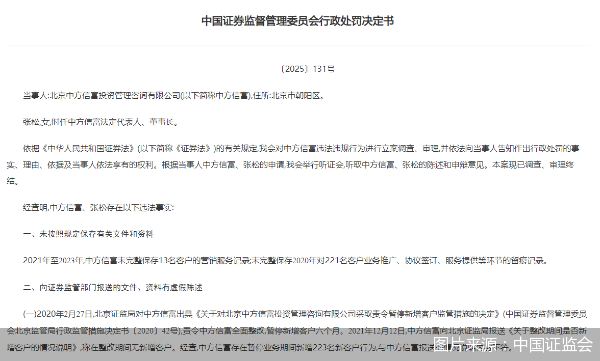
Core Viewpoint - The regulatory environment for the securities investment consulting industry in China is becoming increasingly stringent, as evidenced by the recent penalties imposed on Beijing Zhongfang Xinfu Investment Management Consulting Co., Ltd. for various violations, including a fine of 3 million yuan and the revocation of its securities investment consulting license [1][4][5]. Regulatory Actions - The China Securities Regulatory Commission (CSRC) has issued 68 regulatory letters to securities investment consulting firms in 2023, indicating a significant increase in enforcement actions [1][9]. - Zhongfang Xinfu is the first firm this year to have its securities investment consulting license revoked, highlighting the serious nature of its violations [5][9]. Violations and Penalties - Zhongfang Xinfu failed to maintain proper records for 13 clients and provided false information to regulatory authorities, including the addition of 223 new clients during a business suspension [4][5]. - The penalties for Zhongfang Xinfu include a 3 million yuan fine and the revocation of its consulting license, while its chairman, Zhang Song, received a warning and a 600,000 yuan fine, along with a six-year ban from the securities market [5][6]. Industry Impact - The revocation of Zhongfang Xinfu's license will severely impact its ability to conduct business, leading to potential loss of clients and damage to its brand reputation [8]. - Other firms in the industry have also faced similar penalties, indicating a trend of increased scrutiny and enforcement by regulatory bodies [5][9]. Compliance Issues - The frequent violations in the industry are attributed to low penalties compared to the potential gains from non-compliance, leading firms to prioritize short-term profits over long-term compliance [10][11]. - There is a noted lack of internal controls and compliance culture within many firms, which exacerbates the issue of regulatory violations [10][11].
罚单不断、违规不止,证券投资咨询机构如何“治病”
Bei Jing Shang Bao· 2025-06-22 14:18
Core Viewpoint - The frequent violations by licensed securities investment consulting firms highlight the need for a fundamental reshaping of industry values rather than merely reducing the number of penalties [1][9]. Regulatory Actions - As of June 22, the China Securities Regulatory Commission (CSRC) and local securities regulatory bureaus issued 45 regulatory letters to 40 licensed securities investment consulting firms, with over half of these firms being named [5]. - Multiple firms, including Jinzheng Investment Consulting and Fujian Zhongxun Securities Research, have been ordered to suspend new client acquisitions for 3 to 6 months due to violations such as inadequate internal controls and misleading marketing practices [2][3][4]. Common Violations - Common issues among the firms include inadequate internal systems, misleading marketing, promises of investment returns, and unregistered personnel providing investment advice [5][8]. - The industry has seen a pattern of violations, with many firms failing to provide reasonable bases for investment advice and lacking adequate risk warnings [6]. Industry Challenges - Factors contributing to the high incidence of violations include profit-driven motives, lack of professional training among staff, and the rapid development of the industry outpacing regulatory frameworks [7]. - Intense competition within the industry has led some firms to lower service standards and resort to non-compliant practices to attract clients [7]. Recommendations for Improvement - Establishing a correct industry value system and enhancing internal management are crucial for improving service quality and compliance [10]. - Firms should focus on long-term investment principles, strengthen compliance training, and develop robust internal oversight mechanisms to detect and correct violations [10][12]. Regulatory Enhancements - There is a call for stricter regulatory measures and faster responses to violations, including the use of modern technology for dynamic monitoring of firms [12]. - Increased penalties for violations are suggested to create a more effective deterrent against non-compliance [11][12].