
贫困问题

Search documents
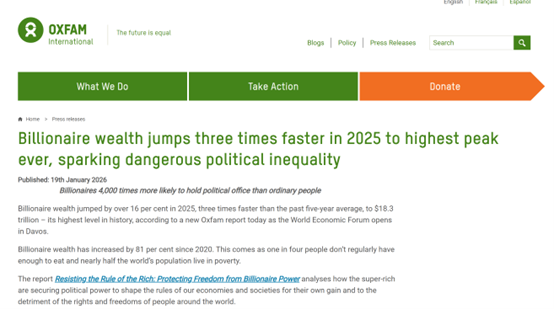
重磅报告:全球亿万富翁财富飙升至18.3万亿美元,创历史新高
Feng Huang Wang· 2026-01-19 04:46
Group 1 - The report by Oxfam indicates that by 2025, the wealth of global billionaires is projected to reach a record $18.3 trillion [1] - The number of billionaires surpassed 3,000 last year, with their total wealth increasing by 16%, equivalent to $2.5 trillion, which is three times the average growth rate over the past five years [3] - Since 2020, the wealth of global billionaires has surged by 81%, marking the past decade as the "golden decade for billionaires" [3] Group 2 - The report highlights a slowdown in global poverty reduction, with current poverty rates roughly equivalent to those in 2019, and nearly half of the world's population living in poverty [3] - Oxfam's report points out that billionaires often leverage their wealth to gain political power and control media resources, citing examples such as Elon Musk's involvement in U.S. government affairs and Jeff Bezos owning The Washington Post [3] - The likelihood of billionaires holding public office is 4,000 times greater than that of ordinary individuals, exacerbating social inequality and diverting efforts to address poverty [3] Group 3 - Oxfam calls for governments to implement plans to reduce inequality, including taxing billionaires to diminish their power and establishing a stronger "firewall" between wealth and politics, with stricter regulations on lobbying and campaign financing [3] - The 56th World Economic Forum Annual Meeting is set to take place from January 19 to 23 in Davos, Switzerland, focusing on the theme of "the spirit of dialogue" to address global challenges [4] - Oxfam has been releasing inequality-related reports annually during the Davos forum since 2014, previously predicting the emergence of at least five trillionaires in the next decade and advocating for tax policies ensuring the wealthy pay their fair share [4]

泰国贫困人口增至343万人
Zhong Guo Xin Wen Wang· 2025-09-17 20:29
Core Insights - The report from Thailand's National Economic and Social Development Council indicates an increase in poverty, with 3.43 million people now classified as poor, representing 4.89% of the national population, up from 3.41% in 2023 [1] - The poverty line has been raised from a monthly income of 3,043 Thai Baht to 3,078 Thai Baht for 2024 [1] - Despite a general trend of improvement in poverty over the past years, the rise in poverty in 2024 highlights significant concerns amid global and domestic economic uncertainties [1] Poverty Demographics - The report notes that the number of people vulnerable to poverty has increased across all levels, with the "extremely poor" group (those with consumption expenditure more than 20% below the poverty line) reaching 879,000 individuals, and the "mildly poor" group increasing to 2.55 million [1] - Agricultural laborers remain the most susceptible to poverty, comprising 45.49% of the total poor population, indicating structural vulnerabilities within the agricultural sector [1] - The reliance of farmers on production income, which is highly affected by weather and agricultural price fluctuations, exacerbates their risk of falling back into poverty, particularly due to climate change impacts [1]
墨西哥贫困人口两年减少逾800万 近三成居民仍处贫困
Xin Hua Cai Jing· 2025-08-20 07:44
Core Insights - The latest multidimensional poverty assessment by Mexico's National Institute of Geography and Statistics indicates that 38.49 million people live in poverty in 2024, accounting for 29.6% of the national population, a decrease of over 8 million from 46.8 million in 2022 [1] - The number of people in extreme poverty has also declined from 9.1 million in 2022 to 7 million in 2024 [1] - The assessment methodology follows the approach of the National Council for the Evaluation of Social Development Policy (CONEVAL), incorporating various indicators such as household income and expenditure, education, healthcare, housing, social security, and basic living services to evaluate and track the effectiveness of social development policies [1] Poverty and Social Issues - In 2024, a total of 80.4 million people experience at least one form of social deficiency, including educational lag, lack of healthcare services, inadequate housing, absence of basic services, lack of social security, or insufficient nutrition [1] - All indicators show improvement compared to 2022, but the lack of social security remains the most widespread issue, affecting 48.2% of the population [1] Analysis and Outlook - Analysts believe that the data reflects progress in reducing poverty and improving living standards in Mexico, although structural challenges persist, particularly regarding insufficient coverage of the social security system [1]