
超巨星自调控坍缩星模型

Search documents
引发全球天文学家不同解读
Xin Lang Cai Jing· 2026-02-24 19:19
Core Insights - A record-breaking gamma-ray burst (GRB 250702B) occurred on July 2, 2025, lasting over 29 hours, challenging traditional understanding of gamma-ray bursts and prompting global astronomical investigation [5][6] - The event is believed to involve a medium-mass black hole tearing apart and consuming a white dwarf star, as proposed by the research team from the Chinese Academy of Sciences [6][8] Group 1: Event Details - The gamma-ray burst was detected by the Fermi Gamma-ray Space Telescope and was initially named GRB 250702D, later unified under the name GRB 250702B after confirming it originated from the same high-energy source [6][7] - This gamma-ray burst is noted for being the longest known, with energy release equivalent to that of 1,000 suns burning for 10 billion years, which significantly alters the understanding of such cosmic events [6][8] Group 2: Scientific Explanations - The "Tian Guan" satellite's research team proposed a model where a medium-mass black hole, between hundreds to hundreds of thousands of solar masses, uses tidal forces to disrupt and consume a dense white dwarf star [8][9] - Alternative theories suggest the event could be due to a supernova collapse model, where a massive supernova's core collapses into a black hole, leading to relativistic jets that produce gamma-ray emissions [9][10] - Another hypothesis involves a stellar-mass black hole interacting with a helium star, leading to the formation of an accretion disk and subsequent gamma-ray emissions [10][11]

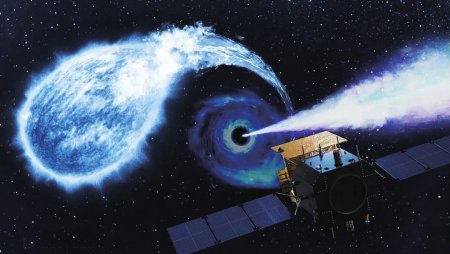
【新华社】我国科研人员提出超长伽马暴成因新解
Xin Hua She· 2026-02-24 02:27
Core Viewpoint - The gamma-ray burst GRB 250702B, occurring on July 2, 2025, challenges traditional understanding of gamma-ray bursts due to its unique properties and has sparked significant academic debate regarding its origins [1] Group 1: Discovery and Analysis - A research team from the National Key Laboratory of Particle Astrophysics at the Chinese Academy of Sciences utilized new analytical tools to comprehensively search observational data from satellites like Huayan and Jiemu, revealing that the gamma-ray burst lasted for 29 hours, setting a new record for duration [1] - The team also identified unique time-varying characteristics in the accompanying X-ray radiation, contributing to the understanding of this event [1] Group 2: New Model Proposal - Based on their findings, the research team proposed a novel "supernova self-regulating collapse star model," suggesting that the progenitor star of this gamma-ray burst was a supergiant star with a mass significantly greater than that of the Sun [1] - Unlike typical gamma-ray burst progenitors, the collapse of a supergiant can last for several days. As the supergiant exhausts its fuel, its core collapses to form a black hole, which rapidly accretes material from the star's inner layers, generating jets that produce the gamma-ray burst [1] - During the subsequent accretion process, slower jets are produced, emitting X-ray radiation [1]