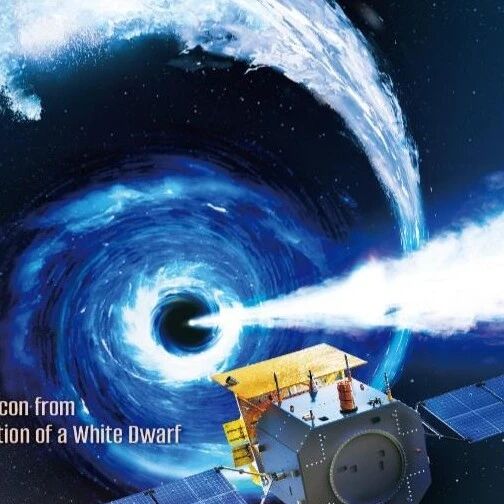
白矮星

Search documents
引发全球天文学家不同解读
Xin Lang Cai Jing· 2026-02-24 19:19
Core Insights - A record-breaking gamma-ray burst (GRB 250702B) occurred on July 2, 2025, lasting over 29 hours, challenging traditional understanding of gamma-ray bursts and prompting global astronomical investigation [5][6] - The event is believed to involve a medium-mass black hole tearing apart and consuming a white dwarf star, as proposed by the research team from the Chinese Academy of Sciences [6][8] Group 1: Event Details - The gamma-ray burst was detected by the Fermi Gamma-ray Space Telescope and was initially named GRB 250702D, later unified under the name GRB 250702B after confirming it originated from the same high-energy source [6][7] - This gamma-ray burst is noted for being the longest known, with energy release equivalent to that of 1,000 suns burning for 10 billion years, which significantly alters the understanding of such cosmic events [6][8] Group 2: Scientific Explanations - The "Tian Guan" satellite's research team proposed a model where a medium-mass black hole, between hundreds to hundreds of thousands of solar masses, uses tidal forces to disrupt and consume a dense white dwarf star [8][9] - Alternative theories suggest the event could be due to a supernova collapse model, where a massive supernova's core collapses into a black hole, leading to relativistic jets that produce gamma-ray emissions [9][10] - Another hypothesis involves a stellar-mass black hole interacting with a helium star, leading to the formation of an accretion disk and subsequent gamma-ray emissions [10][11]

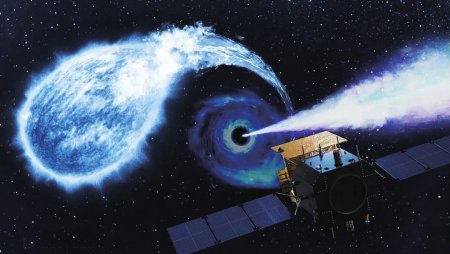
“天关”卫星可能捕捉到黑洞“进食”现场
Ren Min Ri Bao· 2026-02-14 03:37
Core Viewpoint - The Chinese Academy of Sciences' National Astronomical Observatory reported the detection of an unusually bright and rapidly changing X-ray source, designated EP250702a, which is believed to be a medium-mass black hole tearing apart and consuming a white dwarf star, marking the first observation of such an extreme black hole "feeding" event [1] Group 1 - The event EP250702a exhibited brightness variations, radiation patterns, and spectral characteristics that are significantly different from any previously known outbursts [1] - The research team proposed a groundbreaking explanation for the event, suggesting it involves a medium-mass black hole with a mass between hundreds to hundreds of thousands of solar masses, capable of gradually tearing apart a dense white dwarf star [1] - White dwarfs are remnants of dead stars with an average density that can reach up to one million times that of the Sun [1]
极可能是一次黑洞“进食”全过程!“天关”捕捉到罕见天文事件
Xin Lang Cai Jing· 2026-02-13 20:37
Core Insights - The article discusses a groundbreaking astronomical event captured by China's first space X-ray astronomy satellite "Tian Guan," which observed an unprecedented source of intense explosion, identified as EP250702a, indicating a potential first observation of a medium-mass black hole tearing apart and consuming a dense white dwarf star [1][2]. Group 1: Event Discovery - "Tian Guan" discovered a highly variable X-ray source during its survey on July 2, 2025, which coincided with gamma-ray bursts detected by the Fermi satellite [1]. - The X-ray signals appeared approximately one day before the gamma-ray bursts, suggesting a different physical mechanism than traditional gamma-ray bursts [1][2]. Group 2: Characteristics of the Event - The research team identified three main characteristics: X-ray radiation precedes gamma rays, the brightness is extremely high with near-light-speed jets, and the event occurred in the outskirts of a distant galaxy rather than its center [2]. - The event's high brightness and rapid decay indicate that the disrupted celestial body is highly dense, ruling out the possibility of a supermassive black hole at the galaxy's center [2]. Group 3: Implications and Contributions - The findings strongly suggest a rare encounter between a medium-mass black hole and a white dwarf star, with theoretical models supporting the ability of medium-mass black holes (ranging from hundreds to thousands of solar masses) to shred such dense stars [2]. - The discovery of EP250702a highlights "Tian Guan's" unique monitoring capabilities and underscores China's contributions to global astronomical exploration [2].
我国卫星捕捉到罕见黑洞“进食”现场
Xin Lang Cai Jing· 2026-02-11 06:24
Core Viewpoint - The "Tian Guan" satellite has captured an unprecedented event involving a medium-mass black hole tearing apart and consuming a white dwarf star, marking the first time such an extreme black hole "feeding" event has been observed by humanity [1][3]. Group 1: Discovery and Observation - The "Tian Guan" satellite detected an unusually bright and rapidly changing X-ray source, designated EP250702a (also known as GRB 250702B), during its routine sky survey [1][3]. - This event's brightness variation, radiation rhythm, and spectral characteristics are significantly different from any previously known outbursts, prompting a global observational effort using multiple telescopes [1][3]. Group 2: Scientific Explanation - The research team proposed that the observed phenomenon is likely a medium-mass black hole ripping apart and consuming a white dwarf star, which is a dense remnant left after a star's death [3]. - The average density of a white dwarf can reach up to one million times that of the Sun, and only medium-mass black holes, with masses between hundreds to hundreds of thousands of solar masses, can effectively tear apart such a dense object without "gulping" it whole [3]. Group 3: Implications and Contributions - The findings provide strong support for the theory of a medium-mass black hole tearing apart a white dwarf, characterized by extremely short timescales, high peak luminosity, and soft X-ray "afterglow" observed post-explosion [3]. - The discovery of EP250702a highlights the unique monitoring capabilities of the "Tian Guan" satellite and underscores China's contributions to global astronomical exploration [3].
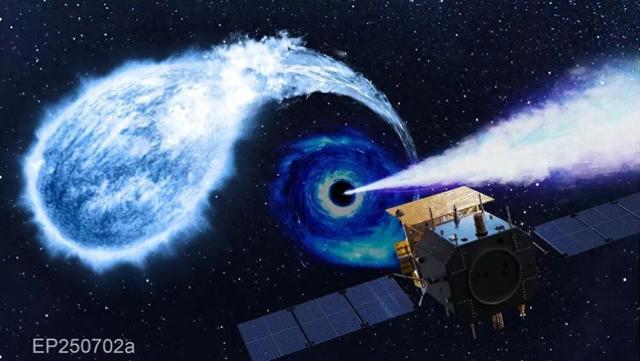
非常罕见!黑洞“干饭”现场,被中国卫星捕捉
Ke Ji Ri Bao· 2026-02-11 03:50
Core Insights - The "Tian Guan" satellite may have captured a rare event of a medium-mass black hole tearing apart and consuming a white dwarf star, which, if confirmed, would be the first clear observation of such an extreme cosmic phenomenon, significantly enhancing the understanding of black hole activity and high-energy astrophysical mechanisms [1][3] Group 1 - The "Tian Guan" satellite's wide-field X-ray telescope, "Wan Xing Tong," discovered an exceptionally bright and rapidly changing X-ray source, designated EP250702a, on July 2, 2025, in the outskirts of a distant galaxy [1] - Observations indicated that X-ray radiation was present at the location approximately one day before a significant gamma-ray burst, suggesting that the physical engine of the explosion was activated much earlier than traditional gamma-ray bursts [1] - The characteristics of the event, including its high brightness and rapid evolution, could not be explained by common astrophysical explosion models, leading the scientific team to propose that a medium-mass black hole was involved in the disruption of a white dwarf star [1][3] Group 2 - The research team noted that the rapid decay and high brightness of the event imply that the consumed celestial body had a very high density, which aligns with the characteristics of a white dwarf star [3] - The estimated mass of the black hole involved is less than approximately 75,000 times that of the Sun, based on gamma-ray data from the Fermi satellite, and the event's location in the outskirts of the galaxy rules out the possibility of a supermassive black hole [3] - Only a medium-mass black hole would possess the capability to tear apart a dense body like a white dwarf, resulting in the observed brief, intense, and high-energy jets [3]

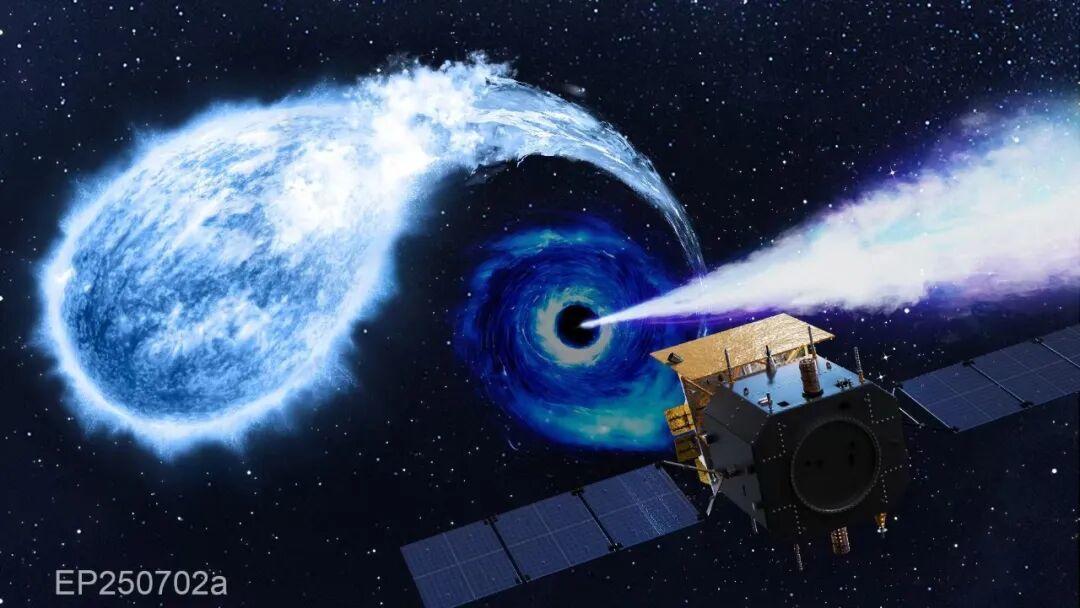
【科技日报】中等质量黑洞“进食”白矮星事件或首次被捕捉
Ke Ji Ri Bao· 2026-02-11 01:53
Core Viewpoint - The "Tian Guan" satellite may have captured a rare event of a medium-mass black hole tearing apart and consuming a white dwarf star, which, if confirmed, would be the first clear observation of such an extreme cosmic phenomenon, significantly enhancing the understanding of black hole activity and high-energy astrophysical mechanisms [1][2]. Group 1 - The "Tian Guan" satellite's wide-field X-ray telescope, "Wan Xing Tong," discovered an exceptionally bright and rapidly changing X-ray source, identified as event EP250702a, located in the outskirts of a distant galaxy [1]. - Observations indicated that X-ray radiation was present about a day before a significant gamma-ray burst, suggesting that the physical engine of the explosion was activated early, differing from traditional gamma-ray bursts [1]. - The characteristics of the event, including high brightness and rapid evolution, could not be explained by common astrophysical explosion models, leading the scientific team to propose that a medium-mass black hole was tearing apart a white dwarf star [1]. Group 2 - The rapid decay and high brightness of the event suggest that the consumed celestial body had a high density, which aligns with the characteristics of a white dwarf star [2]. - The estimated mass of the black hole is less than approximately 75,000 times that of the Sun, ruling out the possibility of it being a supermassive black hole [2]. - The findings highlight the "Tian Guan" satellite's capability to capture fleeting cosmic phenomena, providing crucial insights into the long-sought medium-mass black hole population and opening new avenues for studying extreme cosmic environments [2].
我国卫星捕捉到罕见事件
财联社· 2026-02-10 16:06
Core Viewpoint - The discovery of the EP250702a event by China's "Tian Guan" satellite represents a significant breakthrough in astrophysics, suggesting that a medium-mass black hole is tearing apart and consuming a white dwarf star, marking the first time such an extreme black hole "feeding" event has been captured [1][5]. Group 1: Discovery and Observation - The "Tian Guan" satellite detected an unusually bright and rapidly changing X-ray source, designated as EP250702a, during its sky survey [1][3]. - This event has distinct brightness variations, radiation rhythms, and spectral characteristics that differ significantly from any previously known outbursts [1]. Group 2: Scientific Explanation - The research team proposes that the event is likely caused by a medium-mass black hole, which has the capability to tear apart a dense white dwarf star using tidal forces [5]. - The average density of a white dwarf can reach up to one million times that of the Sun, making it a challenging target for such interactions [5]. Group 3: Implications and Contributions - The findings provide strong support for the theory of medium-mass black holes interacting with white dwarfs, characterized by extremely short time scales and high peak luminosity [5]. - The discovery highlights the unique monitoring capabilities of the "Tian Guan" satellite and underscores China's contributions to global astronomical exploration [5].
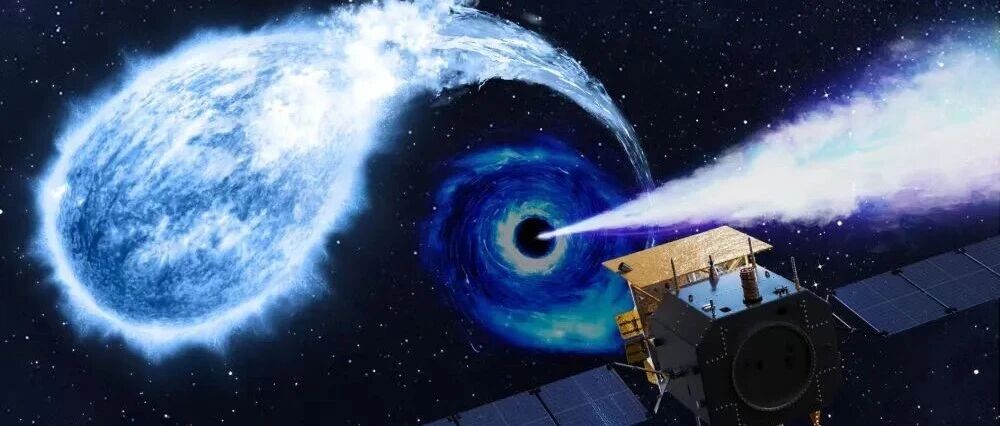
黑洞研究又有新发现!
Xin Lang Cai Jing· 2026-02-10 14:55
Core Viewpoint - The "Tian Guan" satellite (Einstein Probe Satellite) has captured an unprecedented high-energy cosmic explosion, which is believed to be the process of a medium-mass black hole tearing apart a white dwarf star, as reported in the academic journal "Science Bulletin" [1][2]. Group 1: Event Details - The "Tian Guan" satellite detected an exceptionally bright and rapidly changing X-ray source, designated "EP250702a," on July 2, 2025 [1]. - Following the detection, multiple global telescopes conducted a coordinated observation, confirming the source's location at the outskirts of a galaxy with a redshift of 1.04 [1]. - The "WXT" (Wide Field X-ray Telescope) and "FXT" (Follow-up X-ray Telescope) on the "Tian Guan" satellite played crucial roles in the observation, with the brightness of the event decreasing over ten days by more than 100,000 times after an intense explosion lasting about one day [1]. Group 2: Scientific Implications - The event "EP250702a" exhibited a series of unconventional characteristics, including multiple explosions from billions of light-years away, emitting extremely high energy, and rapid, complex changes in brightness and energy spectrum [2]. - The observed phenomena resemble rare black hole tidal disruption events, suggesting that a medium-mass black hole is involved in the process of tearing apart a white dwarf star, which is a dense celestial body [2]. - This event may provide the first clear evidence of such processes, aiding in the understanding of the long-missing population of medium-mass black holes and opening new avenues for research in black hole growth and the ultimate fate of dense celestial objects [2].
黑洞研究又有新发现!
券商中国· 2026-02-10 14:49
Core Insights - The "Tian Guan" satellite (Einstein Probe Satellite) captured an unprecedented high-energy cosmic explosion, which exhibits significant differences in brightness variation, radiation rhythm, and spectral characteristics compared to any known explosions [1][2] - The event, designated as "EP250702a," was observed on July 2, 2025, and involved a bright and rapidly changing X-ray source, leading to a global collaborative observation effort [1] Summary by Sections - **Event Characteristics** - The explosion occurred billions of light-years away, displaying multiple bursts of high energy with rapid and complex changes in brightness and energy spectrum, which cannot be fully explained by existing astronomical event models [2] - The rapid decay in brightness, dropping over 100,000 times within twenty days, suggests the involved celestial body is a dense white dwarf, indicating a medium-mass black hole tearing apart and consuming it [2] - **Scientific Implications** - This event may provide the first clear evidence of such a process, aiding in the understanding of medium-mass black holes, their growth, the ultimate fate of dense celestial bodies, and opening new avenues in multi-messenger astronomy [2]