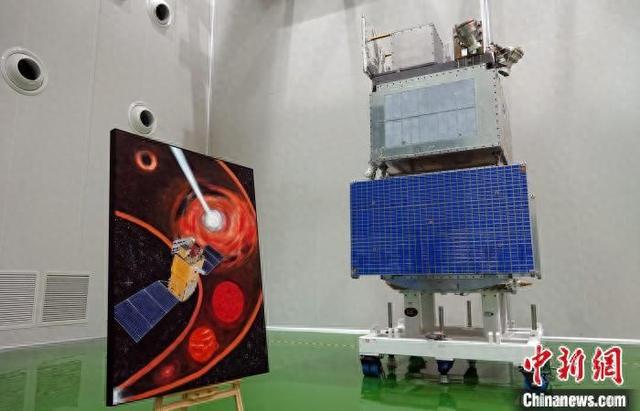
伽马暴

Search documents
【新华社】我国科研人员提出超长伽马暴成因新解
Xin Hua She· 2026-02-24 02:27
Core Viewpoint - The gamma-ray burst GRB 250702B, occurring on July 2, 2025, challenges traditional understanding of gamma-ray bursts due to its unique properties and has sparked significant academic debate regarding its origins [1] Group 1: Discovery and Analysis - A research team from the National Key Laboratory of Particle Astrophysics at the Chinese Academy of Sciences utilized new analytical tools to comprehensively search observational data from satellites like Huayan and Jiemu, revealing that the gamma-ray burst lasted for 29 hours, setting a new record for duration [1] - The team also identified unique time-varying characteristics in the accompanying X-ray radiation, contributing to the understanding of this event [1] Group 2: New Model Proposal - Based on their findings, the research team proposed a novel "supernova self-regulating collapse star model," suggesting that the progenitor star of this gamma-ray burst was a supergiant star with a mass significantly greater than that of the Sun [1] - Unlike typical gamma-ray burst progenitors, the collapse of a supergiant can last for several days. As the supergiant exhausts its fuel, its core collapses to form a black hole, which rapidly accretes material from the star's inner layers, generating jets that produce the gamma-ray burst [1] - During the subsequent accretion process, slower jets are produced, emitting X-ray radiation [1]
【新华社】“怀柔一号”卫星再立功:首次发现伽马暴里藏着周期信号
Xin Hua She· 2025-09-22 09:26
Core Insights - A Chinese research team utilized the "Huairou-1" satellite to observe a unique gamma-ray burst (GRB), identifying a rapidly rotating magnetar with a rotation period of only 1.1 milliseconds as a potential driver of the event, marking the first observation of millisecond pulsation signals in a gamma-ray burst [1][2] - The study, published in the journal Nature Astronomy, provides critical evidence for understanding the nature of products resulting from the merger of compact celestial bodies [1] Group 1 - The research was a collaboration between Nanjing University, the Institute of High Energy Physics of the Chinese Academy of Sciences, and the University of Hong Kong, and was published on September 19 [1] - Gamma-ray bursts are among the most intense explosive phenomena in the universe, with the mainstream view suggesting that some are produced by the merger of two neutron stars, leading to the formation of black holes or magnetars [1] - The breakthrough was based on the observation of GRB 230307A, the second brightest gamma-ray burst in human history, which was detected by the "Huairou-1" satellite on March 7, 2023, and exhibited high-energy gamma-ray radiation lasting nearly one minute, significantly longer than typical "short bursts" [1] Group 2 - The research team leveraged the high temporal resolution capabilities of the "Huairou-1" satellite to conduct an in-depth analysis of the observational data, identifying a central frequency of approximately 909 Hz and a signal duration of about 160 milliseconds, with a pulsation period closely matching the expected rotation period of a millisecond magnetar [2] - This finding enhances the understanding of the central engine of gamma-ray bursts and provides key insights into the evolution of compact celestial bodies under extreme physical conditions [2] - The "Huairou-1" satellite, launched in December 2020, serves as a monitor for gravitational wave counterparts and has achieved several original results in the fields of gamma-ray bursts, magnetar explosions, gravitational waves, and fast radio bursts [2]
【科技日报】“怀柔一号”发现磁陀星驱动伽马暴直接证据
Ke Ji Ri Bao· 2025-09-22 06:02
Core Insights - A collaborative team from Nanjing University, the Chinese Academy of Sciences, and the University of Hong Kong has provided direct evidence of magnetar-driven gamma-ray bursts (GRBs) through high-precision observations using the "Huairou-1" satellite [1][2] - Gamma-ray bursts are among the brightest and most intense explosions in the universe, releasing energy exceeding that of the Sun's entire lifespan within seconds [1] - The breakthrough was achieved with the observation of GRB 230307A, the second brightest gamma-ray burst recorded, which posed challenges for international observation equipment due to its brightness [1] Group 1 - The "Huairou-1" satellite successfully observed a stable quasi-periodic oscillation signal with a central frequency of 909 Hz and a duration of 160 milliseconds, indicating a magnetar with a rotation period of approximately 1.1 milliseconds [1] - This observation marks the first time a stable millisecond pulsation signal has been detected in a gamma-ray burst, providing crucial evidence for understanding the nature of compact object mergers [2] Group 2 - The research team plans to continue utilizing data from various satellites, including "Jiguang," "Huiyan," "Tianguan," and SVOM, to search for quasi-periodic oscillation signals in more gamma-ray bursts [2] - The ongoing research will combine theoretical and numerical simulations to comprehensively understand the physical mechanisms behind magnetar-driven gamma-ray bursts [2]
“怀柔一号”发现磁陀星驱动伽马暴直接证据
Ke Ji Ri Bao· 2025-09-21 01:22
Core Insights - A collaborative team from Nanjing University, the Institute of High Energy Physics of the Chinese Academy of Sciences, and the University of Hong Kong has provided direct evidence of magnetar-driven gamma-ray bursts (GRBs) using high-precision observational data from the "Huairou-1" satellite [1][2] - This breakthrough marks the first observation of a stable millisecond pulsation signal in a gamma-ray burst, offering crucial evidence for understanding the nature of compact object mergers [2] Group 1 - The gamma-ray burst GRB 230307A, which is the second brightest in human observation history, was observed with unprecedented precision due to the innovative design of the "Huairou-1" satellite [1] - The research team identified a quasi-periodic oscillation signal with a central frequency of 909 Hz, lasting only 160 milliseconds, which aligns with the expected millisecond rotation period of a magnetar [1] Group 2 - Future research will involve utilizing data from multiple satellites, including "Jiguang," "Huiyan," "Tianguan," and SVOM, to search for similar quasi-periodic oscillation signals in more gamma-ray bursts [2] - The team aims to combine observational data with theoretical and numerical simulations to gain a comprehensive understanding of the physical mechanisms behind magnetar-driven gamma-ray bursts [2]
新华财经早报:9月21日
Xin Hua Cai Jing· 2025-09-21 00:55
Group 1 - The Ministry of Commerce expressed hope for a fair business environment for Chinese companies like TikTok in the U.S. [2] - The National Organization for Drug Procurement released the 11th batch of centralized drug procurement documents, emphasizing principles of clinical stability, quality assurance, and anti-competitive practices [2] - Kuaishou and Weibo responded to regulatory discussions by forming special teams for rectification and improving content management [2] Group 2 - The 2025 World Manufacturing Conference opened in Hefei, with over 1,000 guests from more than 40 countries, highlighting the increase in the threshold for the top 500 Chinese manufacturing companies [2] - The China-Laos Railway has facilitated over 1,500 million tons of goods since its operation, with significant growth in agricultural exports [2] - The construction of the Duku Highway project commenced, aiming to enhance transportation efficiency in the region [2] Group 3 - The first fully autonomous 500 kV substation in China was launched in Liaoning, showcasing advancements in domestic technology for power grid safety [2] - Research teams confirmed high-temperature superconductivity in nickel oxide materials, marking a significant scientific breakthrough [2] - Observations from the Huairou-1 satellite provided evidence of a millisecond pulsar associated with a gamma-ray burst, contributing to astrophysical research [2]

“怀柔一号”卫星再立功:首次发现伽马暴里藏着周期信号
Xin Hua She· 2025-09-20 13:04
Core Insights - A Chinese research team has discovered that a gamma-ray burst (GRB) may be driven by a newly formed magnetar with a rotation period of only 1.1 milliseconds, marking the first observation of millisecond pulsation signals in a gamma-ray burst [1][2] - The study was conducted by Nanjing University, the Institute of High Energy Physics of the Chinese Academy of Sciences, and the University of Hong Kong, and published in the journal Nature Astronomy [1] Group 1 - The research utilized the "Huairou-1" satellite to analyze data from a particularly bright gamma-ray burst, GRB 230307A, which was detected on March 7, 2023, and emitted high-energy gamma rays for nearly one minute, significantly longer than typical short bursts [1][2] - The team identified a central frequency of approximately 909 Hz, with a signal duration of about 160 milliseconds, and a pulsation period of around 1.1 milliseconds, aligning with expectations for a magnetar's rotation period [2] - This finding enhances the understanding of the central engine of gamma-ray bursts and provides critical clues for revealing the evolution of compact objects under extreme physical conditions [2] Group 2 - The "Huairou-1" satellite, launched in December 2020, serves as a monitor for gravitational wave counterparts and has achieved several original results in the study of gamma-ray bursts, magnetar explosions, gravitational waves, and fast radio bursts [2]
中法天文卫星首批科学成果发布 看见“婴儿期”宇宙的“烟花”
Huan Qiu Wang Zi Xun· 2025-04-25 04:05
Core Insights - The China-France astronomical satellite (SVOM) has officially released its first scientific results, including the capture of gamma-ray burst signals from 13 billion years ago, marking significant breakthroughs in astronomical research [1][3]. Group 1: Project Overview - The China-France astronomical satellite is a key space cooperation project between the Chinese National Space Administration and the French National Center for Space Studies, initiated in 2005 and launched in June of the previous year [3]. - SVOM is equipped with four observation payloads, including a gamma-ray monitor and optical telescope from China, and hard and soft X-ray telescopes from France, enabling multi-band coverage and precise observations [3]. Group 2: Scientific Achievements - SVOM has detected over 100 gamma-ray bursts and identified several special types, setting a new record for the farthest observation of short-duration gamma-ray bursts [3]. - The most notable discovery is the gamma-ray burst GRB250314A, originating from 13 billion years ago with a redshift of 7.3, indicating it comes from the early universe, just 730 million years after its formation [3][4]. Group 3: Future Research Goals - SVOM is expected to operate in orbit for at least three years, with scientists aiming to reveal the formation and death processes of the first generation of stars, study black hole formation mechanisms, and discover electromagnetic counterparts to gravitational wave events [5].
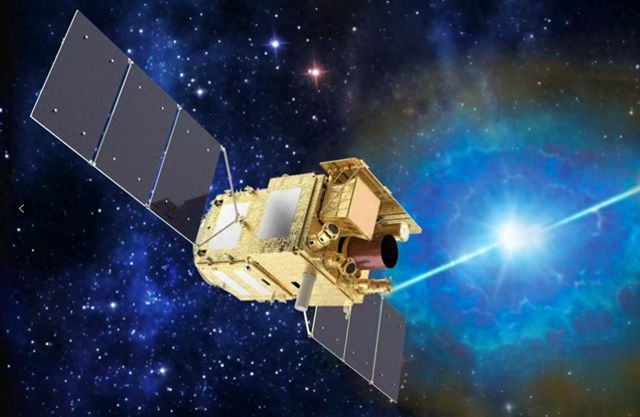
130亿年前宇宙“婴儿”是何模样?中法天文卫星首批成果揭示
Huan Qiu Wang Zi Xun· 2025-04-24 04:35
Core Insights - The China-France astronomical satellite (SVOM) has successfully captured significant scientific results, including signals from a gamma-ray burst (GRB) that occurred 13 billion years ago, marking a breakthrough in understanding the early universe [1][4][15] Group 1: Scientific Achievements - SVOM has detected over 100 gamma-ray bursts during its 10 months in orbit, including several unique types, setting a new record for the farthest observed short-duration gamma-ray bursts [2][4] - The satellite's most notable discovery is GRB250314A, which has a redshift of 7.3, indicating it originated when the universe was only 700 million years old, providing insights into the formation of the first stars and black holes [4][15] - The satellite's observations are expected to enhance understanding of cosmic phenomena such as the formation and death of the first generation of stars, the birth of black holes, and the electromagnetic counterparts of gravitational wave events [14][15] Group 2: Technical Capabilities - SVOM is equipped with a gamma-ray monitor and optical telescope from China, and hard and soft X-ray cameras from France, showcasing its multi-band detection capabilities [7][9] - The satellite demonstrates four core capabilities: multi-band coverage, autonomous rapid response, precise and stable observation, and global ground-space collaboration [7][10] - Its autonomous rapid response allows for immediate high-precision follow-up observations after detecting gamma-ray bursts, crucial for capturing transient astronomical events [9][10] Group 3: International Collaboration - The satellite project, a significant collaboration between China and France, has been in development since 2005 and represents a milestone in international space cooperation [11][14] - The satellite is expected to operate for at least three years, continuing to search for high-energy cosmic phenomena and contributing to global astrophysical research [14][15]