伽马射线暴

Search documents
引发全球天文学家不同解读
Xin Lang Cai Jing· 2026-02-24 19:19
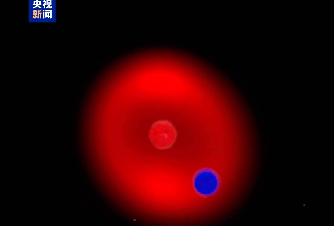
Core Insights - A record-breaking gamma-ray burst (GRB 250702B) occurred on July 2, 2025, lasting over 29 hours, challenging traditional understanding of gamma-ray bursts and prompting global astronomical investigation [5][6] - The event is believed to involve a medium-mass black hole tearing apart and consuming a white dwarf star, as proposed by the research team from the Chinese Academy of Sciences [6][8] Group 1: Event Details - The gamma-ray burst was detected by the Fermi Gamma-ray Space Telescope and was initially named GRB 250702D, later unified under the name GRB 250702B after confirming it originated from the same high-energy source [6][7] - This gamma-ray burst is noted for being the longest known, with energy release equivalent to that of 1,000 suns burning for 10 billion years, which significantly alters the understanding of such cosmic events [6][8] Group 2: Scientific Explanations - The "Tian Guan" satellite's research team proposed a model where a medium-mass black hole, between hundreds to hundreds of thousands of solar masses, uses tidal forces to disrupt and consume a dense white dwarf star [8][9] - Alternative theories suggest the event could be due to a supernova collapse model, where a massive supernova's core collapses into a black hole, leading to relativistic jets that produce gamma-ray emissions [9][10] - Another hypothesis involves a stellar-mass black hole interacting with a helium star, leading to the formation of an accretion disk and subsequent gamma-ray emissions [10][11]

极可能是一次黑洞“进食”全过程!“天关”捕捉到罕见天文事件
Xin Lang Cai Jing· 2026-02-13 20:37
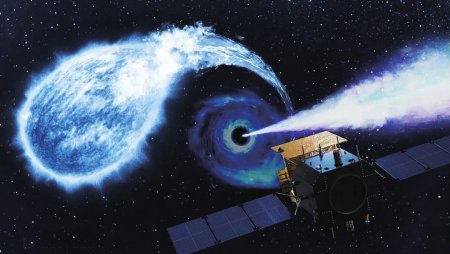
Core Insights - The article discusses a groundbreaking astronomical event captured by China's first space X-ray astronomy satellite "Tian Guan," which observed an unprecedented source of intense explosion, identified as EP250702a, indicating a potential first observation of a medium-mass black hole tearing apart and consuming a dense white dwarf star [1][2]. Group 1: Event Discovery - "Tian Guan" discovered a highly variable X-ray source during its survey on July 2, 2025, which coincided with gamma-ray bursts detected by the Fermi satellite [1]. - The X-ray signals appeared approximately one day before the gamma-ray bursts, suggesting a different physical mechanism than traditional gamma-ray bursts [1][2]. Group 2: Characteristics of the Event - The research team identified three main characteristics: X-ray radiation precedes gamma rays, the brightness is extremely high with near-light-speed jets, and the event occurred in the outskirts of a distant galaxy rather than its center [2]. - The event's high brightness and rapid decay indicate that the disrupted celestial body is highly dense, ruling out the possibility of a supermassive black hole at the galaxy's center [2]. Group 3: Implications and Contributions - The findings strongly suggest a rare encounter between a medium-mass black hole and a white dwarf star, with theoretical models supporting the ability of medium-mass black holes (ranging from hundreds to thousands of solar masses) to shred such dense stars [2]. - The discovery of EP250702a highlights "Tian Guan's" unique monitoring capabilities and underscores China's contributions to global astronomical exploration [2].
非常罕见!黑洞“干饭”现场,被中国卫星捕捉
Ke Ji Ri Bao· 2026-02-11 03:50
Core Insights - The "Tian Guan" satellite may have captured a rare event of a medium-mass black hole tearing apart and consuming a white dwarf star, which, if confirmed, would be the first clear observation of such an extreme cosmic phenomenon, significantly enhancing the understanding of black hole activity and high-energy astrophysical mechanisms [1][3] Group 1 - The "Tian Guan" satellite's wide-field X-ray telescope, "Wan Xing Tong," discovered an exceptionally bright and rapidly changing X-ray source, designated EP250702a, on July 2, 2025, in the outskirts of a distant galaxy [1] - Observations indicated that X-ray radiation was present at the location approximately one day before a significant gamma-ray burst, suggesting that the physical engine of the explosion was activated much earlier than traditional gamma-ray bursts [1] - The characteristics of the event, including its high brightness and rapid evolution, could not be explained by common astrophysical explosion models, leading the scientific team to propose that a medium-mass black hole was involved in the disruption of a white dwarf star [1][3] Group 2 - The research team noted that the rapid decay and high brightness of the event imply that the consumed celestial body had a very high density, which aligns with the characteristics of a white dwarf star [3] - The estimated mass of the black hole involved is less than approximately 75,000 times that of the Sun, based on gamma-ray data from the Fermi satellite, and the event's location in the outskirts of the galaxy rules out the possibility of a supermassive black hole [3] - Only a medium-mass black hole would possess the capability to tear apart a dense body like a white dwarf, resulting in the observed brief, intense, and high-energy jets [3]

极为罕见!“中国天眼”有重要发现
Mei Ri Jing Ji Xin Wen· 2025-05-23 03:56
Core Viewpoint - The discovery of a rare millisecond pulsar by the FAST telescope has significant implications for the understanding of stellar evolution, dense star accretion physics, and gravitational wave sources from binary star mergers [1][3][4]. Group 1: Discovery and Characteristics - The research team led by researcher Han Jinlin from the National Astronomical Observatories of China discovered a millisecond pulsar with a rotation period of 10.55 milliseconds, orbiting a companion star every 3.6 hours [1][3]. - The companion star is estimated to have a mass at least equal to that of the Sun, but its compact orbit suggests it is not a typical star, but rather a stripped-down core of a star that has undergone common envelope evolution, likely a hot helium star [3][4]. Group 2: Implications for Astronomy - This unique binary system is extremely rare, with only a few dozen such systems estimated to exist among the hundreds of billions of stars in the Milky Way, making it a fleeting phenomenon in the universe [4]. - The findings are expected to enhance the understanding of stellar evolution processes, including how stars interact and exchange material, and the dynamics of neutron stars entering companion stars [4]. Group 3: FAST Telescope Capabilities - The FAST telescope, known as the "Chinese Sky Eye," has discovered over 1,000 pulsars since its operation began in 2020, serving as a crucial tool for deep space exploration [5]. - Its advanced design allows it to detect weak signals from billions of light-years away, contributing to significant astronomical discoveries, including the first complete recording of a gamma-ray burst's lifecycle [5].