跨境业务布局

Search documents
汤臣倍健20260320
2026-03-22 14:35
Company and Industry Summary Company Overview - **Company**:汤臣倍健 (Tongrentang) - **Industry**: Health Supplements Key Points Business Goals and Growth Strategy - The company aims for double-digit growth across all channels by 2026, with online growth expected to outpace overall growth. Key growth engines include interest e-commerce and cross-border e-commerce [2][3] - In Q1 2026, the company anticipates significant operational pressure due to high baseline effects from 2025, a shift towards online channels, and upfront costs for new product promotions [2][4] - The company plans to increase its focus on the JD channel, which saw a nearly 35% growth in 2025, to offset profit pressures from Douyin channels [2][4] Financial Performance and Projections - Gross margin is expected to recover from a low of 66.7% in 2024 to 67.9% in 2025, with further improvements anticipated in 2026 as the proportion of high-margin online new products increases [2][5] - Sales expense ratio is projected to rise by several percentage points in 2026 as the company adopts aggressive strategies in Douyin and cross-border sectors to capture market share [2][5][9] - The company maintains a clear dividend policy, aiming for a long-term annualized dividend rate of around 70% to ensure stable returns for investors [2] Channel Performance and Strategy - Offline channels account for approximately 46% of sales, with pharmacies being the dominant segment (70-80% share). The focus for 2026 will shift towards refined operations in supermarket channels, including exclusive products for Sam's Club [2][3][10] - The company recognizes the need for rapid growth in all e-commerce channels, including cross-border and traditional e-commerce, with a specific focus on interest e-commerce [3][4] Market Challenges and Regulatory Environment - The company faces challenges in achieving significant breakthroughs in cross-border e-commerce and Douyin channels, with ongoing adjustments needed in team building and product launches [4][6] - Recent tightening of regulations on online platforms like Douyin may impact market share, requiring brands to adapt their content strategies and flow rules [6][8] Product Development and Innovation - The company plans to launch new products in 2026, focusing on high-growth categories such as fish oil and children's calcium, while also expanding the Life-Space brand into new segments like anti-aging and coenzyme Q10 [7][16] - The company is actively pursuing innovation in product formulations and delivery methods, including the use of AI in live streaming and content generation to enhance operational efficiency [13][16] Financial Metrics and Future Outlook - In 2025, online sales accounted for approximately 54% of total revenue, with offline sales at 45-46%. Pharmacies remain the primary offline channel, while e-commerce platforms like Tmall and JD are crucial for online sales [15][16] - The company anticipates that the overall gross margin will continue to improve as the e-commerce business grows, despite potential pressures from increased sales expenses and regulatory changes [11][12] Conclusion - The company is strategically positioned to leverage growth in e-commerce and refine its product offerings across various channels. However, it must navigate regulatory challenges and market dynamics to achieve its ambitious growth targets for 2026 and beyond [2][6][10]

内地私募机构借道香港布局全球
Zheng Quan Ri Bao· 2025-11-26 16:12
Core Insights - The increasing number of private equity firms in mainland China obtaining the Hong Kong 9 license reflects a strong demand for global asset allocation capabilities [1][3] - The trend indicates that both large and small private equity firms are actively seeking to expand their business boundaries through the Hong Kong market [1][2] Group 1: Motivations for Obtaining Hong Kong 9 License - Private equity firms aim to diversify investment risks and enhance portfolio resilience by entering overseas markets [1] - The availability of diverse asset classes and financial instruments in global markets provides private equity firms with more opportunities to explore differentiated returns [1] - Growing investor demand for global asset allocation drives private equity firms to enhance cross-border service capabilities [1] - Global expansion is seen as a necessary strategy for private equity firms to overcome local competition and build international brands [1] Group 2: Characteristics of Licensed Firms - Among the 107 licensed private equity firms, 35 have assets under management exceeding 10 billion, while 19 have between 5 billion and 10 billion, indicating a significant presence of large firms in cross-border operations [1][2] - Smaller firms, with assets under management below 500 million, also show active participation, highlighting a diverse range of firms engaging in the Hong Kong market [1] Group 3: Investment Strategies - Subjective strategy private equity firms are more active in global expansion, with 69 out of 107 licensed firms employing this strategy, representing over 60% of the total [2] - In contrast, quantitative strategy firms account for 28, and mixed strategy firms for 10, indicating a preference for subjective strategies among larger firms [2] - Among the 10 newly licensed firms this year, both subjective and quantitative strategy firms are evenly represented, with 5 firms each [2] Group 4: Market Trends - The ongoing opening of China's capital markets is driving more private equity firms to establish a presence in Hong Kong, which serves as a crucial link between mainland and global markets [3] - The trend encompasses a wide range of firms, from large to small, and includes both subjective and quantitative strategy firms, all working towards building an international and diversified asset management system [3]
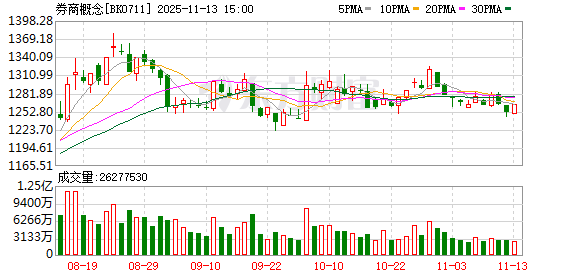
补涨行情要来?券商股被吐槽“业绩炸裂 股价躺平” 机构:交投保持热度 行情不会缺席
Hua Xia Shi Bao· 2025-11-14 00:04
Core Viewpoint - The A-share market has recently reached new highs, but brokerage stocks have underperformed despite strong earnings growth, leading to investor frustration [2][5][8]. Group 1: Market Performance - On November 13, the A-share market fluctuated around 4000 points, with the ChiNext Index rising over 5% [2]. - The brokerage sector has seen a significant divergence between performance and stock price, with a net profit growth rate of 64% in the first half of the year, ranking 4th among 34 Shenwan industry indices, while the sector's cumulative increase was only 7% in the first three quarters, ranking 22nd [2][8]. - As of November 13, the brokerage sector experienced a net inflow of 490 million yuan, but over the previous three days, there was a net outflow of 5.791 billion yuan [2]. Group 2: Brokerage Stock Performance - Among the brokerage stocks, only Guosheng Securities and Xiangcai Securities saw significant price increases of 85% and 83%, respectively, while major firms like CITIC Securities and CITIC Jiantou had less than 5% growth [4]. - The performance of brokerage stocks has been described as "too slow" compared to the rising Shanghai Composite Index, which has crossed the 4000-point mark [5]. - The brokerage sector is currently viewed as a tool for asset allocation rather than a high-return investment, with expectations that it will not easily replicate past performance [5]. Group 3: Earnings and Valuation - In the first three quarters of 2025, 42 listed brokerages reported a total operating income of 419.56 billion yuan and a net profit of 169.05 billion yuan, representing year-on-year increases of 42.6% and 62.4%, respectively [7]. - The cost management ratio for these brokerages decreased by 7.2 percentage points to 48.6%, indicating a potential turning point in cost efficiency [7]. - The current price-to-book (PB) ratio for the brokerage sector is 1.53, which is at the 41.48 percentile of the past decade, suggesting potential for valuation recovery [11]. Group 4: Market Dynamics and Future Outlook - The number of new A-share accounts opened from January to October 2025 reached 22.4588 million, a year-on-year increase of 10.57%, although October saw a significant drop in new accounts compared to previous months [10]. - Analysts suggest that the brokerage sector's performance will improve if the Shanghai Composite Index reaches around 4500 points by 2026 [6]. - The capital market is expected to see a more balanced funding structure, with increased participation from retail and institutional investors, which could support steady market growth [12].