跨境贸易运输

Search documents
前8月中亚班列发送货物增长超三成
Ren Min Ri Bao· 2025-09-12 22:16
Core Insights - The China-Europe Railway Express has achieved a record high of 9,626 trains operated in the first eight months, with a year-on-year increase of 22.7% in the number of trains and 31.1% in the volume of goods sent, totaling 751,000 TEUs [1] Group 1: Operational Performance - The cumulative number of trains operated by the China-Europe Railway Express has exceeded 69,000, with over 5.19 million TEUs of goods sent since its inception [1] - The opening of new transport corridors, such as the China-Laos Railway and the Trans-Caspian Transport Corridor, has expanded the coverage of the China-Europe Railway Express to over 100 cities in 11 Asian countries and 128 cities in 28 provincial-level regions in China [1] Group 2: Cargo Diversification - The types of goods transported have diversified from mainly second-hand vehicles to include 22 major categories such as new energy vehicles, photovoltaic products, and machinery [1] - Goods from Central Asia, including cotton yarn, antimony concentrate, and barley, as well as tropical fruits and fertilizers from Southeast Asia, are entering the Chinese market [1] - Chinese manufactured goods, including new energy vehicles, photovoltaic components, electronic products, and daily necessities, are increasingly reaching various Asian countries and regions [1] Group 3: Efficiency Improvements - The transportation time for the China-Europe Railway Express from Lianyungang, China, to Almaty, Kazakhstan, has been reduced from over 10 days in 2014 to 6 days currently [1] - The upcoming launch of the "cross-border e-commerce special train" in 2024 will enable shipments from Yiwu, Zhejiang, to Tashkent, Uzbekistan, in just 10 days, at a cost 80% lower than air freight [1]
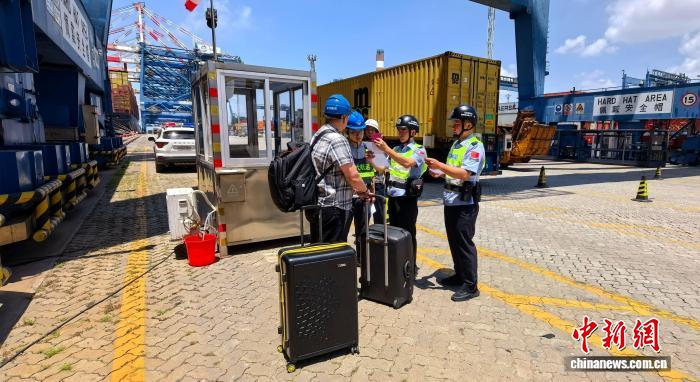
厦门港顺利开通地中海航运美西新航线
Zhong Guo Xin Wen Wang· 2025-08-11 09:27
Core Viewpoint - The opening of the new SENTOSA shipping route connects Southeast Asia, South China, and the US West Coast, enhancing trade networks and logistics efficiency [1][2][3]. Group 1: Shipping Route Details - The SENTOSA route deploys 8 vessels with a capacity of 14,000 to 15,000 TEUs, linking major ports including Port Klang, Singapore, Laem Chabang, Vung Tau, Yantian, Xiamen, Long Beach, and Auckland [2]. - The route primarily carries cross-border e-commerce goods, high-tech products, automobiles and parts, chemical products, and textiles [3]. Group 2: Impact on Xiamen Port - The addition of Xiamen Port to the route is expected to generate an additional throughput of 60,000 TEUs annually [3]. - The efficient handling of the inaugural vessel was ensured by the Xiamen East Ferry Inspection Station, which implemented measures for quick customs clearance and zero delays in port operations [5].