软件公司颠覆风险审计框架

Search documents
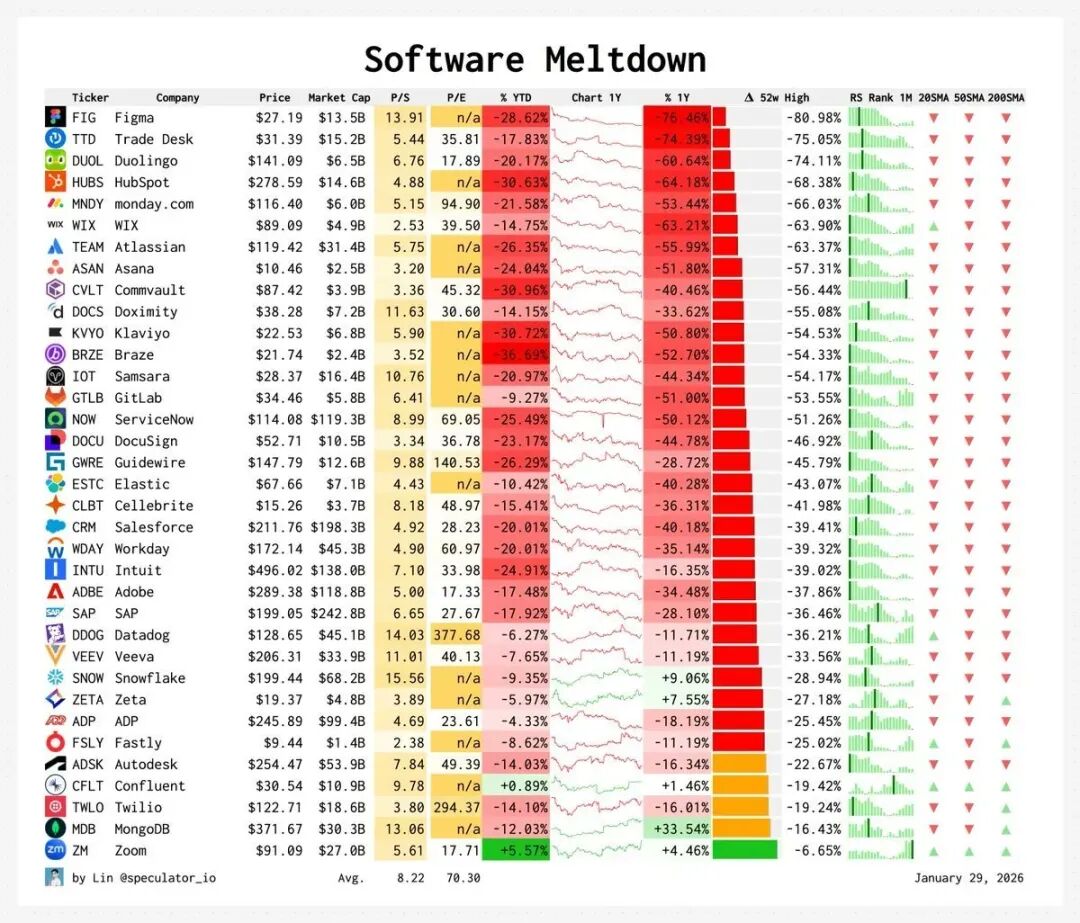
软件没有死,但“通用软件”已死
3 6 Ke· 2026-02-09 01:58
Core Insights - The software sector is experiencing a significant downturn, characterized by a broad sell-off rather than a tactical adjustment, indicating a potential capitulation phase across various software companies [1][4] - The current market sentiment reflects a loss of confidence in the business models of software companies, leading investors to simplify their holdings and view software stocks as a single trading entity rather than a diverse collection of business models [5] Market Performance - A detailed analysis of several software companies reveals substantial declines in stock prices, with many experiencing over 60% drops from their recent highs, indicating severe market distress [2] - Companies like Figma, Trade Desk, and Duolingo have seen year-to-date declines of 80.98%, 75.05%, and 60.64% respectively, highlighting the widespread impact of the downturn [2] Industry Dynamics - The competitive boundaries within the software industry are shifting, with companies like Robinhood expanding their service offerings beyond traditional brokerage functions to include comprehensive financial services [6][8] - The integration of software with financial and professional services is blurring traditional lines, prompting investors to focus on where disruptions may occur and their potential impact on existing profit pools [8] Disruption Framework - A framework for assessing software companies' vulnerability to disruption has been proposed, focusing on five key dimensions: record systems vs. surface tools, seat-based pricing vs. data-based economics, timeless data vs. ephemeral information, deep workflows vs. shallow automation, and durable structural advantages vs. shallow ones [47] - This framework encourages a nuanced understanding of software companies, moving beyond the assumption that all software stocks are equally at risk to a more detailed analysis of their underlying value structures [43][58] Strategic Considerations - Companies with core systems that are deeply embedded in client operations face higher switching costs and risks, while those that are merely supplementary tools may be more easily replaced [45] - The pricing model of a software company can indicate its resilience; those tied to human labor are at greater risk of being undermined by AI advancements, while those linked to long-term data or critical processes may be more secure [24][29] - The longevity of data value is crucial; companies that generate data with a long half-life are better positioned against disruption compared to those with rapidly depreciating data [30][31] Conclusion - The current sell-off in the software sector is not irrational but reflects a rational reassessment of the risks posed by AI and changing market dynamics [47][56] - Understanding the structural vulnerabilities and strengths of software companies is essential for investors navigating this turbulent landscape, as some companies are inherently more resilient than others due to their foundational business models and data assets [58][59]