
递归自改进技术

Search documents
OpenAI,65倍,8300亿美元
Ge Long Hui· 2025-12-20 11:39
Core Viewpoint - OpenAI plans to raise $100 billion in a new funding round, potentially increasing its valuation to $830 billion, a significant jump from $500 billion just two days prior, highlighting the rapid escalation in perceived value within the AI sector [1][3]. Group 1: Valuation and Revenue Projections - If OpenAI achieves its target valuation of $830 billion, its price-to-sales ratio would be 65 times based on projected revenues of $12.7 billion in 2025 [2][3]. - OpenAI's revenue is expected to grow significantly, with estimates of $3.7 billion in 2024 and $12.7 billion in 2025, representing a 243% increase [6][7]. - The revenue structure includes substantial contributions from consumer subscriptions, enterprise services, and ecosystem commissions, with projections indicating that by 2029, revenues could reach $100 billion [7][8]. Group 2: Technological Advancements - OpenAI's competitive edge is attributed to its technological moat, particularly with the development of GPT-5, which utilizes a dual-track design for improved efficiency and cost reduction [3][11]. - The company is also working on "recursive self-improvement" technology, which could enhance model training efficiency by tenfold, necessitating a significant portion of the new funding [3][12]. Group 3: Financial Needs and Expenditures - OpenAI's projected costs for training advanced models are expected to soar into the tens of billions, driven by hardware and energy expenses, with estimates indicating a need for $100 billion in funding to support these initiatives [13][14]. - The company plans to invest heavily in building its own data centers to reduce reliance on external cloud services, with projected expenditures exceeding $450 billion from 2024 to 2030 [16][20]. Group 4: Market Dynamics and Competition - OpenAI faces intense competition for talent, necessitating substantial investments in employee compensation to retain top researchers amid offers from tech giants [20][21]. - The involvement of major investors, including SoftBank and Middle Eastern sovereign wealth funds, reflects a strategic interest in securing a foothold in the evolving AI landscape [25][26]. Group 5: Risks and Future Outlook - OpenAI's current business model is characterized by high cash burn rates, with projections indicating potential losses of $14 billion in 2026 and cumulative losses of $44 billion from 2023 to 2028 [23]. - The company's future hinges on successfully achieving AGI and significantly lowering inference costs; failure to do so could lead to a substantial market correction [27].

巴克莱最新研究报告:OpenAI算力需求持续激增,2028年支出将达到1100亿美元的峰值 | 巴伦精选
Tai Mei Ti A P P· 2025-11-20 16:25
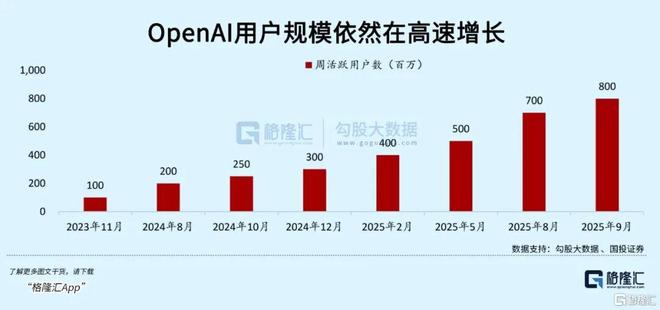
Core Insights - Barclays Bank's latest research report concludes that the AI sector is far from experiencing a bubble burst, with capital expenditure cycles expected to continue, particularly with significant technological breakthroughs anticipated between 2027 and 2028 that could lead to a surge in computing power demand [1] Group 1: OpenAI's Revenue and Growth - OpenAI's recent revenue performance exceeded expectations, with CEO Sam Altman indicating that the company's 2025 revenue forecast was raised by approximately 15% compared to mid-year internal predictions, and the 2027 revenue forecast was adjusted from $60 billion to $90 billion, with a target of achieving $100 billion in annual recurring revenue (ARR) by 2027, one year earlier than previously expected [1] - The upward revision in revenue is accompanied by increases in key metrics such as inference computing costs, weekly active users, and average revenue per paid user, reflecting rapid growth in demand for AI technology in commercial applications [1] Group 2: Computing Resource Demand - OpenAI's substantial demand for computing resources is highlighted, with Barclays estimating that the company's computing operating expenditure budget will exceed $450 billion from 2024 to 2030, peaking at $110 billion in 2028 [2] - To ensure stable computing power supply, OpenAI has signed long-term computing power leasing contracts worth approximately $650 billion with several tech companies, including Oracle and Microsoft, which not only support OpenAI's business expansion but also encourage capital investment from partners in the AI computing sector [2] Group 3: Next-Generation Technology Development - OpenAI is advancing the development of next-generation technologies, including the GPT-6 large language model and the Sora 3 video generation model, with the potential introduction of "recursive self-improvement" technology between 2027 and 2028, which will significantly enhance model performance and efficiency but will require vast computing resources [3] - OpenAI has reserved approximately $43 billion in additional "monetizable computing power" funds to address the computing demands following the implementation of this technology [3] Group 4: Industry Competition and Investment - OpenAI's rapid development is prompting competitors like Google and Meta to increase their investments, further solidifying the continuity of the AI capital expenditure cycle [4] - To catch up with OpenAI's technological advantages, companies are expanding user bases and accelerating model iteration speeds, necessitating substantial computing investments [4] Group 5: Overall Industry Trends - The dynamics surrounding OpenAI reflect a broader trend in the AI capital expenditure cycle, with global semiconductor manufacturers increasing AI chip production capacity to meet growing computing demands, maintaining a year-on-year growth rate of over 60% since 2025 [5] - Competitors are also ramping up their computing investments, with Google increasing its Gemini model's computing input by 30% and Meta planning to double its AI data center capacity by 2026, supporting Barclays' assessment that the AI capital expenditure cycle will continue [5]