酒店收并购

Search documents
万豪“鲸吞”瑰丽?
3 6 Ke· 2026-01-14 02:10
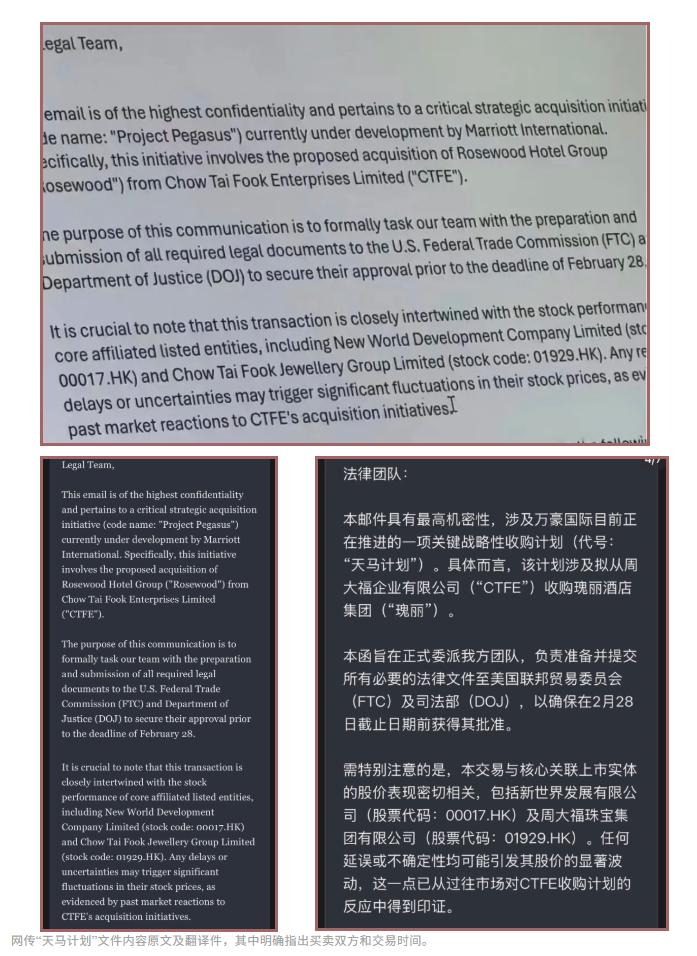
Core Viewpoint - The news discusses the potential acquisition of Rosewood Hotel Group by Marriott International, highlighting the financial pressures faced by Rosewood's parent company, New World Development, and the implications for both companies in the luxury hotel market [1][5][19]. Group 1: Acquisition Rumors - A leaked email suggests that Marriott is planning to acquire Rosewood Hotel Group, with the deal referred to as "Project Pegasus" [1]. - The acquisition is reportedly in the legal approval stage, requiring submission to the U.S. FTC and DOJ by February 28 [1]. - The rumors of the acquisition are linked to New World Development's liquidity crisis, as the company reported a loss of approximately HKD 17.126 billion for the fiscal year 2024 [5][6]. Group 2: Financial Context - New World Development's total debt reached HKD 146.488 billion, with HKD 32.21 billion due within 12 months, indicating significant financial pressure [5]. - The company's stock price has dropped nearly 90% from its peak in 2019, reflecting severe market concerns [6]. - New World Development aims to recover HKD 26 billion by selling off assets, including Rosewood, which is viewed as a "cash cow" due to its high valuation and cash flow [6][12]. Group 3: Historical Context - The relationship between Marriott and New World Development dates back to the 1980s, with various collaborations and acquisitions over the decades [7][8]. - Rosewood Hotel Group was acquired by New World Development in 2011 for approximately USD 229.5 million, marking a significant shift in the brand's ownership [11]. - The brand has since undergone substantial transformation under the leadership of CEO Sonia Cheng, focusing on unique local experiences and rapid expansion in Asia [10][13]. Group 4: Market Implications - If the acquisition proceeds, concerns arise about the preservation of Rosewood's unique brand identity within Marriott's extensive portfolio [17]. - Marriott's acquisition strategy has historically involved integrating brands into its centralized systems, which may dilute the distinctiveness of Rosewood [18]. - The potential acquisition could signify a shift in the competitive landscape of the global hotel industry, moving from a "brand era" to an "ecosystem era" [19].


酒店收并购走向激流深处
Xin Lang Cai Jing· 2025-12-30 04:33
Core Insights - The Chinese hotel industry in 2025 is marked by significant mergers and acquisitions, indicating a profound transformation in the market landscape [1][5] - The second wave of consolidation is more mature and involves a diverse range of participants with clearer strategic goals compared to the first wave in 2015 [2][3] - The industry is shifting from extensive expansion to refined operations and from individual competition to ecological competition [4] Group 1: Mergers and Acquisitions - Major players are engaging in collective actions, such as Tongcheng Travel's acquisition of Wanda Hotel Management for 2.49 billion yuan and Hubei Culture Tourism's takeover of Junting Hotel [1][11] - The hotel acquisition market has formed three main forces: local state-owned enterprises, OTA platforms, and traditional hotel groups, each with distinct strategic intentions [6][7] - Local state-owned enterprises are increasingly active, with Hubei Culture Tourism becoming the largest shareholder of Junting Hotel by acquiring approximately 36% of its shares [8][9] Group 2: Strategic Intentions - Local state-owned enterprises view hotels as key nodes for integrating cultural and tourism resources, as evidenced by Hubei Culture Tourism's ownership of multiple scenic spots and hotels [9][10] - OTA platforms like Tongcheng Travel and Ctrip are acquiring existing quality accommodation to enhance their supply chain and competitive advantage [11] - Traditional hotel groups are strengthening their market positions through strategic investments and acquisitions, such as China Tourism Group's investment in the Aegean Hotel Group [12] Group 3: Industry Challenges and Trends - The hotel industry is experiencing a shift towards ecological competition, moving from individual operations to integrated strategies across the entire tourism industry [13] - The competitive landscape is increasingly dominated by major players like Jinjiang, Huazhu, and Shouqi, making it difficult for smaller groups to grow independently [26][27] - The market is witnessing a significant growth rate in new hotel formats, with boutique and themed hotels seeing revenue growth rates of over 25%, compared to traditional hotels' 3% [31] Group 4: Future Outlook - The hotel industry is expected to continue evolving, with a multi-layered and multi-format ecosystem emerging [37] - The integration of technology, capital, and operations will lead to a more diverse hotel ecosystem [38] - Companies that can quickly adapt to changes and establish advantages in niche markets will thrive in the upcoming industry reshuffle [40]