量化投资人才招聘

Search documents
国际量化大厂的“人才突袭”
Sou Hu Cai Jing· 2025-11-16 19:00
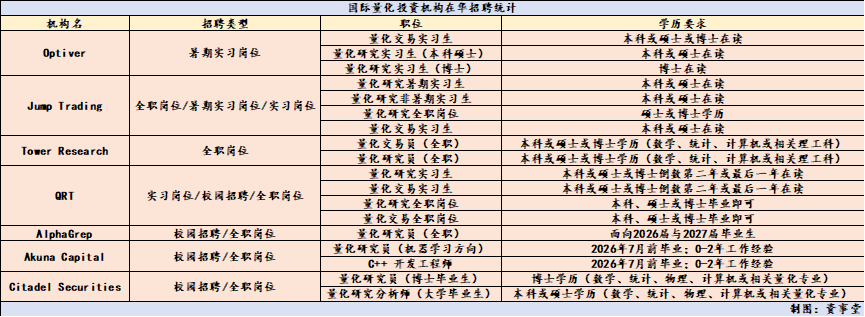
Core Insights - A new wave of international quantitative investment firms is intensifying their recruitment efforts in mainland China, particularly targeting top-tier talent from leading universities [1][2] - The competition for talent is not limited to quantitative private equity firms but includes a diverse range of players such as foreign quantitative firms, multi-asset proprietary trading platforms, and tech giants [1][5] - The recruitment focus is primarily on three core areas: quantitative research, quantitative trading, and engineering technology [7][9] Recruitment Trends - Multiple renowned international quantitative investment firms have launched their autumn recruitment campaigns targeting mainland Chinese talent since September [2] - These firms are establishing offices in Shanghai while seeking candidates from the best universities across the country [1][4] - The recruitment strategies are increasingly sophisticated, with firms like QRT creating a long-term talent pipeline by integrating internships with full-time positions [12][13] Job Position Insights - The majority of positions being recruited are in quantitative research, which is crucial for model building and market signal interpretation [7][9] - Quantitative trading roles are also prevalent, requiring candidates to understand strategies and execute trading models in high-speed environments [7] - Engineering roles, while less emphasized, are essential for developing systems that can execute strategies at high speeds [8][9] Targeted Talent Profiles - Firms like AlphaGrep and Akuna Capital are focusing on candidates with strong mathematical and statistical backgrounds, as well as programming skills in Python or C++ [17] - The recruitment efforts are aimed at students with solid foundations in machine learning, statistics, and market data analysis [17] - Citadel Securities is specifically looking for local talent capable of model development and market structure analysis, indicating a strategic focus on research capabilities in the Asia-Pacific region [19]