量子/安全

Search documents
中国电信前三季度持续拓展战略新兴业务规模
Zheng Quan Ri Bao· 2025-10-21 16:37
Core Insights - China Telecom reported a revenue of 394.27 billion yuan for the first three quarters of 2025, a year-on-year increase of 0.59%, and a net profit attributable to shareholders of 30.773 billion yuan, up 5.03% year-on-year [2] - In Q3 2025, the company achieved a revenue of 124.848 billion yuan, a decrease of 0.91% year-on-year, while the net profit was 7.756 billion yuan, an increase of 3.6% year-on-year [2] Financial Performance - For the first three quarters of 2025, China Telecom's operating costs were 274.8 billion yuan, an increase of 0.1% year-on-year [3] - Sales expenses were 38.9 billion yuan, down 1.4% year-on-year, while management expenses were 27.1 billion yuan, up 0.7% year-on-year [3] - R&D expenses reached 9.1 billion yuan, a year-on-year increase of 4.4%, focusing on core technologies in network, cloud, AI, quantum, and security [3] Business Development - As of the report date, China Telecom had 290 million 5G network users, with a penetration rate of 66.9% [2] - Mobile internet traffic grew by 16.9% year-on-year, with a data usage per user (DOU) of 22.3 GB, up 11.4% year-on-year [2] - The penetration rate of gigabit broadband users was approximately 31.0% [2] Strategic Emerging Businesses - Revenue from IDC reached 27.5 billion yuan, a year-on-year increase of 9.1% [2] - Security revenue was 12.6 billion yuan, up 12.4% year-on-year [2] - Intelligent revenue grew by 62.3%, video internet revenue increased by 34.2%, satellite communication revenue rose by 23.5%, and quantum revenue surged by 134.6% [2] New Business Initiatives - China Telecom has officially launched eSIM mobile services, previously supporting smartwatches and in-car devices [3] - The company reported a rapid increase in reservations for the eSIM mobile service, indicating strong market interest [3]


中国电信2025年中报简析:营收净利润同比双双增长,公司应收账款体量较大
Zheng Quan Zhi Xing· 2025-08-15 22:18
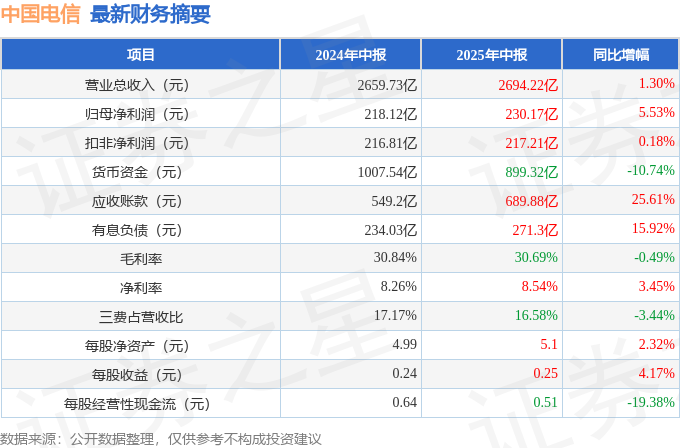
Core Viewpoint - China Telecom reported a year-on-year increase in total revenue and net profit for the first half of 2025, indicating stable growth despite challenges in cash flow and accounts receivable management [1][2]. Financial Performance - Total revenue for the first half of 2025 reached 269.42 billion yuan, a 1.3% increase from 2024 [1]. - Net profit attributable to shareholders was 23.02 billion yuan, up 5.53% year-on-year [1]. - In Q2 2025, total revenue was 134.91 billion yuan, reflecting a 2.61% increase compared to the same quarter in 2024 [1]. - Q2 net profit attributable to shareholders was 14.15 billion yuan, a 7.1% increase year-on-year [1]. - Gross margin stood at 30.69%, a slight decrease of 0.49% from the previous year [1]. - Net margin improved to 8.54%, an increase of 3.45% year-on-year [1]. Accounts Receivable and Cash Flow - Accounts receivable increased significantly, with the amount reaching 68.99 billion yuan, a 25.61% rise compared to the previous year [1]. - The ratio of accounts receivable to net profit was notably high at 208.98%, indicating potential liquidity concerns [4]. - Operating cash flow per share decreased by 19.38% to 0.51 yuan, reflecting longer collection periods in the digital business [1][3]. Cost Management - Total sales, management, and financial expenses amounted to 44.66 billion yuan, accounting for 16.58% of revenue, a decrease of 3.44% year-on-year [1]. - Sales expenses decreased by 5.99%, attributed to digital marketing initiatives [2]. - Financial expenses increased by 17.33%, due to a shift in investment strategy towards low-risk structured deposits [3]. Investment and Market Position - The company’s return on invested capital (ROIC) was reported at 6.43%, indicating average capital returns [3]. - Analysts project a net profit of 34.92 billion yuan for 2025, with an average earnings per share estimate of 0.38 yuan [4]. Fund Holdings - The largest fund holding China Telecom shares is the Industrial Bank Cultural Industry Stock A, with 32.44 million shares held [5]. - Other funds have shown varied movements, with some reducing their holdings in the company [5].