
金穹防御系统

Search documents
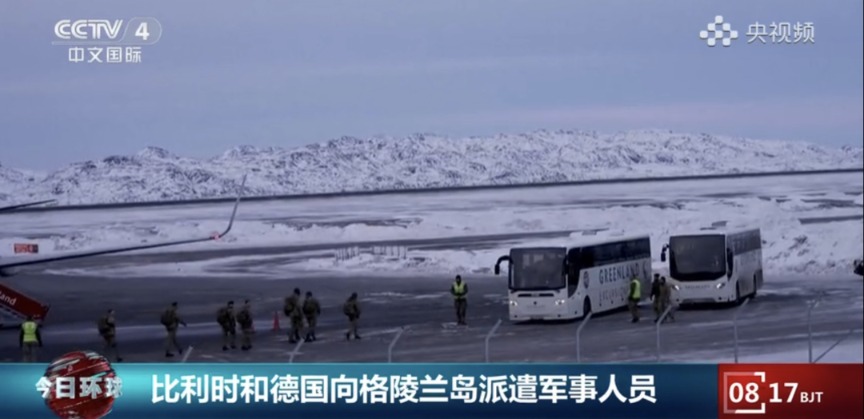
上岛才几天 德军今天撤离格陵兰!德国副总理:不能被美国“吓倒”
Mei Ri Jing Ji Xin Wen· 2026-01-18 16:25
Group 1 - Germany has deployed a reconnaissance team of 13 military personnel to Greenland, with the possibility of future larger deployments [1][3] - Other European countries have also sent military personnel to Greenland, including France (approximately 15), Sweden (3), Norway (2), Finland (2), and others [3] - The Danish Joint Arctic Command currently has about 150 military and civilian personnel stationed in Greenland, with around 200 U.S. troops also present [3] Group 2 - The White House stated that the deployment of European troops to Greenland will not affect Trump's stance on the territory, which is currently under Danish control [4] - Trump announced a 10% tariff on goods exported to the U.S. from Denmark, Norway, Sweden, France, Germany, the UK, the Netherlands, and Finland starting February 1, 2026, increasing to 25% by June 1, 2026, until an agreement to "fully purchase Greenland" is reached [6] - The eight European countries issued a joint statement condemning the tariff threat as damaging to transatlantic relations and pledged to respond collectively to protect their sovereignty [6][7] Group 3 - Germany's Vice Chancellor and Finance Minister stated that Germany will not be intimidated by U.S. policies regarding Greenland [7] - French President Macron indicated that France may request the activation of the EU's anti-coercion tool in response to U.S. tariff threats, which is seen as a strong trade countermeasure [7] - The EU's anti-coercion tool aims to address third countries attempting to influence EU decision-making through trade measures, emphasizing the need for unity among European nations [7]

五角大楼“中国军力报告”硬中有缓?专家解读
Xin Lang Cai Jing· 2025-12-24 22:53
Core Viewpoint - The latest "China Military and Security Development Report" released by the U.S. Department of Defense emphasizes the growing military capabilities of China, which are perceived as a direct threat to U.S. security, while also indicating a shift in the U.S. understanding of China's military strength and the dynamics of U.S.-China relations [1][2]. Group 1: Military Capabilities - The report claims that China possesses a large and growing arsenal of nuclear weapons, naval power, conventional long-range strike capabilities, cyber capabilities, and space capabilities, which threaten U.S. security [1]. - The People's Liberation Army (PLA) is reportedly making steady progress towards its 2027 goals, which include achieving a "strategic decisive victory" over Taiwan and establishing "strategic deterrence and control" over other regional countries [1][2]. Group 2: Military Activities and Strategies - In 2024, the PLA is expected to test key components of its military options, including exercises targeting maritime and land objectives, as well as the ability to strike U.S. forces in the Pacific region [2]. - The report suggests that if the scale of the PLA's strikes is significant, it could severely challenge and disrupt U.S. presence in the Asia-Pacific conflict areas [2]. Group 3: U.S.-China Relations - The tone of the report regarding U.S.-China relations is relatively moderate, stating that under President Trump, the relationship has reached its best level in years, and the U.S. Department of Defense will support efforts to strengthen this positive momentum [3]. - Analysts note that the report reflects an adjustment in the U.S. perception of China's military capabilities and the nature of U.S.-China interactions, influenced by recent military conflict simulations in the Western Pacific [3].