
钠电产业化

Search documents
中科海钠如何“算清”钠电商业运营“账”?
高工锂电· 2026-03-28 08:36
Core Insights - The sodium-ion battery industry is experiencing a significant shift towards commercialization, with increased participation from various players and the establishment of viable business models [2][3] - The upcoming "Sodium Leadership Revolution: Electric Definition of Jiangcheng" conference on March 31, 2026, aims to accelerate the next phase of sodium-ion battery industrialization [4][16] Group 1: Market and Business Model Development - The sodium-ion battery has found its breakthrough in the power market, particularly in electric heavy trucks, with ongoing efforts to optimize performance and reduce costs [5][6] - Zhongke Haina has successfully transitioned from performance testing to actual operational data for its sodium-ion heavy truck, marking a significant step in commercial viability [7] - The sodium-ion battery offers a 20% higher range compared to lithium-ion batteries in heavy truck applications, along with a fast-charging capability and a cycle life of 8,000 times [9] Group 2: Diversified Commercialization Strategies - Zhongke Haina's commercialization strategy includes not only the heavy truck market but also energy storage and start-stop applications [12][15] - The company has established a framework for its energy storage business, having previously identified performance and cost boundaries, which will guide future development [12][13] - The start-stop market is expected to grow rapidly, with sodium-ion batteries positioned to replace lead-acid batteries due to their superior performance and lower maintenance costs [15]

钠电产业化提速,26年拾级而上
Shenwan Hongyuan Securities· 2026-03-26 14:17
Investment Rating - The report suggests a positive outlook for the sodium battery industry, indicating a potential exponential growth in the coming years due to technological advancements and market demand [3][4]. Core Insights - Sodium batteries are expected to experience rapid industrialization, with significant developments in technology, cost reduction, and application expansion. Major players like CATL are leading the way in production and innovation [3][4]. - The report emphasizes the importance of the sodium battery cycle, highlighting that the industry is at a bottoming phase with expectations for substantial growth. Key companies to watch include Zhihua New Materials, Meilian New Materials, and CATL [3][4]. - The report outlines the competitive advantages of sodium batteries, including lower costs, safety, and performance in various temperature conditions, making them suitable for a wide range of applications [12][39]. Summary by Sections 1. Sodium Battery Development Dynamics - The report identifies multiple driving forces behind sodium battery development, including technological breakthroughs and increasing demand in specific sectors [8][29]. - The cost competitiveness of sodium batteries is analyzed, showing a clear path from theoretical advantages to practical applications [30][32]. 2. Cost Competitiveness - The report details the significant cost advantages of sodium battery materials, particularly the NFPP cathode, which is expected to see a reduction in costs from 0.42 CNY/Wh at the end of 2025 to 0.28 CNY/Wh by 2030 [31][32]. - The cost comparison between sodium and lithium batteries shows a narrowing gap, with sodium batteries potentially achieving price parity with lithium iron phosphate batteries by 2026 [35][36]. 3. Supply and Demand Resonance - The report highlights the growing orders for sodium batteries and the ongoing efforts to scale production, indicating a strong market demand [28][30]. - The supply chain for sodium battery materials is expected to expand significantly, driven by technological advancements and increased production capacity [25][39]. 4. Policy Support - Global and domestic policies are increasingly supportive of sodium battery commercialization, with initiatives aimed at accelerating development and application [13][16]. - The report notes that policy focus has shifted from research and development to large-scale application, indicating a systemic approach to fostering the sodium battery industry [16][29].





华阳股份(600348):无烟煤龙头蝶变,钠电+碳纤维开启第二增长曲线
Datong Securities· 2026-03-25 11:15
Investment Rating - The report assigns a cautious recommendation rating to Huayang Co., Ltd. [1] Core Viewpoints - Huayang Co., Ltd. is a leading producer of smokeless coal in China, with over 80% of its revenue and 94% of its gross profit derived from its coal business, which serves as the core pillar of its performance [1] - The company is transitioning towards new energy and materials, focusing on sodium batteries and carbon fiber to establish a second growth curve [2] - The company has a strong cost control mechanism, with coal gross margins maintained around 40%, showcasing resilience during market downturns [1][2] - The integration of coal and electricity operations has led to stable revenue growth in its power supply business, effectively countering coal price fluctuations [1] Company Overview - Huayang Co., Ltd. has a clear business structure with coal as its core and new energy materials as growth drivers, aiming for new energy and materials to account for 40% of revenue by the end of the 14th Five-Year Plan [13][14] - The company has a robust financial position with a high dividend payout ratio, expected to reach around 50% in 2023-2024, enhancing shareholder value [2] Coal Business - The coal business generated revenue of 201.54 billion yuan in 2024, contributing 81.06 billion yuan to gross profit, solidifying its role as the main profit contributor [20] - The company is actively increasing its coal production capacity, with a total approved capacity of 40.9 million tons per year by the end of 2025 [21] - Huayang Co., Ltd. has secured significant coal resources, including a recent acquisition of a coal exploration right with an estimated resource of 630 million tons [22] Power Supply Business - The power supply business has seen significant growth, with revenue reaching 20.11 billion yuan in 2024, a year-on-year increase of 295% [32] - The company operates a key low-heat value coal power project, which enhances its coal-electricity integration and reduces fuel costs [29] New Energy Transition - The sodium battery business is a core focus, with a complete industrial chain established, and commercial applications are accelerating [36] - The company is also developing high-performance carbon fiber, with plans to produce 1,000 tons by the end of 2025, targeting high-end markets [51] - The photovoltaic business is expanding steadily, although it faces challenges due to industry competition and has not yet achieved profitability [47]

欧洲2026电池战略,钠电将上主桌
高工锂电· 2026-02-28 12:29
Core Viewpoint - The article emphasizes the growing importance of sodium batteries in Europe's energy transition, especially following the bankruptcy of Northvolt, which exposed the vulnerabilities in the local lithium battery supply chain. Sodium batteries are seen as a strategic technology for enhancing the EU's industrial competitiveness and are expected to receive similar financial support as lithium batteries from the EU [4][9]. Group 1: European Sodium Battery Industry Development - The European sodium battery industry began earlier than in China, with notable companies like Faradion and Tiamat emerging in the market [5][6]. - Faradion, established in 2011, was acquired by Reliance New Energy Solar for £100 million in 2021 and is collaborating with Chinese company Yuhuang New Energy to build a 10GWh sodium-ion cell production line [5][8]. - Tiamat received investment from Stellantis in 2024 and is constructing a sodium-ion battery factory in France, aiming to produce second-generation products for electric vehicles [6][8]. - Altris completed a B1 funding round in 2024, raising 150 million Swedish Krona to produce low-voltage sodium-ion batteries for the automotive sector by 2026 [6][8]. - Moonwatt, founded in September 2024, raised $8.3 million in seed funding and plans to pilot its sodium battery project in Europe by 2026 [6][8]. Group 2: Market Dynamics and Trends - The European sodium battery market is characterized by a focus on battery production rather than material development, contrasting with China's current trend of prioritizing material advancements [7]. - The European market is expected to see sodium batteries leading the way in large-scale energy storage solutions, particularly in response to the region's increasing energy stability challenges [9][10]. - The high latitude of Europe makes sodium batteries an attractive option due to their performance in extreme temperatures, which is crucial for the region's energy needs [10]. Group 3: Chinese Sodium Battery Companies Targeting Europe - The surge in lithium prices in late 2022 marked the beginning of China's sodium battery commercialization, with significant investments and capacity planning emerging [11]. - In 2023, over 50 billion yuan was invested in sodium battery projects in China, with a planned capacity exceeding 120GWh [11]. - Despite a slowdown in financing, the focus is shifting towards material development, particularly in sodium battery cathode materials, to support future industry growth [11][12]. - Major Chinese battery manufacturers are expected to launch new sodium battery products in 2026, indicating a new phase of commercialization and market expansion [13]. Group 4: Competitive Advantages and Challenges - Sodium batteries have a lower carbon footprint certification compared to lithium batteries, with a recovery rate target of 50% for sodium batteries, significantly higher than that of lithium [14]. - Chinese sodium battery companies are successfully entering the European market, with significant partnerships and product launches planned for 2026 [15][16]. - However, potential trade barriers and competition from European entities pose challenges for Chinese companies, despite their technological lead in sodium battery patents [16]. Group 5: Future Outlook - The sodium battery sector in China is poised for significant growth, with diverse applications anticipated to emerge, positioning sodium batteries as a key player in the next generation of energy solutions [17].
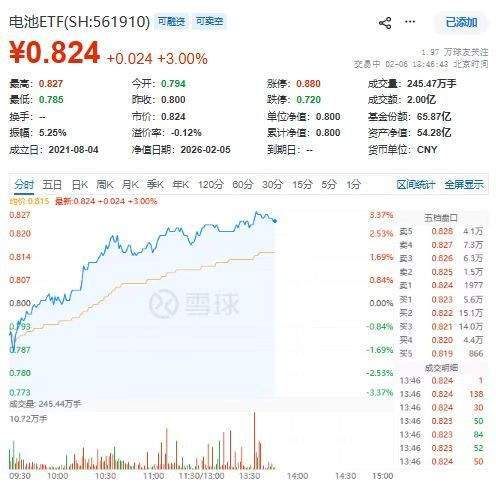
钠电+储能共振,电池ETF(561910)午后拉涨超3%引领两市!震裕科技暴涨超12%
Sou Hu Cai Jing· 2026-02-06 06:43
Core Insights - The battery industry chain is experiencing a comprehensive surge, with the battery ETF (561910) rising by 3.12%, leading the market [1] - The strong bullish sentiment in the sector is reflected in the performance of key companies, such as Enjie Co., which hit the daily limit, and other core material companies like Tianci Materials and Molybdenum & Tungsten, which saw increases exceeding 7% [1] Industry Dynamics - A significant breakthrough has been achieved with the industrialization of sodium batteries, marked by the launch of the world's first mass-produced sodium battery passenger vehicle by CATL and Changan Automobile on February 5, indicating the beginning of a new market space worth trillions [2] - The battery industry's fundamentals are showing signs of improvement after a prolonged adjustment period, with global energy storage demand expected to exceed 2TWh by 2030, while supply expansion is becoming more rational due to "anti-involution" policies [3] - Recent national policies have introduced capacity compensation mechanisms for energy storage, enhancing the economic viability of storage power stations and likely accelerating the construction of previously approved projects, thereby increasing demand for storage batteries [3] Future Outlook - The battery industry is positioned at a new starting point, driven by technological iterations (sodium and solid-state batteries) and global green demands (electric vehicles and energy storage) [3] - The battery ETF (561910) encompasses the entire industry chain from leading battery manufacturers to core material suppliers, serving as an efficient tool for investors to capitalize on the industry's opportunities [3]

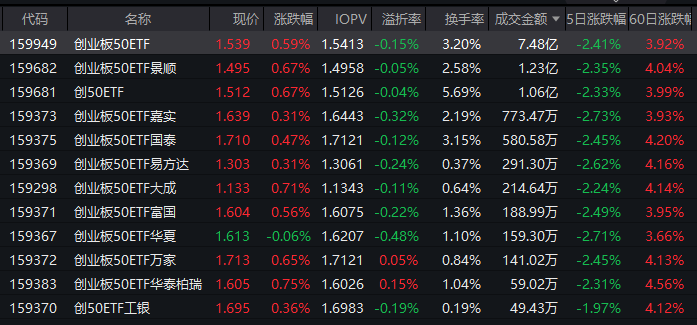
钠电产业化进程提速!创业板50ETF(159949)半日成交7.48亿元领跑 机构一致看好景气延续
Xin Lang Ji Jin· 2026-02-06 04:20
Market Performance - The market showed a rebound with all three major indices rising, particularly the ChiNext Index which increased by 0.65% [1] - The ChiNext 50 ETF (159949) rose by 0.59%, closing at 1.539 yuan, with a turnover rate of 3.20% and a transaction amount of 748 million yuan, leading among similar ETFs [1] ETF Details - The ChiNext 50 ETF tracks the ChiNext 50 Index, which consists of 50 stocks selected from the ChiNext market based on size, liquidity, and technology growth characteristics [4] - The ETF has a three-year return rate of 35.02%, outperforming its benchmark and ranking 447th among 1634 similar products [4] Lithium Battery Industry - As of February 5, 2026, 70 A-share companies in the lithium battery industry have disclosed performance forecasts, with over 70% of them reporting year-on-year profit growth [2] - A global sodium battery strategy was launched by Changan Automobile in collaboration with CATL, with the world's first sodium battery passenger vehicle expected to be launched mid-year [2] - Sodium batteries are noted for their advantages over lithium batteries in terms of resource availability, cost of extraction, temperature adaptability, fast charging performance, and safety [2] Sodium Battery Market Outlook - The demand for sodium batteries is expected to grow rapidly in the short to medium term due to their high safety, long lifespan, and strong environmental adaptability [3] - If the cost advantages of sodium batteries continue to expand, they may become more economically viable than lithium iron phosphate batteries, leading to sustained industry growth [3] - The global shipment of sodium batteries is projected to reach 9 GWh by 2025, a 150% increase year-on-year, with the market size for energy storage sodium batteries expected to reach 580 GWh by 2030 [2][3] Investment Recommendations - Companies that are early in positioning themselves within the sodium battery supply chain are likely to benefit from industry growth [3] - Investors are advised to focus on battery manufacturers and related material suppliers that are leading in the industrialization process [3]

钠电风起,规模上车打响第一枪?
2 1 Shi Ji Jing Ji Bao Dao· 2026-02-05 13:32
Core Insights - Changan Automobile and CATL have launched a global sodium battery strategy, unveiling the world's first mass-produced sodium-ion passenger vehicle, expected to hit the market by mid-year [1] - Sodium batteries are viewed as a complementary alternative to lithium batteries, with significant advancements anticipated by 2026, marking a second wave of industrialization for sodium technology [1][6] - The sodium battery's low-temperature performance and safety features position it as a viable option for specific applications, particularly in cold climates [3][5] Group 1: Sodium Battery Development - The sodium battery technology has faced challenges in achieving large-scale commercialization, primarily due to lower energy density compared to lithium batteries [1][6] - Companies like EVE Energy and Zhongda Energy are actively developing sodium battery products, with EVE Energy's headquarters project and Zhongda's "Yuan Sodium Light" battery expected to launch in early 2026 [1] - The first-generation sodium-ion batteries have an energy density of 140-160 Wh/kg, which is significantly lower than that of lithium batteries, limiting their application in high-end electric vehicles [6] Group 2: Performance Advantages - Sodium-ion batteries exhibit superior low-temperature performance, maintaining charge capacity even in extreme cold, with the CATL's sodium battery functioning at temperatures as low as -30°C [3][4] - The sodium battery's design allows for simplified thermal management systems, enhancing efficiency and safety, particularly in cold regions [4][5] - The safety profile of sodium batteries is enhanced due to their lower internal resistance, reducing risks of thermal runaway and fire [4] Group 3: Commercialization Challenges - The sodium battery industry is still in its infancy, with a less mature supply chain compared to lithium batteries, affecting cost and production stability [6][7] - The cost of sodium batteries is projected to be around 0.45 yuan/Wh by 2025, which does not yet provide a competitive edge over lithium iron phosphate batteries priced at approximately 0.3 yuan/Wh [6] - The path to commercialization for sodium batteries is expected to be gradual, with 2026 identified as a pivotal year for transitioning from demonstration applications to mass production [7]
宁德时代高管解读轻商电动化:技术创新回归场景本质
Zhong Guo Jing Ying Bao· 2026-01-26 07:37
Core Insights - The company aims to make lithium-ion batteries more economical in the next 2 to 3 years, focusing on technological innovations that address real operational pain points in the new energy light commercial vehicle sector [1][4] - The electric logistics market, particularly intercity freight, presents a significant opportunity, with current electrification rates below 12% despite over 45% of light trucks being used for this purpose [1][2] Technological Innovations - The company has developed a hybrid battery system that balances energy density between lithium iron phosphate and ternary lithium batteries, achieving 800 km of real-world range while keeping cost increases minimal [2] - The newly launched sodium-ion battery, with a capacity of 45 kWh, retains over 92% usable capacity at -20°C and can be charged even after being frozen at -30°C, addressing low-temperature operation challenges [2][3] Market Opportunities - The domestic market for new energy light commercial vehicles is projected to exceed 900,000 units by 2026, indicating a major opportunity for large-scale electrification [4] - The company plans to establish 3,000 battery swap stations by the end of 2026, enhancing the infrastructure needed for electric logistics [5] Competitive Landscape - The competition in the new energy commercial vehicle battery market is intensifying, with second-tier battery manufacturers gaining market share as main manufacturers seek cost-effective solutions [6] - The company emphasizes value competition over price competition, focusing on transforming cutting-edge technology into practical, replicable solutions for users [6] Strategic Goals - The company aims to achieve cost parity between sodium-ion and lithium-ion batteries within 2 to 3 years, while also enhancing the energy density of sodium batteries to match current lithium iron phosphate levels [3] - The company is committed to providing a comprehensive value system for users, including battery health transparency and lifecycle management to enhance the resale value of electric vehicles [3][5]
当锂价冲上高位 钠电“备胎”火速上位
3 6 Ke· 2026-01-21 01:04
Core Viewpoint - The sodium battery industry in China is entering a commercialization phase, with annual shipments expected to exceed 3.7 GWh by 2025, marking a significant milestone despite being far behind lithium battery giants [1][2]. Industry Overview - The sodium battery industry is poised for growth, driven by rising lithium carbonate prices, which have surged to as high as 179,000 yuan/ton, prompting interest in sodium batteries as a cost-effective alternative [3][5]. - The industry is characterized by a dual structure, with established lithium battery leaders like CATL and BYD alongside emerging sodium battery companies such as Zhongke Haina and Sodium Innovation Energy [3][7]. Market Dynamics - The year 2026 is being marked as the "year of sodium battery industrialization," with companies ramping up production lines and securing orders in response to market demand [3][5]. - The sodium battery's advantages include abundant raw materials, stable pricing of sodium carbonate, and superior low-temperature performance and safety features compared to lithium batteries [1][3]. Challenges and Pressures - The sodium battery industry faces significant challenges, including capacity bottlenecks, performance gaps compared to lithium batteries, and an immature supply chain [3][9]. - Current sodium battery energy densities range from 100 to 160 Wh/kg, while lithium iron phosphate batteries achieve 160 to 200 Wh/kg, indicating a need for technological advancements [9]. Standardization Efforts - The establishment of a comprehensive standardization framework is underway, with the Ministry of Industry and Information Technology guiding the development of national and industry standards for sodium batteries [4][15]. - Existing standards are insufficient, particularly in areas such as safety, performance requirements, and testing methods for specific sodium battery applications [14][16]. Future Outlook - The sodium battery industry is expected to see increased investment and development, with major players like CATL and BYD committing to large-scale applications in various sectors [7][8]. - The industry's growth will depend on overcoming current challenges, including production capacity, cost competitiveness, and the establishment of a robust standardization system [9][12].


当锂价冲上高位,钠电“备胎”火速上位
3 6 Ke· 2026-01-20 12:11
Core Viewpoint - The sodium-ion battery industry is experiencing a significant surge due to skyrocketing lithium carbonate prices, which have reached as high as 179,000 yuan/ton, prompting a shift towards sodium-ion technology as a cost-effective alternative [1][4][8]. Industry Overview - The sodium-ion battery industry is marked as the "year of industrialization" in 2026, with companies like CATL and BYD leading the charge alongside emerging players focused on sodium technology [2][5]. - As of 2025, China's sodium-ion battery shipments exceeded 3.7 GWh, indicating the industry's transition from laboratory to commercial viability [1]. Market Dynamics - The rising prices of lithium carbonate are driving inquiries from clients and investors, leading to increased production efforts in sodium-ion materials [2]. - The sodium-ion battery's economic viability becomes apparent when lithium carbonate prices exceed 130,000 to 150,000 yuan/ton, making it a competitive option for mid-range power and energy storage applications [4]. Technological and Production Challenges - The sodium-ion battery industry faces significant challenges, including production capacity bottlenecks and the need to improve performance metrics to match lithium batteries [10]. - Current sodium-ion batteries have energy densities ranging from 100 to 160 Wh/kg, while lithium iron phosphate batteries achieve 160 to 200 Wh/kg, highlighting the performance gap [10]. Supply Chain and Material Availability - The supply chain for sodium-ion batteries is still maturing, with key materials like hard carbon and electrolyte systems not yet reaching the stability of lithium battery supply chains [12]. - The fluctuation in lithium carbonate prices poses a risk to the cost advantage of sodium-ion batteries, as demonstrated by a recent drop of 8.99% in lithium futures [11]. Standardization Efforts - The establishment of a comprehensive standardization framework for sodium-ion batteries is underway, with multiple national and industry standards being developed to guide the industry [3][15]. - Current standards are insufficient, particularly in areas such as safety, performance requirements, and testing methods for specific sodium-ion products [14]. Future Outlook - The sodium-ion battery industry is seen as a complementary technology to lithium batteries, focusing on specific applications where its unique advantages can be leveraged [12][8]. - The ongoing development of standards and improved production capabilities will be crucial for the industry's growth and acceptance in the market [15].