钠锂协同

Search documents
用技术创新打开增量空间 长时储能解码能源未来
Xin Lang Cai Jing· 2026-02-13 00:18
Core Viewpoint - The energy storage industry is transitioning from "scale expansion" to "value reconstruction," driven by the rigid demand from new energy consumption and AI data centers, while facing challenges such as high costs and technological competition [1][7]. Group 1: Cost Reduction Strategies - The goal of achieving a storage cost of 0.1 yuan per kWh is not solely due to a single technological breakthrough but requires a collaborative innovation across the entire supply chain, including cells, systems, manufacturing, and services [2][9]. - The development of ultra-large battery cells is a key economic foundation, with a clear iterative path from 1175Ah to 1300Ah, resulting in over 30% reduction in system components and more than 50% cost reduction in key power components compared to traditional cells [3][10]. - Long-duration energy storage systems are essential for efficiency improvements, with optimized algorithms saving nearly 40 million yuan in electricity costs over a 25-year lifespan for a 1 GWh system [3][11]. - Extreme intelligent manufacturing supports cost control, with a 45% reduction in unit manufacturing costs at the Shandong base, enhancing both capacity and quality [3][11]. Group 2: Integrated Solutions and Market Expansion - The company has transformed from a equipment provider to an integrated solution provider, offering comprehensive solutions from project planning to operation, addressing core pain points such as deployment efficiency and space requirements [4][12]. - The promotion of long-duration energy storage solutions is seen as a key to breaking the cycle of price competition, potentially expanding market capacity from hundreds of GWh to 150 TWh, allowing companies to focus on innovation [5][12]. - The company’s lithium-sodium collaborative solution is designed to meet the growing energy storage demand in AI data centers, with projections indicating over 300 GWh of demand in this sector by 2030 [5][12]. Group 3: Future Technology and Global Strategy - The company predicts that lithium iron phosphate batteries will remain the mainstream technology in the next five years, while lithium-sodium collaboration will become common in ten years [6][13]. - The company has achieved mass production of sodium-ion batteries, which complement lithium batteries in extreme environments and power support scenarios, providing a resource-secure backup solution [6][13]. - The Texas factory has commenced local production, with Europe and Australia identified as key markets for expansion, leveraging grid-level system solutions and localized service networks to build competitive advantages [6][14].
【国金电新】锂电行业12月洞察:涨价潮继续演绎,新技术协同发展
Xin Lang Cai Jing· 2026-01-08 11:37
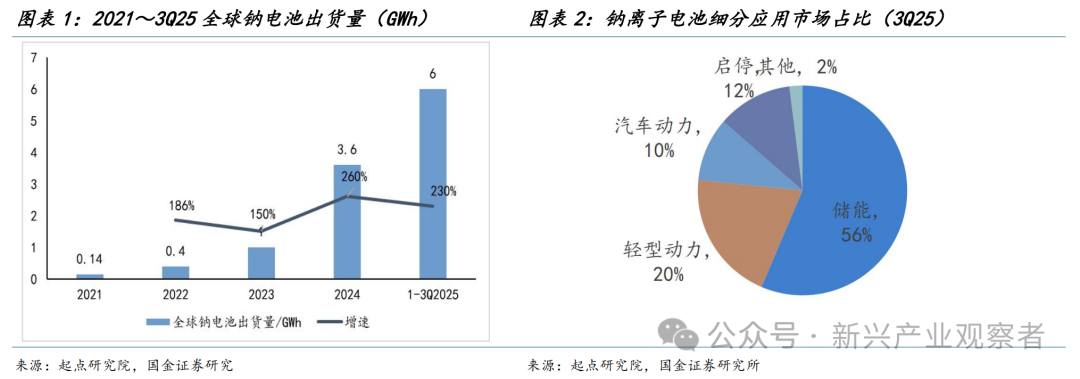
Investment Logic - The lithium carbonate price reached 107,000 yuan/ton on December 26, up 16% from the previous month; lithium hydroxide price was 89,000 yuan/ton, up 11% [3][45] - In November, domestic wholesale sales of new energy passenger vehicles reached 1.57 million units, with year-on-year and month-on-month growth of 19% and 5% respectively; cumulative sales from January to November reached 12.8 million units, up 30% year-on-year [4][71] Market Review - Since December 2025, the lithium battery sector has shown active performance, with most segments outperforming the CSI 300 and SSE 50 indices; lithium battery electrolyte led the gains with an 8% increase [5][72] - However, the monthly transaction volume of most lithium-related sectors has decreased, primarily due to a decline in overall market trading activity [5][72] - Over half of the lithium-related sectors are currently at high historical valuation percentiles, indicating strong market attention towards the lithium battery sector [5][72] Research Topic - The sodium-ion battery industry is entering a phase characterized by explosive shipments, scene implementation, and ecological closure, marking a significant commercialization period [6][73] - The energy storage sector has become the absolute mainstay of industry growth due to its long lifespan and wide temperature range; the two-wheeler market is rapidly penetrating under the wave of lead-acid battery replacement [6][73] - The application of sodium batteries in passenger vehicles has shown potential, particularly with CATL's 175Wh/kg "sodium new battery" achieving a breakthrough in mainstream models [6][73] Industry Insights - In November, new energy vehicle sales continued to show differentiation, with high growth in China and Europe, while the U.S. faced impacts from subsidy withdrawals; sales in China, Europe, and the U.S. reached 1.57 million, 300,000, and 80,000 units respectively, with year-on-year growth of 19%, 39%, and a decline of 42% [7][29] - Domestic energy storage installations rebounded strongly in November, reaching 11.6 GWh, with year-on-year and month-on-month growth of 31% and 213% respectively; cumulative installations from January to November reached 83.4 GWh, up 28% year-on-year [7][37] Sodium Battery Production - In January 2026, production for batteries, positive electrodes, negative electrodes, separators, and electrolytes is expected to increase by 29% to 52% year-on-year, with separators and electrolytes exceeding 50% growth [8][43] - The sodium battery industry is projected to see significant growth, with shipments expected to reach nearly 20 GWh by 2026, driven by advancements in technology and cost reductions [8][48] Investment Recommendations - The sodium battery industry is entering a new phase characterized by explosive growth and substantial market opportunities; key players include CATL and BYD, which are leading the technology and application of sodium batteries [9][20] - The investment focus should be on core materials, battery manufacturers, and companies involved in the complete ecosystem from materials to applications [9][24]



破局AIDC“能耗锁”,RE+展海辰储能亮出“金钥匙”
行家说储能· 2025-09-12 06:56
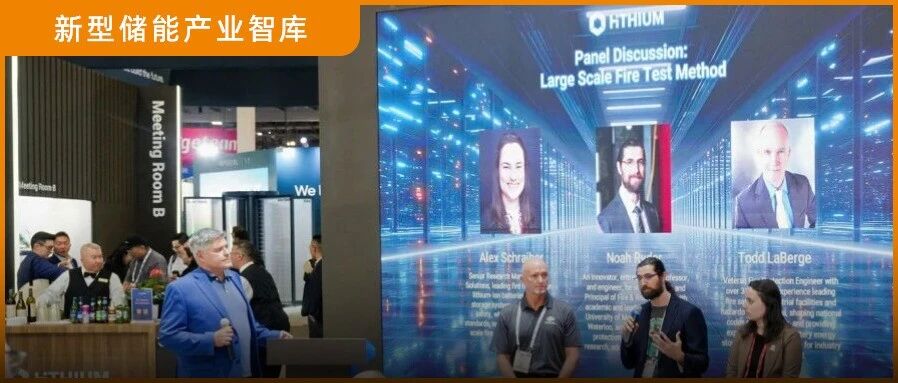
Core Viewpoint - The article highlights the innovative energy storage solutions presented by Haicheng Energy at the RE+ 2025 event, focusing on the integration of sodium-ion and lithium-ion batteries to address the energy challenges faced by AI data centers [2][3][5]. Group 1: Energy Storage Solutions - Haicheng Energy introduced the AI Data Center (AIDC) energy storage solution, which includes the ∞Power 6.25MWh 8h lithium battery system and the ∞Power N2.28MWh 1h sodium battery system, aimed at providing stable energy support and rapid response to power fluctuations [2][5]. - The AIDC storage system features a specialized lifespan assessment model that offers more accurate predictions of energy storage system degradation compared to general lifespan models, ensuring better performance guarantees for clients [5][12]. Group 2: Safety and Testing - During the RE+ 2025 event, Haicheng Energy showcased the global first open-door combustion test of the ∞Block 5MWh storage system, validating its safety capabilities under extreme conditions with the involvement of international certification bodies [8][11]. - The company plans to conduct similar rigorous testing in the U.S. to demonstrate its commitment to safety and transparency in energy storage technology [11]. Group 3: Market Expansion and Partnerships - Haicheng Energy signed a cooperation agreement with Microgrid Networks LLC to provide comprehensive solutions for 10 energy storage projects in New York, totaling 55MW/290MWh, marking a significant step in its North American market strategy [12][14]. - The company has established a localized manufacturing and service network in the U.S., enhancing its ability to meet diverse customer needs and ensuring long-term operational stability [15]. Group 4: Industry Position and Future Outlook - Haicheng Energy has achieved a top 2 position in global energy storage battery shipments and power storage shipments in the first half of 2025, setting a new benchmark for high-quality development in the energy storage industry [14][15]. - The launch of the AIDC energy storage solution signifies Haicheng Energy's strong capabilities in technological innovation and customized solutions, paving the way for new applications in energy storage and supporting the transition to a greener and more efficient future [15].