AI数据中心储能

Search documents
新需求扩容,天齐锂业呼吁重估碳酸锂定价机制
高工锂电· 2026-03-27 10:57
Core Viewpoint - The lithium industry is facing a significant shift as demand boundaries expand, while the pricing mechanisms that have been in place for years remain outdated [2][8]. Group 1: Demand Side - The lithium demand forecast for the next decade includes not only electric vehicles but also new applications such as AI data center storage, humanoid robots, low-altitude economy, and solid-state batteries [6][11]. - The global AIDC storage battery shipment is expected to grow from 15 GWh in 2025 to 300 GWh by 2030, translating to a demand of approximately 180,000 tons of lithium carbonate equivalent [12][13]. - The long-term demand for lithium is projected to remain on an upward trajectory, with electric vehicles as the main driver, while new variables are being integrated into demand assessments [11][10]. Group 2: Pricing Mechanism - The lithium industry lacks a unified pricing mechanism, leading to discrepancies in price transmission across the supply chain [19][20]. - Different segments of the supply chain, including mines, lithium salt plants, and battery manufacturers, utilize various pricing methods, resulting in a lack of coherent pricing language [21][23]. - Long-term contracts still dominate the market, accounting for 60% to 80% of lithium carbonate sales in China, but discrepancies between spot prices and institutional quotes can lead to significant pressure on intermediate processing segments [25][27]. Group 3: Industry Dynamics - The lithium industry's competitive landscape is evolving, with a focus on resource availability, cost, and capacity, while the ability to define prices and manage volatility is becoming a critical differentiator [29][28]. - The industry is calling for a more unified and diverse pricing system to better reflect real trading conditions and improve value distribution across the supply chain [27][28].



储能-战略地位升级-投资主线梳理及重点标的更新
2026-03-13 04:46
Summary of Key Points from the Conference Call Industry Overview - The global energy storage capacity is expected to grow by 70% to over 470 GWh by 2026, with a further growth rate of approximately 40% in 2027 [1][11] - The energy storage industry is generally valued at under 20 times earnings, indicating significant potential for valuation recovery compared to other sectors like transformers and gas turbines [1][2] Core Insights and Arguments - **AI Data Centers (AIDC) Demand**: AIDC is driving new demand for large-scale energy storage, with a 1 GW data center requiring 5 GW/20 GWh of storage [1][3] - **Policy Upgrades**: The Chinese government has classified new energy storage as one of six emerging pillar industries, enhancing its strategic importance [5] - **Investment Drivers**: The capacity pricing policy ensures project IRR exceeds 6%, prompting large-scale investments from state-owned enterprises by 2026 [5] - **European Market Dynamics**: The European market is entering a growth phase due to frequent negative electricity prices and policies mandating energy storage [1][7] - **Supply Chain Tightness**: The supply of battery cells for household storage is tight, dominated by three companies (瑞浦, 亿纬, and 鹏辉) with no new capacity, leading to increased profit margins [1][16] Market Dynamics - **Valuation Comparison**: Energy storage companies are valued significantly lower than transformer and gas companies, prompting a shift in investment [2] - **Regional Growth**: The Australian subsidy policy is expected to drive growth in household storage, while European subsidies are anticipated to support market expansion [2][4] - **Large-Scale Storage Growth**: The growth in large-scale storage is driven by the integration of renewable energy sources in China, Europe, and the U.S. [3][11] Emerging Trends - **Technological Advancements**: The transition to 1,500V systems is seen as a core advantage for leading companies like 阳光电源 in the AIDC sector [12] - **Market Opportunities**: The demand for energy storage is expected to rise due to energy security concerns exacerbated by geopolitical tensions [2][6] Company-Specific Insights - **阳光电源**: Expected to grow from 40 GWh in 2025 to over 70 GWh in 2026, with a projected net profit of 19 billion yuan, currently undervalued at under 20 times earnings [12] - **海博思创**: Anticipated to develop 50 GWh in the domestic market and 10 GWh for state-owned enterprises in 2026, with a profit forecast of 2.3 billion yuan [13] - **正泰电源**: Actively expanding in the U.S. market with a strong sales team and partnerships, aiming for significant growth in both storage and solar markets [14] - **艾罗能源**: Positioned for a profit rebound with a projected revenue increase to 7.5-8 billion yuan in 2026, benefiting from a large R&D team [15] - **鹏辉能源**: Expected to achieve a profit of 1.6 billion yuan in 2026, benefiting from tight supply in the household storage battery market [16] - **德业股份**: Projected to achieve over 5 billion yuan in profit in 2026, driven by diverse market presence and strong demand in Europe and Asia [17] Risks and Challenges - **Lithium Price Volatility**: The impact of lithium price fluctuations on the supply chain is diminishing, with recent price corrections observed [8] - **Regulatory Risks**: The U.S. MADE Act's implications are manageable for Chinese manufacturers through strategic sourcing [8] Conclusion - The energy storage sector is poised for significant growth driven by technological advancements, favorable policies, and increasing demand from various applications, particularly in the context of AI and renewable energy integration. The market presents substantial investment opportunities, especially for leading companies with strong positioning and innovative capabilities.




从“内卷”到“印钞”:储能价格战终结背后 一场关乎万亿电力的价值重估
Quan Jing Wang· 2025-12-24 02:20
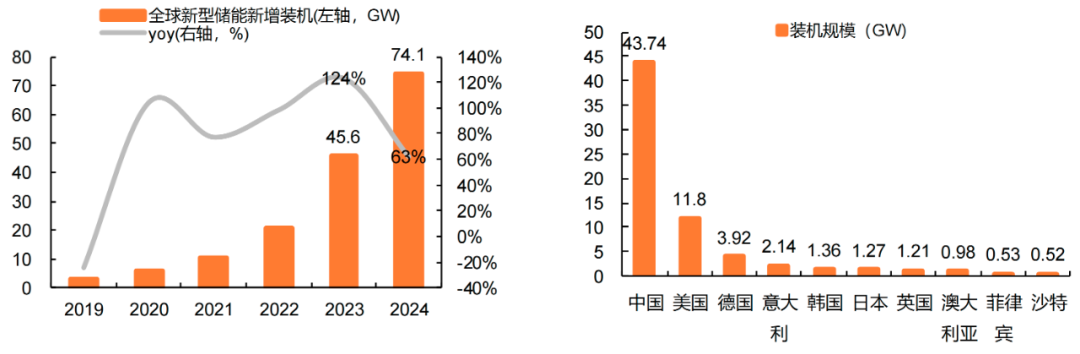
Core Viewpoint - The energy storage industry is experiencing a robust growth phase driven by strong demand both domestically and internationally, with leading battery companies operating at full capacity and battery prices continuing to rise, indicating a shift towards a more profitable and sustainable business model [1] Group 1: Demand Explosion - Global energy storage installations are on the rise, with China being the largest market. In 2024, global new energy storage installations are expected to reach 74 GW, a 62.5% increase year-on-year. China, the US, and Europe will account for 90% of this growth [2] - In 2024, China's new energy storage installations are projected to reach 43.7 GW, a 103% increase year-on-year, marking the first time installations exceed 100 GWh [2] Group 2: Policy Changes - The release of the "136 Document" in February 2025 marks a significant policy shift, ending the controversial "mandatory storage" era and allowing energy storage to operate independently in the electricity market [4] - The "New Energy Storage Scale Construction Action Plan (2025-2027)" aims for a national energy storage capacity of over 180 million kilowatts by 2027, promoting diverse revenue channels for energy storage [4] Group 3: Market Dynamics - In the first half of 2025, new energy storage projects in China added 23.0 GW, with a year-on-year increase of 68% in both power and energy capacity [6] - Local governments are introducing capacity price subsidies, leading to an internal rate of return (IRR) of 6-12% for energy storage projects, significantly boosting bidding and registration volumes [7] Group 4: International Market Trends - In the US, the rapid growth of AI data centers is reshaping energy demand, with projections indicating that by 2030, AI data centers could account for over 20% of electricity demand. This is expected to drive a significant increase in energy storage installations [9] - The European market is also expanding, with expected installations of 20 GWh in 2025, a 131% increase year-on-year, driven by supportive capacity pricing policies [9] Group 5: Price Recovery - The energy storage market is witnessing a price recovery, with the average price of 2-hour storage systems rising by 31% in September 2025. This marks a departure from the previous low-price competition [13][14] - The introduction of capacity pricing and spot markets is expected to enhance the profitability of independent energy storage, leading to sustained demand and price increases [14] Group 6: Conclusion - The growth of the energy storage sector is closely linked to the transition towards renewable energy and the evolving electricity system, positioning it as a critical infrastructure in the AI era [16] - Major players in the industry, including leading battery manufacturers and specialized companies, are being propelled to the forefront of this transformative wave [16][18]


储能行业2026年度策略:全球开花,开启两年持续高增新周期-东吴证券
Sou Hu Cai Jing· 2025-12-22 18:09
Global Market Overview - The global energy storage industry is expected to enter a two-year high-growth cycle starting in 2026, driven by strong demand in both domestic and international markets, optimizing the industry chain structure, and highlighting the advantages of leading companies [1] - Global energy storage demand is projected to explode, with installed capacity reaching 236 GWh in 2025 (+69%), 428 GWh in 2026 (+82%), and 617 GWh in 2027 (+44%) [1][10] - China and the United States are the main markets driving this growth, with Europe and emerging markets also experiencing rapid penetration [1][11] Domestic Market Dynamics - In China, the energy storage market is benefiting from capacity price subsidies and innovative business models, with a tendering volume of 190 GWh from January to November 2025 (+138%) and a record filing volume exceeding 1 TWh [1][6] - The installed capacity in China is expected to reach 163 GWh in 2025 (+47%) and 265 GWh in 2026 (+60%) [1][6] - Independent energy storage is becoming mainstream, replacing mandatory storage requirements, with diversified revenue sources and an internal rate of return (IRR) generally between 6-12% [1][6] Segment Analysis - Large-scale energy storage (big storage) is the core growth driver, with global demand expected to continue high growth from 2025 to 2027 [3] - The demand for energy storage batteries is projected to reach 628 GWh in 2025 (+91%) and 663 GWh in 2026 (+61%), with prices rebounding from the bottom [3][6] - The user-side storage market is also growing steadily, with global installations expected to maintain a growth rate of 10-20% from 2025 to 2026, particularly in Australia and Europe [3][6] International Market Trends - In the United States, the surge in electricity demand from AI data centers and grid shortcomings is driving the adoption of solar-plus-storage systems, with expected installations of 53 GWh in 2025 and 80 GWh in 2026 (+51%) [2][6] - Europe is seeing significant policy support, with large-scale storage installations projected to reach 20 GWh in 2025 (+131%) and 42 GWh in 2026 (+109%) [2][6] - Emerging markets, including the Middle East, Australia, and Southeast Asia, are expected to contribute significantly, with large-scale storage installations projected to reach 34 GWh in 2025 (+220%) and 80 GWh in 2026 (+134%) [2][6] Investment Recommendations - The energy storage market in China and the U.S. is entering a new growth cycle, supported by multiple points of growth in Europe and emerging markets, indicating a sustained high growth potential for 2026-2027 [6] - Companies such as Sungrow Power Supply, CATL, Haibo Technology, and Yiwei Lithium Energy are recommended for investment in the large-scale storage sector, while companies like Deye Technology, Airo Energy, and Jinlang Technology are favored in the user-side storage segment [6]


疯涨13倍!今年A股最大赢家?
格隆汇APP· 2025-12-13 08:09
Core Viewpoint - The article highlights the significant growth and transformation of Haibo Shichuang in the energy storage sector, emphasizing its impressive stock performance and the positive market perception of the company as a key player in the industry [3][4]. Financial Performance - In Q3, the company achieved a revenue of 3.39 billion yuan, representing a year-on-year growth of 124.4%, while the net profit reached 307 million yuan, soaring by 872% [5]. - The operating cash flow turned positive, amounting to 852 million yuan, indicating a strong financial position [7]. Industry Trends - The domestic energy storage market is experiencing a boom, with new bidding data showing that the new energy storage bidding scale has exceeded 400 GWh from January to November 2025, a 75% increase year-on-year [8]. - A policy shift in 2025 will see the end of the "mandatory storage" model, allowing energy storage to develop independently from renewable energy projects, which is expected to enhance profitability [10][15]. Market Dynamics - The transition to independent energy storage projects is expected to significantly increase the market's growth potential, with projections indicating an additional 150-200 GW of installed capacity from 2025 to 2027, translating to approximately 600-800 GWh of new capacity [19]. - The company aims to deliver 300 GWh of products from 2026 to 2028, focusing heavily on independent storage and data center applications [19]. Competitive Landscape - The energy storage integration segment is highly competitive, with major players like Tesla and BYD also involved, but Haibo Shichuang maintains a leading market share of approximately 18.82% in the grid-side independent storage market [28]. - The company differentiates itself through its technical capabilities, particularly in battery management systems (BMS) and inverter technology, which are crucial for meeting the high standards required by the grid [30][31]. Business Model and Growth Strategy - The company is transitioning from being a storage system provider to offering full lifecycle services, leveraging its AI cloud platform for real-time battery monitoring and power trading support [34]. - The international market presents a significant growth opportunity, with overseas orders for energy storage systems expected to increase, particularly in regions like Europe and the Middle East [34]. Conclusion - The explosive growth of independent energy storage projects mirrors previous trends in solar and residential storage, positioning Haibo Shichuang for continued success as long as supportive policies remain in place [36].

好家伙!单日涨停、跌停、再涨停,天地天重现江湖!还有15天13板妖股!股民:心脏受得了吗?
雪球· 2025-11-20 07:54
Market Overview - The market experienced fluctuations with the ChiNext Index dropping over 1%, while the Shanghai Composite Index fell by 0.4% and the Shenzhen Component Index decreased by 0.76%. The total trading volume in the Shanghai and Shenzhen markets was 1.71 trillion yuan, a decrease of 177 billion yuan compared to the previous trading day [2] - Over 3,800 stocks in the market declined, with sectors such as Hainan, banking, and lithium batteries showing gains, while beauty care, photovoltaic equipment, and food processing sectors faced losses [2] Stock Performance - Notable stocks included Jiayuan China, which achieved 13 consecutive trading days of gains within 15 days, and Jiumuwang, which exhibited a volatile trading pattern with multiple limit-ups and limit-downs, achieving 7 consecutive limit-ups [3][9] - Jiayuan China's stock price surged by 256.29% over a period of 14 trading days, with the company announcing a resumption of trading after completing a review of abnormal trading fluctuations [14] Banking Sector - The banking sector showed strong performance, with China Bank's stock price increasing by 4%, reaching a historical high and a market capitalization of 2 trillion yuan. Other banks like China Construction Bank and Postal Savings Bank also saw gains exceeding 3% [17] - Analysts from various brokerages have given "buy" or "hold" ratings for China Bank, citing its robust operational resilience and growth in non-interest income despite low interest margins [20] Lithium Battery Industry - The lithium battery supply chain remained active, with significant price increases in energy metals and lithium extraction sectors. Companies like Beijiete and Zhengguang Co. saw substantial stock price increases [22] - A recent agreement between Shengxin Lithium Energy and Huayou Holding Group for the procurement of 22,140 tons of lithium salt products from 2026 to 2030 indicates strong future demand in the lithium sector [24] - The current market for lithium carbonate is experiencing a supply shortage, with prices expected to remain strong due to increasing demand from energy storage solutions [25][26]

万里扬(002434):储能专题报告:新型电力系统转型浪潮中的先行者
Tianfeng Securities· 2025-11-04 11:31
Investment Rating - The report gives a "Buy" rating for the company with a target price of 13.3 CNY, based on a 35x PE for 2026 [6]. Core Insights - The company, Wanliyang Energy, is positioned as a leading provider of flexible power regulation in China's new power system, focusing on energy storage and virtual power plants [2][4]. - The energy storage industry is expected to thrive due to the rapid growth of AI data centers and the push for a green, low-carbon economy in China [3][46]. - The company has established a dual business model combining automotive parts manufacturing and new energy storage, with significant growth in its energy storage segment [4][14]. Summary by Sections Company Overview - Wanliyang Energy, founded in 2019, specializes in flexible power regulation, energy storage stations, and virtual power plants, aiming to support renewable energy and provide zero-carbon energy solutions [2][13]. - The company has operational energy storage capacity of 200 MW/400 MWh and is constructing additional capacity of 250 MW/500 MWh, with a project reserve exceeding 3000 MW/6000 MWh [4][22]. Market Context - The Chinese government is promoting a new power system with increasing renewable energy proportions, which is crucial for the energy storage industry's growth [3][47]. - The global demand for data centers is expected to drive the energy storage market, with significant growth projected in lithium battery shipments for data centers [3][61]. Financial Projections - Revenue projections for the company are 6.19 billion CNY in 2025, 7.45 billion CNY in 2026, and 9.05 billion CNY in 2027, with net profits expected to reach 401.74 million CNY, 505.28 million CNY, and 601.48 million CNY respectively [5][4]. - The company anticipates an EPS of 0.31 CNY in 2025, 0.38 CNY in 2026, and 0.46 CNY in 2027 [5][4]. Business Model and Services - The company offers services in flexible regulation, multi-level market trading, and new power safety simulation, leveraging advanced technology for energy management [16][34]. - Wanliyang Energy's virtual power plant integrates distributed energy resources to provide flexible regulation capabilities, enhancing operational efficiency for clients [28][29]. Industry Trends - The energy storage sector is becoming increasingly vital in balancing the supply and demand of renewable energy, especially with the rise of AI and data centers [3][61]. - The Chinese government aims for significant increases in renewable energy capacity by 2025 and 2030, which will further support the energy storage market [47][50].

美国电力和AI数据中心储能
2025-11-03 15:48
Summary of Key Points from the Conference Call Industry Overview - The conference call discusses the **AI data center** industry in the **United States**, highlighting the significant increase in electricity demand due to the rapid growth of companies like **OpenAI** and the expected rise in AI-related electricity consumption to **13%** of total electricity usage by **2030** [1][11]. Core Insights and Arguments - **Electricity Demand Growth**: AI-related electricity consumption is projected to reach nearly **700 terawatt-hours** annually by **2030**, with an annual growth rate increasing from **2%** to **5%**, necessitating an additional **200 terawatt-hours** of electricity each year [1][11]. - **Supply Solutions**: The U.S. is addressing electricity supply challenges primarily through **gas turbines**, **solar power**, and **energy storage** solutions. The combination of solar and storage is identified as the fastest and most flexible method to meet data center electricity needs while promoting sustainability [1][3]. - **Market Potential for Energy Storage**: The market potential for data centers equipped with energy storage systems is substantial, with an estimated **100 to 200 gigawatt-hours** of new market capacity expected based on a **30%** integration ratio of the **50 gigawatt-hours** installed capacity in **2025** [1][5]. - **Cost Competitiveness of Solar and Storage**: The cost of electricity from solar and storage is approximately **5 cents per kilowatt-hour**, which can drop to **3 cents** with the **Investment Tax Credit (ITC)**, making it economically attractive and aligned with tech companies' zero-carbon goals [1][12]. Additional Important Insights - **Regional Price Disparities**: There are significant differences in industrial electricity prices across U.S. states, with new data centers favoring low-cost regions like **Texas** and **New Mexico**. However, these areas experience high volatility in wholesale prices [1][4][13]. - **Emerging Trends in Energy Storage**: The adoption of **low-voltage direct current (DC)** architecture in energy storage applications is becoming a trend, enhancing efficiency and extending the lifespan of GPUs in data centers [1][6][17]. - **Investment Opportunities**: Investors are encouraged to focus on strong companies with established market presence in the U.S., such as **Sungrow**, **CATL**, and **Huawei**, as well as emerging firms like **Xingwangda** and **Zhongchuang** [1][9][30]. - **Future of Energy Generation**: The U.S. energy generation mix has remained stable over the past decade, with natural gas accounting for **43%** of generation. However, significant retirements of coal plants and the rise of renewables are expected to reshape the landscape [1][10]. Market Outlook - **U.S. Energy Storage Market Growth**: The U.S. energy storage market is projected to grow significantly, with an expected **50 gigawatt-hours** of installed capacity in **2025**, reflecting a **40%** year-on-year increase [1][25]. - **AI-Related Storage Demand**: By **2030**, the demand for AI-related energy storage could reach **250-300 gigawatt-hours**, with potential increases if green electricity supply ratios rise [1][26][29]. - **Chinese Manufacturers' Opportunities**: Chinese battery manufacturers and system integrators are well-positioned to benefit from the U.S. AI storage market's unexpected growth, despite existing trade barriers [1][29]. This summary encapsulates the critical insights and projections regarding the U.S. AI data center and energy storage market, highlighting the implications for industry stakeholders and potential investment opportunities.
AI时代下一战场-“瓦特”瓶颈,储能为矛
2025-11-03 02:35
Summary of Key Points from Conference Call Industry Overview - The focus is on the energy storage industry, particularly in the context of the increasing demand driven by AI data centers and supportive policies from major companies and local governments in China and abroad [1][4][14]. Core Insights and Arguments - **Sustained Demand for Energy Storage**: The demand for energy storage is expected to exceed expectations, with major companies like Sungrow, Canadian Solar, and CATL receiving support from government policies, enhancing market optimism [1][4]. - **Challenges to the Power Grid**: The rapid construction of AI data centers is putting pressure on aging power grids, especially in the U.S., where there is a shortage of natural gas generation capacity. This has led to a growing recognition of the advantages of battery storage [1][5]. - **Diverse Energy Storage Configurations**: Energy storage configurations vary by application, with backup applications requiring 20-30 minutes to several hours, off-grid applications needing 24-hour power, and grid-connected applications requiring 4 hours of redundancy [1][6][7]. - **Projected Energy Storage Demand**: In the U.S., energy storage demand is projected to reach 24 GWh (conservative), 100 GWh (neutral), and 200 GWh (aggressive) by 2026, driven by the trend towards off-grid data centers [1][10]. - **Lithium Battery Inventory Cycle**: The lithium battery sector is expected to recover from a low inventory cycle starting in Q1 2024, with production rates increasing and price support anticipated [1][11][12]. - **Global Energy Storage Market Forecast**: By 2026, China's energy storage demand is expected to reach 250 GWh (67% growth), the U.S. 82 GWh (58% growth), and Europe 51 GWh (55% growth), with emerging markets exceeding 70% growth [2][13]. Additional Important Insights - **Impact of Policy Changes**: Initial market skepticism regarding energy storage demand due to policy changes has shifted, with recent price increases from battery manufacturers indicating stronger-than-expected demand [3][4]. - **Supply Chain Dynamics**: The supply of lithium resources is constrained due to low capital expenditure willingness from mining companies and financing difficulties for overseas firms, leading to a potential rebound in lithium carbonate prices [19][24]. - **Investment Opportunities**: Companies like Aters and Sungrow, which have significant exposure to the U.S. market, are expected to benefit from the growth in data center energy storage demand. Other domestic companies like Nandu Power and Haibo Technology are also positioned to gain from this trend [14][25]. - **Future Price Trends**: The price of lithium carbonate is expected to rise, potentially reaching 80,000 yuan per ton, driven by strong demand from the energy storage sector [19][24]. Conclusion - The energy storage industry is poised for significant growth driven by technological advancements, supportive policies, and increasing demand from data centers. Companies involved in this sector are likely to see substantial benefits, making it a key area for investment consideration.
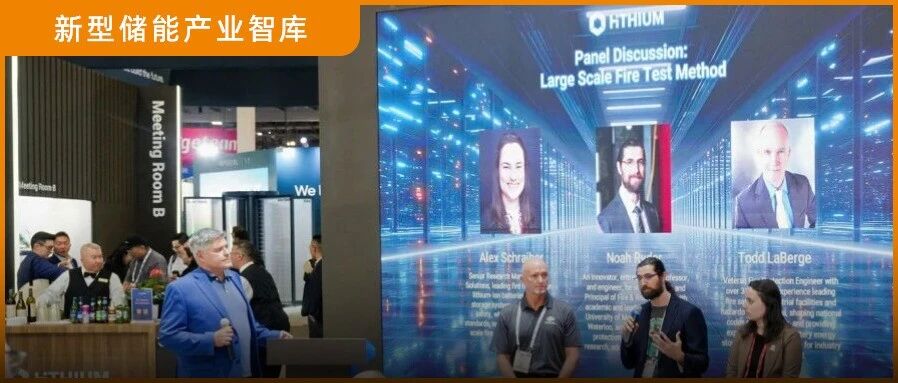
破局AIDC“能耗锁”,RE+展海辰储能亮出“金钥匙”
行家说储能· 2025-09-12 06:56
Core Viewpoint - The article highlights the innovative energy storage solutions presented by Haicheng Energy at the RE+ 2025 event, focusing on the integration of sodium-ion and lithium-ion batteries to address the energy challenges faced by AI data centers [2][3][5]. Group 1: Energy Storage Solutions - Haicheng Energy introduced the AI Data Center (AIDC) energy storage solution, which includes the ∞Power 6.25MWh 8h lithium battery system and the ∞Power N2.28MWh 1h sodium battery system, aimed at providing stable energy support and rapid response to power fluctuations [2][5]. - The AIDC storage system features a specialized lifespan assessment model that offers more accurate predictions of energy storage system degradation compared to general lifespan models, ensuring better performance guarantees for clients [5][12]. Group 2: Safety and Testing - During the RE+ 2025 event, Haicheng Energy showcased the global first open-door combustion test of the ∞Block 5MWh storage system, validating its safety capabilities under extreme conditions with the involvement of international certification bodies [8][11]. - The company plans to conduct similar rigorous testing in the U.S. to demonstrate its commitment to safety and transparency in energy storage technology [11]. Group 3: Market Expansion and Partnerships - Haicheng Energy signed a cooperation agreement with Microgrid Networks LLC to provide comprehensive solutions for 10 energy storage projects in New York, totaling 55MW/290MWh, marking a significant step in its North American market strategy [12][14]. - The company has established a localized manufacturing and service network in the U.S., enhancing its ability to meet diverse customer needs and ensuring long-term operational stability [15]. Group 4: Industry Position and Future Outlook - Haicheng Energy has achieved a top 2 position in global energy storage battery shipments and power storage shipments in the first half of 2025, setting a new benchmark for high-quality development in the energy storage industry [14][15]. - The launch of the AIDC energy storage solution signifies Haicheng Energy's strong capabilities in technological innovation and customized solutions, paving the way for new applications in energy storage and supporting the transition to a greener and more efficient future [15].