铁矿石供需博弈

Search documents
1.7亿吨库存压顶,铁矿石市场为何现“过山车”行情?
Xin Lang Cai Jing· 2026-02-10 10:40
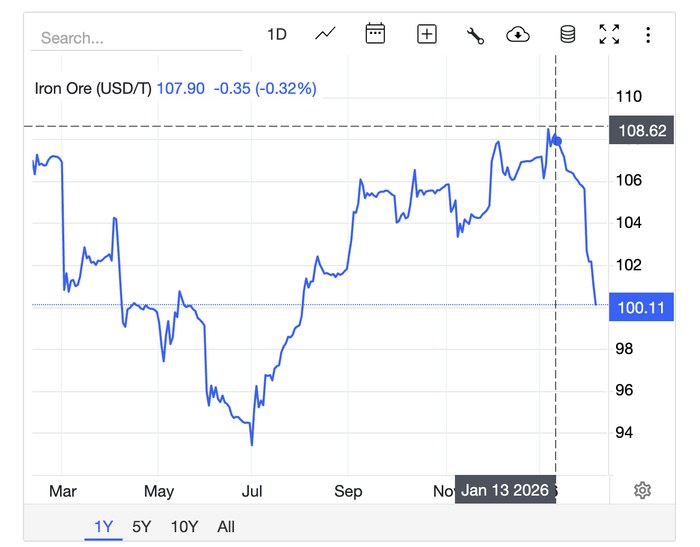
Core Viewpoint - The iron ore market has experienced significant volatility in early 2023, with high inventory levels and fluctuating prices, indicating a complex supply-demand dynamic [1][2][4]. Group 1: Market Dynamics - As of early January, iron ore inventory at 47 ports reached approximately 170 million tons, a two-year high, with a month-on-month increase of 0.8% [1]. - Daily average port throughput was 3.5758 million tons, reflecting a nearly 3% month-on-month increase [1]. - Despite high inventory, iron ore prices surged to $109 per ton in mid-January, marking a 15-month high [1]. - However, prices fell by 7.72% over the past month and were down 5.89% year-on-year [2]. Group 2: Price Fluctuations - On February 6, iron ore prices fell below $100 per ton for the first time since August 2025, with Singapore Exchange futures dropping to $99.35 per ton [4]. - The price increase in January was driven by seasonal inventory replenishment expectations, but this was countered by weak actual demand [5][8]. Group 3: Supply and Demand Factors - The iron ore market is characterized by a supply-demand tug-of-war, with high port inventories and cautious demand from steel mills [8][10]. - The West Simandou iron ore project has made significant progress, with its first shipment of nearly 200,000 tons arriving at Chinese ports, indicating a full supply chain integration [7]. - Analysts predict that the long-term trend will see a downward shift in iron ore prices due to persistent high inventory levels and weak demand [12][18]. Group 4: Future Price Predictions - Goldman Sachs has revised its 2026 iron ore price forecast down to $88 per ton, reflecting a 15% decline from current levels [15]. - Other forecasts suggest that iron ore prices will stabilize between $85 and $110 per ton in 2026, with a central tendency around $90-95 per ton [18].