
长征

Search documents
【红色故事】栈道险行军
Xin Lang Cai Jing· 2026-02-12 01:01
Core Points - The article describes the perilous journey of the Red Army's First Front Army as they navigate a treacherous path to reach Mo Yasi, highlighting the challenges faced due to damaged infrastructure and hostile forces [1][2] - The successful crossing of the dangerous plank road boosts the morale of the soldiers, instilling confidence for the journey ahead [2] Group 1 - The Red Army faced significant obstacles on their march, including a damaged plank road, treacherous cliffs, and hostile militia attacks [1] - Soldiers had to repair the damaged road using materials from the forest, demonstrating resourcefulness and teamwork [1] - The journey was marked by a notable incident where a leader fell into the river but managed to swim to safety, showcasing individual resilience [2] Group 2 - After a day of arduous travel, the troops managed to cover less than fifty miles, indicating the slow progress due to the challenging conditions [2] - The next day, the army continued their advance but encountered an ambush from local militias, resulting in casualties [2] - Following a brief rest, the Red Army successfully captured the last major obstacle, Lazi Pass, which opened a route for their northward advance [2]
【红色印记】从俄界决策到突破天险腊子口——党中央率红一方面军入境甘肃
Xin Lang Cai Jing· 2026-02-12 01:01
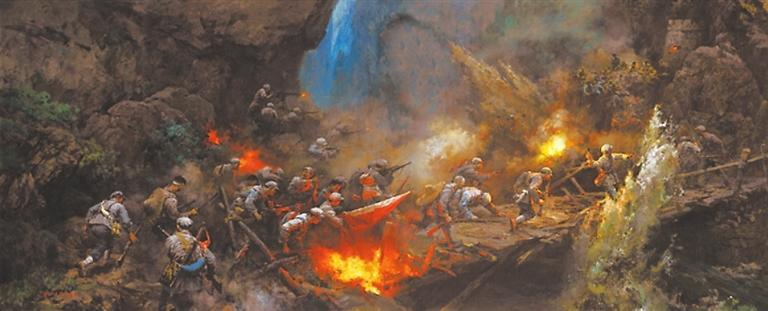
Core Viewpoint - The article discusses the historical significance of the Red Army's strategic decisions during the Long March, particularly the leadership of Mao Zedong and the successful navigation through challenging terrains and political divisions, culminating in the victory at the Battle of Lazikou, which opened a crucial route for the Red Army's northward advance against Japanese aggression [3][4][12]. Group 1: Historical Context - In October 1934, the Central Red Army faced significant losses during the Fifth Anti-Encirclement Campaign, leading to a retreat from the Central Soviet Area and the beginning of the Long March [3]. - The Red Army's numbers dwindled from over 86,000 to around 30,000 after the Xiangjiang Campaign, highlighting the dire situation faced by the troops [3]. - The Zunyi Conference in January 1935 established Mao Zedong's leadership within the Party and the Red Army, marking a turning point in their strategic direction [3]. Group 2: Strategic Decisions - On September 10, 1935, the Central Committee decided to advance northward into southern Gansu, emphasizing the importance of establishing a revolutionary base near Soviet territories [4]. - The meeting at the village of Ejie (now Gaoji Village) included key leaders who supported the decision to prioritize the northern advance over retreating to the Sichuan-Kang border [4]. - The resolution criticized Zhang Guotao's opposition to the northern strategy, reinforcing the Party's unity and leadership over the Red Army [4]. Group 3: Ethnic Policies and Local Support - The Red Army implemented policies to win the support of local Tibetan populations, countering the fear and distrust fostered by the Nationalist government [7][10]. - The Army's actions included respectful treatment of local resources and individuals, which helped to change the perception of the Red Army among the Tibetan communities [8][9]. - The successful engagement with local leaders, such as the 19th generation Tusi Yang Jiqing, demonstrated the effectiveness of the Red Army's ethnic policies in gaining local support [10]. Group 4: The Battle of Lazikou - The Red Army faced a formidable challenge at Lazikou, where Nationalist forces were entrenched, aiming to prevent the Red Army's northward movement [12]. - The battle commenced on September 16, 1935, with initial assaults failing due to heavy enemy fire, necessitating a change in tactics [12][13]. - The successful capture of Lazikou on September 17 marked a pivotal victory, allowing the Red Army to break through enemy lines and continue their advance, significantly altering the strategic landscape of the Long March [14].

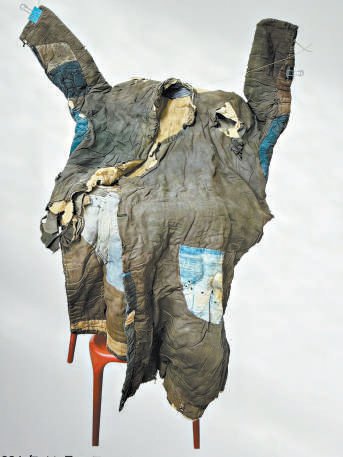
女红军盖过的“襖袍”藏着这些秘密
Xin Lang Cai Jing· 2026-01-10 21:36
Core Viewpoint - The article narrates the poignant story of a revolutionary artifact, a patched "襖袍," which symbolizes the sacrifices made during the Long March and the enduring spirit of the Communist Party in caring for the people [5][8]. Group 1: Historical Context - The "襖袍" belonged to Xu Jiexiu, who shared her experience of hosting three female Red Army soldiers during the Long March in 1934, highlighting the dire conditions and the spirit of mutual support among the revolutionaries [5][6]. - On November 7, 1934, the three Red Army women stayed at Xu's home, where they shared a meager blanket, illustrating the hardships faced during the revolution [6][7]. Group 2: Personal Accounts - Xu Jiexiu expressed her reluctance to accept half of the blanket left by the soldiers, emphasizing their commitment to the people and the promise of future support from the Communist Party [6][8]. - The article includes the emotional recollections of villagers, particularly the regret of not being able to reunite Xu with the soldiers before her passing, underscoring the personal connections formed during the revolutionary period [7][9]. Group 3: Legacy and Remembrance - The search for the three Red Army women became a lifelong commitment for journalist Luo Kaifu, symbolizing the importance of remembering and honoring the sacrifices made during the revolution [7][9]. - The "襖袍" is set to be displayed in a museum, serving as a tangible reminder of the past struggles and the warmth of the Communist spirit that continues to inspire future generations [9].
手掌上的长征
Ren Min Ri Bao· 2025-11-02 22:21
Group 1 - The article reflects on the personal memories of a grandfather sharing stories of the Long March, emphasizing the emotional connection and historical significance of these narratives [1] - It highlights the vivid imagery of the past, illustrating the struggles faced during the Long March with phrases like "the Red Army is not afraid of the difficult expedition" [1] - The text conveys a sense of nostalgia and reverence for the sacrifices made during this historical event, symbolized by the distance of "twenty-five thousand miles" from palm to fingertip [1]
铭记历史 缅怀先烈|抗日英烈郭征:青春热血铸丰碑
Xin Hua She· 2025-08-19 12:36
Core Viewpoint - The article highlights the heroic deeds of Guo Zheng, emphasizing his loyalty to ideals, commitment to the nation and people, and his courageous spirit in the face of death, inspiring others to translate his revolutionary spirit into practical actions in their roles [1] Group 1: Background and Early Life - Guo Zheng, originally named Guo Huimian, was born in 1914 in a poor farming family in Taihe County, Jiangxi Province [1] - His father, Guo Shangqiu, served as the secretary of the Communist Party branch, influencing Guo Zheng to join revolutionary activities from a young age [1] - At 16, Guo Zheng attended the Red Army Cadre School in southwestern Jiangxi and joined the Communist Party in 1931 [1] Group 2: Military Career and Achievements - Guo Zheng participated in the Long March with the Central Red Army in 1934 and later served as the head of the reconnaissance and communication department of the Ninth Corps [1] - In 1939, he was appointed as the chief of reconnaissance for the 120th Division of the Eighth Route Army and fought on the front lines in Shanxi [1] - During the Battle of Qihui Village, Guo Zheng played a crucial role in repelling multiple attacks from the Japanese army, leading to the destruction of over 700 enemy troops [2] Group 3: Final Battle and Legacy - Guo Zheng was fatally wounded during a fierce battle in Chen Zhuang, where he helped eliminate over 1,200 enemy soldiers, sacrificing his life at the age of 25 [3] - His remains were later returned to his hometown in Jiangxi Province, where he was buried under a pine tree, symbolizing his enduring legacy [3] - The local community in Dagang Village has initiated infrastructure projects, embodying Guo Zheng's spirit of perseverance and unity, paving the way for prosperity [3]