防扩散国际义务

Search documents
商务部:中方制止日本“再军事化”和拥核企图 完全正当合理合法
21世纪经济报道· 2026-01-22 08:21
Core Viewpoint - China emphasizes its commitment to international non-proliferation obligations and has implemented export controls on dual-use items to Japan, aiming to prevent militarization and nuclear ambitions [1] Group 1 - The Ministry of Commerce held a press conference to discuss key recent activities in the business sector [1] - China prohibits exports to Japanese military users and any entities involved in enhancing Japan's military capabilities, asserting that these measures are legitimate and lawful [1] - The Chinese government is dedicated to maintaining the stability and security of global supply chains, ensuring that export control applications are processed in compliance with laws and regulations [1]


商务部:中方制止日本“再军事化”和拥核企图 完全正当合理合法
Yang Shi Xin Wen· 2026-01-22 07:41
Core Viewpoint - The Chinese government emphasizes its commitment to international non-proliferation obligations and justifies its export controls to Japan as a measure to prevent militarization and nuclear ambitions [1] Group 1: Export Control Measures - China prohibits the export of dual-use items to Japanese military users and any entities involved in enhancing Japan's military capabilities [1] - The measures are described as legitimate, reasonable, and lawful, aimed at stopping Japan's "re-militarization" and nuclear ambitions [1] Group 2: Commitment to Global Supply Chain Stability - China asserts its dedication to maintaining the stability and security of global supply chains [1] - Export control applications and reviews are conducted in accordance with laws and regulations, ensuring compliance [1] - The spokesperson reiterated that export applications meeting civil use conditions will be approved [1]
日方提出交涉 中国大使:驳回,“将按既定步骤推进”!高市早苗遭在野党批评:“将日本引向战争国家”
Mei Ri Jing Ji Xin Wen· 2026-01-08 16:46
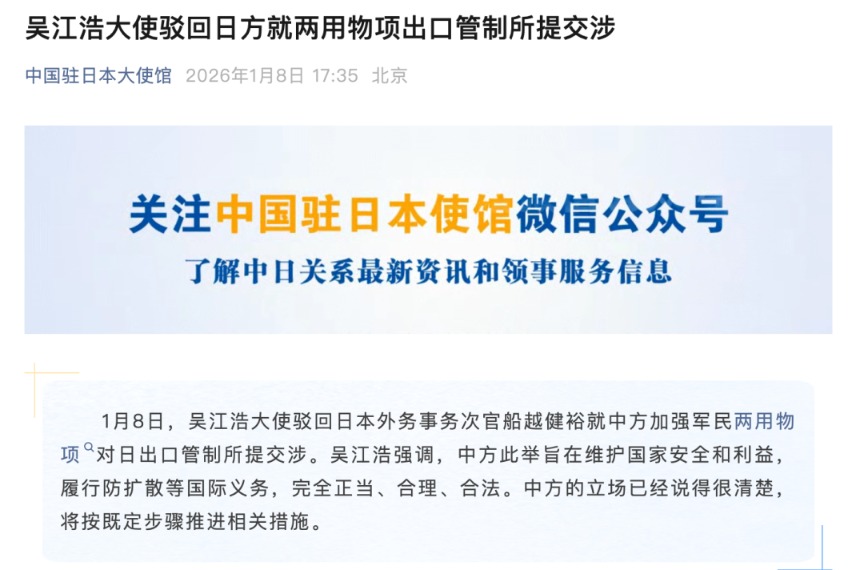
Core Viewpoint - China has strengthened export controls on dual-use items to Japan, emphasizing that this action is legitimate and aimed at safeguarding national security and fulfilling international non-proliferation obligations [1][4][6]. Group 1: Export Control Measures - The Ministry of Commerce announced on January 6 that all dual-use items are prohibited from being exported to Japanese military users and for military purposes, as well as any other end-users that could enhance Japan's military capabilities [4][6]. - Violations of these regulations will lead to legal accountability for organizations and individuals transferring or providing dual-use items from China to Japan [4]. Group 2: Political Context and Reactions - Chinese officials criticized Japanese Prime Minister Fumio Kishida's recent statements regarding Taiwan, claiming they infringe on China's sovereignty and threaten regional stability [4][6]. - Japanese opposition parties have expressed concerns over Kishida's administration, labeling it as the "most dangerous Liberal Democratic Party government" since World War II, and have called for the retraction of his controversial statements [6][7]. Group 3: Japan's Defense Policy Changes - Japan is accelerating discussions to revise its "Security Three Documents," with plans to establish an expert meeting by spring to discuss defense capabilities, budget scales, and funding sources [7]. - Key proposed changes include increasing defense spending, modifying the "Three Non-Nuclear Principles," and lifting restrictions on arms exports to develop offensive military capabilities [7][9].
商务部:加强两用物项对日本出口管制
券商中国· 2026-01-06 08:42
Core Viewpoint - The Chinese Ministry of Commerce has announced strengthened export controls on dual-use items to Japan, citing national security and international obligations as the primary reasons for this decision [1][2]. Group 1: Export Control Announcement - All dual-use items are prohibited from being exported to Japanese military users, military purposes, and any other end-users that may enhance Japan's military capabilities [1][2]. - Organizations and individuals from any country or region that violate these regulations by transferring or providing dual-use items originating from China to Japanese entities will face legal consequences [1][2]. Group 2: Rationale Behind the Decision - The decision is a response to recent provocative statements made by Japanese leaders regarding Taiwan, which are seen as a serious interference in China's internal affairs and a violation of the one-China principle [2].