两用物项出口管制

Search documents
列单四十家日本实体,更严格管控两用物项,中方出手制止日本“再军事化”
Huan Qiu Shi Bao· 2026-02-24 23:05
Core Viewpoint - The Chinese government has implemented export control measures against 20 Japanese entities involved in enhancing Japan's military capabilities, following Japan's Prime Minister's controversial remarks regarding Taiwan. This action has led to significant stock price fluctuations among affected Japanese companies, particularly in the defense and heavy machinery sectors [1][3]. Group 1: Export Control Measures - The Ministry of Commerce has listed Mitsubishi Heavy Industries and other entities involved in military enhancement on a control list, prohibiting exports of dual-use items to these companies [2]. - Subaru Corporation and other entities unable to verify the end-users of dual-use items have been placed on a watch list, requiring stricter risk assessments for exports [2]. - The measures aim to halt Japan's militarization and nuclear ambitions, asserting that they are lawful and reasonable [2][3]. Group 2: Market Impact - Following the announcement, stocks in Tokyo's defense and heavy machinery sectors experienced declines, with Mitsubishi Heavy Industries dropping by 3.1%, IHI Corporation by 5.73%, and Kawasaki Heavy Industries by 4.02% [3]. - The affected companies are currently assessing the implications of these export restrictions and their potential impact on business operations [3]. Group 3: Political Context - The measures are seen as a response to Japan's increasing military spending and efforts to revise its defense strategy, which includes developing offensive capabilities [4][5]. - Analysts suggest that the Chinese government's actions serve as a counterbalance to Japan's military expansion and are part of a broader strategy to maintain regional stability [5][6]. Group 4: Dual-Use Items and Economic Dependency - China has a list of approximately 1,100 dual-use items requiring export permits, which includes critical materials like rare earth elements essential for various industries [6]. - Japan's reliance on China for about 70% of its rare earth imports raises concerns about the long-term implications of these export controls on Japanese industries [6]. Group 5: Academic Perspectives - Japanese scholars indicate that the measures specifically target military and defense-related entities, reflecting a restrained approach by China [7]. - The actions are interpreted not merely as pressure tactics but also as a call for the Japanese business community to contribute to improving Sino-Japanese relations [7].
我国将20家日本实体列入关注名单,涉多家石化企业
Zhong Guo Hua Gong Bao· 2026-02-24 08:54
Core Viewpoint - The Ministry of Commerce of China has announced the inclusion of 20 Japanese entities in a watchlist due to the inability to verify the end users and end uses of dual-use items, aiming to curb Japan's militarization efforts and nuclear ambitions [1][2] Group 1: Watchlist Entities - The watchlist includes companies such as Subaru Corporation, Yusoki Co., Ltd., and ENEOS Corporation, among others [3][6][7] - Exporters are prohibited from applying for general licenses or obtaining export certificates for dual-use items to these entities, and must submit risk assessment reports for individual license applications [1][2] Group 2: Regulatory Measures - The Ministry of Commerce will implement stricter end-user and end-use reviews for exports to the listed entities, particularly concerning military users and purposes that could enhance Japan's military capabilities [1][2] - Entities on the watchlist can apply for removal if they comply with verification obligations as per the relevant export control regulations [1]
商务部将20家日本实体列入关注名单
Shang Wu Bu Wang Zhan· 2026-02-24 02:16
Core Points - The Ministry of Commerce of China has announced the inclusion of 20 Japanese entities on a watch list due to the inability to verify the end users and end uses of dual-use items [1][2] - Exporters are prohibited from applying for general licenses or obtaining export certificates through registration for these entities, and must submit risk assessment reports for individual license applications [1] - The watch list entities will face stricter scrutiny regarding the end users and end uses of dual-use items, particularly concerning military users and purposes that could enhance Japan's military capabilities [1] Summary of Entities - The watch list includes notable companies such as Subaru Corporation, Fuji Aerospace Technology Co., Ltd., and Mitsubishi Materials Corporation among others [4][5] - A total of 20 entities have been listed, which also includes academic institutions like the Institute of Science Tokyo [4][5] - Entities can apply for removal from the watch list if they comply with verification obligations as per the regulations [1]
商务部新闻发言人就对日相关出口管制措施答记者问
Shang Wu Bu Wang Zhan· 2026-02-24 02:09
Group 1 - The Chinese Ministry of Commerce has released a control list and a watch list targeting Japanese entities involved in enhancing Japan's military capabilities [1][2] - 20 entities, including Mitsubishi Heavy Industries, have been placed on the control list, prohibiting exports of dual-use items to these entities and restricting foreign organizations from transferring or providing such items to them [1] - Another 20 entities, including Subaru Corporation, have been placed on the watch list, requiring stricter risk assessments and written commitments regarding the end-use of dual-use items [2] Group 2 - The measures aim to halt Japan's "remilitarization" and nuclear ambitions, asserting that the actions are legitimate and lawful [3] - The restrictions apply only to specific Japanese entities and dual-use items, ensuring that normal trade relations between China and Japan remain unaffected for compliant entities [3]
商务部公告2026年第12号 公布将20家日本实体列入关注名单
Shang Wu Bu Wang Zhan· 2026-02-24 02:05
Core Points - The Ministry of Commerce of China has added 20 Japanese entities, including Subaru Corporation, to a watch list due to the inability to verify the end users and end uses of dual-use items [1][2] - Exporters are prohibited from applying for general licenses or obtaining export certificates through registration for these entities, and must submit risk assessment reports when applying for individual licenses [1] - The Ministry will implement stricter reviews for the export of dual-use items to entities on the watch list, particularly concerning military users and purposes that could enhance Japan's military capabilities [1] Summary by Category Export Control Regulations - The decision is based on the Export Control Law of the People's Republic of China and related regulations [1] - Exporters must provide written commitments that dual-use items will not be used to enhance Japan's military capabilities [1] - The review period for license applications is not subject to the usual time limits specified in the regulations [1] Watch List Entities - The following entities have been added to the watch list: 1. Subaru Corporation 2. Fuji Aerospace Technology Co., Ltd. 3. ENEOS Corporation 4. Yusoki Co., Ltd. 5. ITOCHU Aviation Co., Ltd. 6. Leda Group Holdings Co., Ltd. 7. Institute of Science Tokyo 8. Mitsubishi Materials Corporation 9. ASPP Co., Ltd. 10. Yashima Denki Co., Ltd. 11. Sumitomo Heavy Industries, Ltd. 12. TDK Corporation 13. Mitsui Bussan Aerospace Co., Ltd. 14. Hino Motors, Ltd. 15. Tokin Corporation 16. Nissin Electric Co., Ltd. 17. Sun Tectro Co., Ltd. 18. Nitto Denko Corporation 19. NOF Corporation 20. Nacalai Tesque, Inc. [1][2] Compliance and Removal from Watch List - Entities on the watch list can apply for removal if they comply with verification obligations as per the regulations [1]
日企从中国进口稀土需提供经销商信息?中方回应
财联社· 2026-01-22 08:00
Core Viewpoint - The Chinese Ministry of Commerce emphasizes its commitment to international non-proliferation obligations and has implemented export controls on dual-use items to Japan, particularly concerning military applications and users [1] Group 1: Export Controls - China requires additional documentation from Japanese companies importing rare earths to disclose the intended use and information about distributors [1] - The Ministry of Commerce has stated that export applications meeting civil use conditions will be approved, ensuring compliance with legal regulations [1] Group 2: National Security - The measures aim to prevent Japan's militarization and nuclear ambitions, which are deemed legitimate and lawful by the Chinese government [1] - China maintains that it is committed to the stability and security of global supply chains while adhering to legal compliance in export control processes [1]


国际锐评丨中方对日两用物项出口管制正当合理
Xin Lang Cai Jing· 2026-01-15 15:17
Core Viewpoint - China has implemented stricter export controls on dual-use items to Japan in response to Japan's military expansion and nuclear ambitions, asserting that this measure is both justified and necessary [1][4][7]. Group 1: Definition and Justification of Export Controls - Dual-use items refer to goods, technologies, and services that have both civilian and military applications, particularly those that can be used in the design, development, or production of weapons of mass destruction [3]. - The rationale behind the enhanced export controls is Japan's recent military provocations and attempts to revise its security policies, which pose a threat to regional peace and stability [4][6]. Group 2: Japan's Military Expansion - Japan's defense budget is projected to exceed 9 trillion yen (approximately 60 billion USD) in the fiscal year 2026, marking a historical high and reflecting a continuous increase over 14 years [4]. - Japan's strategic direction includes plans to amend its security policies to develop a so-called "counterattack capability," significantly increasing defense spending and relaxing arms export restrictions [6]. Group 3: Nuclear Concerns - Japan currently possesses 47 tons of separated plutonium, sufficient to produce around 6,000 nuclear warheads, raising international concerns about its nuclear ambitions [6]. - High-ranking officials in Japan have publicly advocated for the country to possess nuclear weapons, further complicating the regional security landscape [6][8]. Group 4: International Response - The international community is urged to take concrete actions to restrain Japan's military expansion, including enhancing oversight of Japan's nuclear materials to ensure compliance with non-proliferation obligations [8]. - A unified international stance is deemed essential to prevent the resurgence of Japanese militarism and to maintain global peace and security [8].
高市早苗要求中方撤回有关措施,商务部驳斥
2 1 Shi Ji Jing Ji Bao Dao· 2026-01-15 12:03
Group 1 - The Chinese Ministry of Commerce responded to Japanese Prime Minister Kishi Nobuo's remarks regarding China's export control measures, stating that these measures are a response to Japan's actions and statements that infringe on China's sovereignty and territorial integrity [2] - The spokesperson highlighted three main points: first, Kishi's comments on Taiwan violate international law and challenge the post-war international order; second, Japan's push for military expansion contradicts its constitutional principles and poses a threat to regional and global peace; third, Japan's attempts to modify its nuclear principles and public support for nuclear armament challenge the international non-proliferation regime [2][3] - The Ministry emphasized that export controls are a common international practice aimed at maintaining world peace and fulfilling non-proliferation obligations, asserting that China's actions are legitimate and necessary to prevent Japan's militarization and nuclear ambitions [3] Group 2 - The Ministry urged Japan to reflect on its actions and correct its mistakes, warning against further escalation down a misguided path [3]
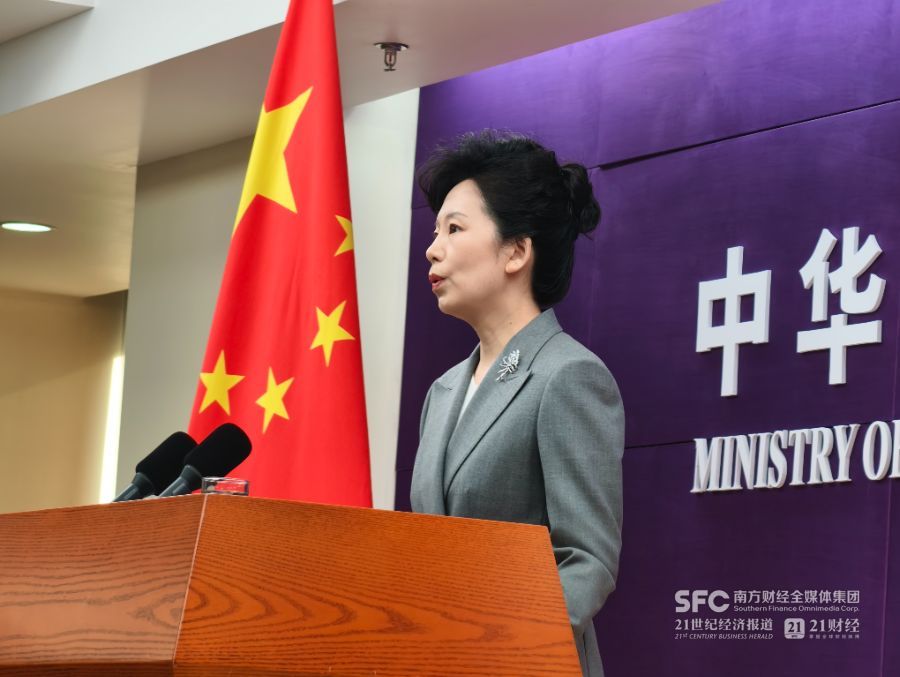
日本要求中方撤回两用物项出口管制措施,商务部:不予接受
Nan Fang Du Shi Bao· 2026-01-15 11:22
Group 1 - The core viewpoint of the article is that China's export control measures on dual-use items are a legitimate response to Japan's actions and statements, particularly those made by Prime Minister Kishi Sanae, which are seen as infringing on China's sovereignty and security [1][2] - China's export control measures are aimed at preventing military use and enhancing Japan's military capabilities, which are viewed as a threat to regional and global peace [2] - The Chinese government emphasizes that its export controls are in line with international practices and are intended to fulfill non-proliferation obligations, asserting that the measures are reasonable and lawful [2] Group 2 - Reports indicate that China has suspended export license reviews for rare earths to Japan, and state-owned enterprises have informed some Japanese companies that new contracts for rare earths will not be signed [2] - The Chinese government maintains that its export controls will not affect civilian uses and aims to ensure the stability and security of global supply chains [2]
高市要求撤回“对日两用物项出口管制”,中方:坚决反对,不予接受!
证券时报· 2026-01-15 09:41
Group 1 - The core viewpoint of the article emphasizes China's firm stance against Japan's claims regarding export control measures, asserting that these measures are legitimate and aimed at preventing Japan's militarization and nuclear ambitions [1] - The Chinese Ministry of Commerce expresses willingness to engage in free trade agreements with Canada, highlighting the mutual benefits and potential for cooperation in the economic sector [1] - The Ministry of Commerce also indicates a commitment to maintaining dialogue with the European Union regarding the electric vehicle case, aiming to deepen cooperation in supply chains and support global green transformation [2] Group 2 - The Ministry of Commerce outlines that despite complex external changes, China's foreign trade development still possesses numerous favorable conditions, emphasizing the country's economic resilience and potential [4] - The Ministry plans to implement the decisions of the Central Committee and the State Council, focusing on innovation, quality improvement, and integration of trade and investment to stabilize the foreign trade landscape [4]