陪伴型AI

Search documents
深度共情?陪伴型AI要厘清“人机边界”
Nan Fang Du Shi Bao· 2025-12-29 23:14
Core Viewpoint - The release of the "Interim Measures for the Management of Human-like Interactive Services of Artificial Intelligence (Draft for Comments)" marks a new phase in the governance of AI human-like interactive services in China, focusing on systematic and precise regulation to balance innovation and risk prevention [7][8]. Regulation and Management - The draft defines AI human-like interactive services as those that simulate human personality traits and communication styles, emphasizing the need for significant user notifications that they are interacting with AI rather than a human [3]. - It establishes eight prohibited activities, including generating content that harms national security or spreads misinformation, and mandates service providers to implement safety responsibilities throughout the service lifecycle [4]. User Protection and Data Security - The draft emphasizes the protection of vulnerable groups, particularly minors and the elderly, by requiring features like a minor mode, consent from guardians, and emergency contact settings [5]. - It mandates that training data must align with socialist core values, ensuring data legality and traceability, and requires user consent for the use of interaction data in model training [5]. Safety Assessment and Reporting Obligations - Service providers are required to conduct safety assessments and report findings when user numbers reach certain thresholds or when significant changes occur, promoting a self-regulatory mechanism [6]. - A tiered regulatory approach is proposed for addressing violations, including warnings and service suspensions [6]. Expert Opinions - Experts highlight that the draft aims to create a dual governance model that emphasizes both positive guidance and risk prevention, particularly focusing on the emotional interaction risks associated with AI [7]. - The core philosophy of "responsible innovation" is emphasized, with a focus on clarifying the boundaries between humans and machines [7].


陪伴型AI:功能性比同理心更重要
Xin Lang Cai Jing· 2025-12-23 19:08
Group 1 - The core viewpoint of the articles highlights the growing trend of young consumers using AI companions to address emotional needs, with a significant percentage preferring AI over traditional confidants like parents [1] - A report indicates that 37.9% of young people are willing to share their troubles with AI virtual beings, and over 13.5% prefer AI as a confidant [1] - The demand for AI companionship is seen as a potential growth area in the emotional economy, driven by the characteristics of AI being non-judgmental and always available for conversation [1] Group 2 - Recent legislative actions in multiple countries, including the EU and the US, are focusing on age restrictions and mental health concerns related to AI companions, with the EU proposing a minimum age of 16 for usage [2] - In the US, lawsuits have been filed against major tech companies for allegedly downplaying the mental health risks associated with their social media products, highlighting the responsibility of these companies [2] Group 3 - Despite ethical challenges faced by advanced AI companions, lower-tier AI toy products are experiencing significant growth, with sales on platforms like JD.com increasing sixfold in the first half of 2025 [3] - The introduction of AI toys with voice interaction capabilities is attracting major companies, such as Huawei, which launched its first companion robot priced at 399 yuan [3] Group 4 - The evolution from tools to companions in AI is attributed to natural technological advancements rather than breakthroughs in product design, indicating a lack of clarity in product positioning among many companies [4] - The disparity in the quality of AI toys is minimal, with many companies producing talking toys without significant differentiation, emphasizing the need for investment in advanced model technology for meaningful dialogue [4] Group 5 - The hardware for AI companionship devices has matured, but software development still has a long way to go, with current technology limiting the depth of communication between humans and machines [5] - The focus should shift from creating a sense of "life" in AI companions to enhancing practical service functions, as this approach is more likely to provide emotional value and lead to success in the industry [5]
AI伴侣翻车?美国对Meta、OpenAI等启动调查
3 6 Ke· 2025-09-12 03:14
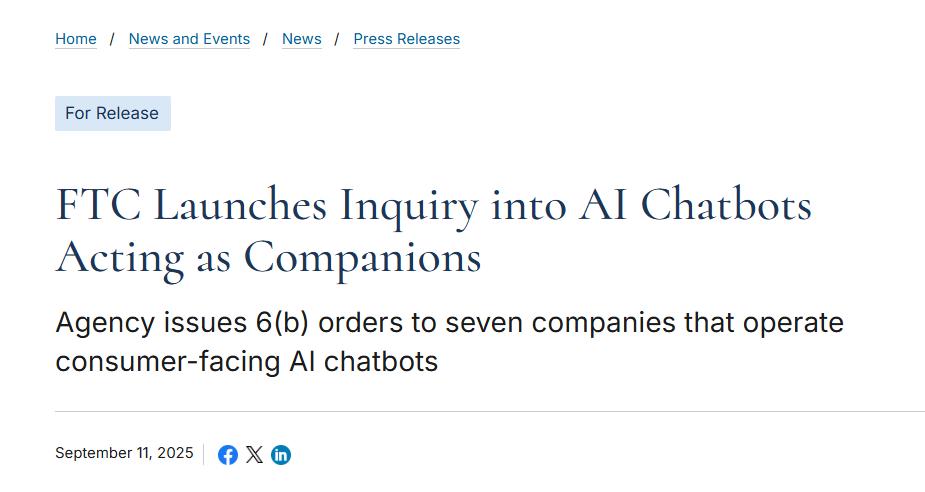
Core Viewpoint - The FTC is investigating the potential negative impacts of AI chatbots on children and adolescents, requiring information from seven major companies in the AI space [1][3]. Group 1: Companies Involved - The seven companies under investigation include Alphabet (Google's parent company), OpenAI, Meta, Instagram (a Meta subsidiary), Snap, xAI, and Character Technologies Inc. [1] - OpenAI has committed to cooperating with the FTC, emphasizing the importance of safety for young users [3]. Group 2: Regulatory Focus - The FTC aims to understand how these companies monetize user interactions, develop and approve chatbot personas, handle personal information, and ensure compliance with company rules [3]. - The investigation is part of a broader effort to protect children's online safety, which has been a priority since the Trump administration [3]. Group 3: Societal Context - The rise of AI chatbots coincides with a growing concern over loneliness in the U.S., where nearly half of the population reports feeling lonely daily [4]. - Research indicates that a lack of social connections increases the risk of early death by 26% and raises the likelihood of various health issues [4]. Group 4: Industry Trends - The development of "companion AI" is being driven by wealthy entrepreneurs, with xAI's "AI companion" Ani being a notable example, achieving over 20 million monthly active users and 4 million paid users [5]. - The emotional interaction capabilities of these AI systems have shown significant user engagement, with an average daily interaction time of 2.5 hours [5]. Group 5: Ethical Considerations - The complexity of defining emotional interaction boundaries is highlighted by recent policy adjustments from Meta under regulatory pressure [6]. - OpenAI has introduced a policy allowing parents to receive alerts if their child experiences "severe distress" while using their systems [7].