青少年心理健康教育

Search documents
基于家校社合作的青少年心理健康教育模式研究
Xin Lang Cai Jing· 2025-12-30 22:18
Core Viewpoint - The importance of youth mental health has gained attention from families, schools, and society, necessitating a collaborative approach to education that integrates family and community involvement in mental health education [1][5]. Group 1: Collaborative Framework - Establishing a collaborative framework with shared goals and effective communication is essential for the cooperation between families, schools, and communities [2]. - Regular communication mechanisms should be implemented, such as open psychological health education activities involving parents and students [2]. - Creating an online communication platform can facilitate interaction among families, schools, and community mental health professionals, providing timely support and resources [2]. Group 2: School's Role in Mental Health Education - Schools should take the lead in mental health education by developing integrated psychological curricula with input from parents and community professionals [3]. - The curriculum should address specific psychological challenges faced by students at different educational stages, such as adaptation issues for new students and career-related stress for graduating students [3]. - Incorporating mental health education into various subjects and practical activities can enhance students' psychological resilience [3]. Group 3: Practical Activities and Community Involvement - Community centers and schools should collaborate to host workshops and activities that empower parents and enhance communication with their children [4]. - Establishing a platform for family mental health practices can facilitate the exchange of resources and knowledge among families, schools, and mental health institutions [5]. - Creating diverse spaces for psychological relaxation and expression can help students manage stress and improve emotional well-being [5]. Group 4: Comprehensive Mental Health Ecosystem - A comprehensive approach to youth mental health education should integrate family, school, and community resources to create a supportive ecosystem [6]. - The collaboration aims to enrich perspectives on mental health education and promote the overall psychological well-being of youth [6].
社教中心中考融媒体行动:一场直抵心灵的青春对话
Yang Shi Wang· 2025-06-23 12:23
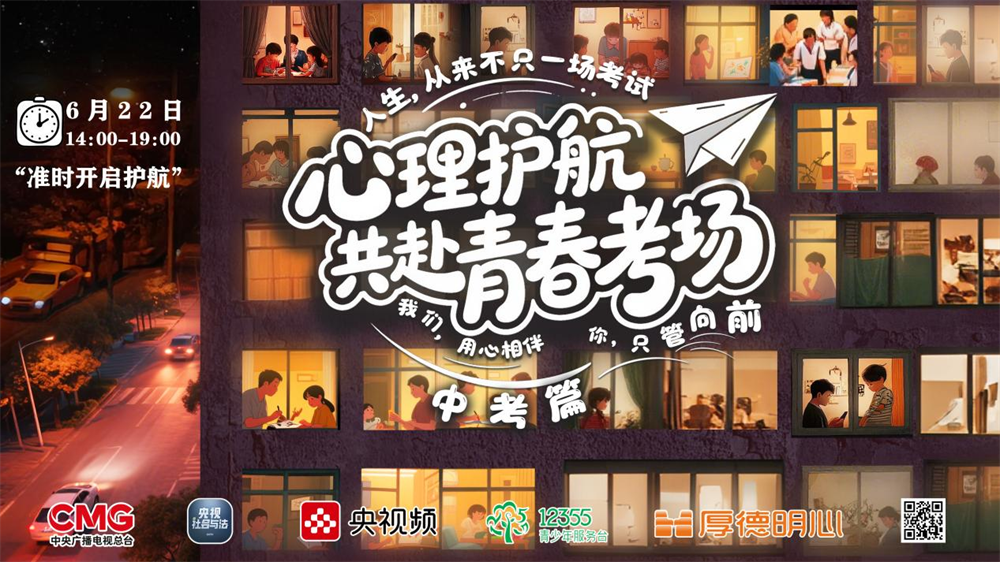
Core Viewpoint - The live broadcast "Psychological Support: Together Towards the Youth Examination" represents an innovative approach to education, focusing on psychological guidance and societal participation during the high-stakes middle school entrance examination season, with a total viewership of nearly 2.1 million across multiple platforms [1][4]. Content Dimension: From "Decompression" to "Empowerment" - The event shifted away from traditional didactic methods, emphasizing the intersection of adolescence and examination pressures through real-life dialogues such as "Parent-Child Debate" and "Parent Roundtable," transforming generational conflicts into opportunities for mutual understanding [7]. - Experts from psychology, neuroscience, and education provided insights into the physiological roots of adolescent emotional fluctuations and offered practical tools for parents, such as "non-violent communication" and "scientific exam support" [7]. - The content addressed both utilitarian demands and conveyed the value of education as a lifelong journey, transitioning from short-term stress relief to long-term growth guidance [7]. Innovative Format: Emotional Resonance through Multimedia - Utilizing platforms like CCTV, Douyin, and Weibo, the live broadcast transcended spatial limitations with a multi-faceted narrative approach, combining "thematic short films, expert courses, interviews, and local experience sharing" to make psychological knowledge engaging and practical [10]. - The integration of personal experiences from social media influencers helped bridge the gap between authoritative discourse and audience relatability, creating a complementary effect of "expert guidance and peer education" [10]. Social Value: Collaborative Governance of Youth Mental Health - The broadcast illustrated a paradigm shift in mental health education from "single-point breakthroughs" to "systematic collaboration," involving multiple stakeholders such as the Communist Youth League, local education bureaus, healthcare institutions, grassroots schools, and social organizations [15]. - Innovative explorations tailored to regional economic differences, such as sand table games in Zhejiang and music therapy in Sichuan, highlighted the adaptability of mental health services [15]. - The integration of contemporary social support systems, like the Youth Hotline and AI mental health stations, emphasized the warmth of humanistic values and the concept of "technology serving humanity," providing imaginative space for future youth mental health support frameworks [15]. Social Response - The live broadcast's viewership of nearly 2.1 million reflects a strong demand among families for scientific parenting concepts, with viewers expressing appreciation for the expert and teacher contributions [18]. - Grassroots mental health service organizations in Shandong, Sichuan, and Zhejiang expressed gratitude for the broadcast, recognizing its value in enhancing their daily work [18]. - The event concluded with the message "Life is more than just one exam," symbolizing its broader significance in fostering rational understanding amidst the tension between exam-oriented and quality education [18].

着力提升教育医疗治理效能丨少年心事谁来守护
He Nan Ri Bao· 2025-05-08 23:34
Core Viewpoint - The article emphasizes the importance of mental health education for adolescents, highlighting collaborative efforts between schools, families, and communities to support the emotional well-being of young people [2][8]. Group 1: Mental Health Education Initiatives - Schools in Zhengzhou are implementing various mental health education programs, such as role-playing and psychological drawing, to help students express their emotions [2]. - The "May Happiness Action" calendar introduced in Zhengzhou encourages students to engage in daily positive activities, promoting mental well-being [3]. - A project in Zhengzhou's Zhongyuan District has developed unique school-based mental health curricula, such as the "Growth Power" and "Dragonfly" courses, which have become popular among students [4]. Group 2: Collaborative Support Systems - The establishment of a "heart station" at schools allows teachers to engage students in emotional discussions, while parents are encouraged to participate in "parent-child listening moments" to foster communication [7]. - The province has set up the Henan Provincial Family Education Guidance Center to enhance the collaboration between school and family education [8]. - A total of 189 regional mental health education centers and 18,057 psychological mailboxes have been established to provide timely support for students [10]. Group 3: Monitoring and Prevention Mechanisms - Zhengzhou has initiated psychological assessments for students, creating individual psychological profiles to identify and address key issues [11]. - An early warning network has been established in Anyang, involving a tiered response mechanism to monitor and support student mental health [11]. - The article notes a shift in perspective among educators and families, focusing on emotional connections rather than solely academic performance [11].