静电

Search documents
别买那些防静电神器了,真正的克星只需要一面墙
虎嗅APP· 2025-12-16 13:38
Core Viewpoint - The article discusses the common issue of static electricity during winter, highlighting its causes and various methods to mitigate its effects on daily life. Group 1: Causes of Static Electricity - Static electricity is primarily caused by friction, where electrons are transferred between materials, leading to an accumulation of electric charge on the body [28][29]. - The dry air in winter prevents the dissipation of electric charges, making static shocks more frequent compared to humid summer conditions [31][32]. Group 2: Materials and Static Electricity - The type of clothing material significantly affects static electricity; polyester fibers tend to accumulate more static charge compared to cotton, which is more neutral [34][40]. - The triboelectric series ranks materials based on their tendency to gain or lose electrons, influencing the intensity of static electricity generated [35][38]. Group 3: Solutions to Combat Static Electricity - Wearing cotton clothing can reduce static electricity due to its moisture-absorbing properties and neutral charge [43][44]. - Using fabric softeners and anti-static sprays can provide temporary relief by creating a conductive layer on clothing [61][62]. - Maintaining indoor humidity levels between 40% to 60% can significantly reduce static charge accumulation [64][65]. Group 4: Physical Discharge Methods - Touching a wall or using a metal object like a key to discharge static electricity can be effective methods to prevent shocks [72][75]. - Industrial anti-static wristbands are reliable for grounding static electricity but are impractical for everyday use [79][84]. Group 5: Individual Variability - The effectiveness of anti-static measures can vary greatly among individuals due to differences in body chemistry, clothing habits, and environmental conditions [93][94]. - A multi-faceted approach combining various methods is recommended for optimal results in reducing static electricity [95].


戴防静电手环、在衣服上涂身体乳……这些爆火的防静电“妙招”靠谱吗
Ke Ji Ri Bao· 2025-12-04 02:57
Core Viewpoint - The article discusses the prevalence of static electricity during winter and evaluates various popular methods claimed to alleviate static electricity, highlighting their scientific validity and effectiveness. Group 1: Static Electricity and Its Causes - Static electricity is generated from the transfer of electric charges due to friction and contact between different materials, leading to charge accumulation on surfaces [1] - The increase in static electricity during winter has led to a rise in the popularity of various anti-static remedies shared on social media [1] Group 2: Effectiveness of Anti-Static Wristbands - Anti-static wristbands that lack grounding wires are ineffective as they cannot fully dissipate static electricity, only allowing temporary transfer of charges [2][3] - Proper anti-static wristbands include conductive contact points, current-limiting resistors, and grounding wires, which facilitate the safe discharge of accumulated static electricity [2] Group 3: Misconceptions About Common Remedies - The claim that a dry battery can neutralize static electricity is debunked, as the charges within a battery are bound and cannot be released without a circuit [4] - The perceived reduction of static when rubbing a battery on clothing is due to a brief discharge of static through the battery's metal casing, not the battery's internal charges [6] Group 4: Limitations of Moisturizers for Static Control - While applying body lotion to clothing can reduce static due to its moisture-retaining properties, it is not the optimal solution due to potential staining and short-lived effectiveness [7] - The effectiveness of body lotion is limited as it can leave residues on fabrics and diminish over time with wear [7] Group 5: Recommended Anti-Static Methods - To effectively reduce static electricity, it is advised to maintain indoor humidity levels between 40% and 60% using humidifiers [8] - Choosing clothing made from natural fibers like cotton and linen, and minimizing the use of synthetic materials can help reduce static generation [8] - Skin care practices, such as applying moisturizer after bathing, can lower skin resistance and facilitate the release of static charges [8]
这些爆火的防静电“妙招”靠谱吗
Ke Ji Ri Bao· 2025-12-03 23:20
Core Viewpoint - The article discusses the prevalence of static electricity during winter and evaluates various popular methods claimed to alleviate static issues, emphasizing the scientific validity of these methods. Group 1: Static Electricity and Its Causes - Static electricity is generated from the transfer of electric charges due to friction and contact between different materials, leading to charge accumulation on surfaces [1] Group 2: Effectiveness of Anti-Static Wristbands - Anti-static wristbands can effectively dissipate static electricity if they are grounded; those without grounding do not provide significant benefits [2][3] - Grounded anti-static wristbands consist of conductive contact points, current-limiting resistors, and grounding wires, allowing static charges to be safely transferred to the ground [2] Group 3: Misconceptions About Common Remedies - The claim that a dry battery can neutralize static electricity is scientifically invalid, as the charges within a battery are fixed and cannot be released without a circuit [4] - The perceived reduction of static when rubbing a battery on clothing is due to a brief discharge of static through the battery's metal casing, not from the battery itself [5][6] Group 4: Moisturizing Methods and Their Limitations - Using body lotion on clothing can reduce static due to its moisture-retaining properties, but it has limitations such as potential staining and short-lived effectiveness [7] - The method is not recommended as a primary anti-static solution due to its drawbacks [7] Group 5: Recommended Anti-Static Solutions - To effectively reduce static electricity, it is advised to maintain indoor humidity levels between 40% and 60%, choose natural fiber clothing, and ensure skin moisture through regular application of lotions [8]
冬季 静电会带来哪些安全隐患?如何远离静电困扰?一文了解↓
Yang Shi Wang· 2025-12-03 16:30
Core Insights - The article discusses the increased risk of static electricity during the winter season, particularly in dry regions of China, and highlights safety measures to mitigate related hazards. Group 1: Static Electricity Risk Areas - Most northern regions of China are identified as static electricity active areas due to dry weather and scarce precipitation [1] - Jiangnan and most parts of South China are classified as static electricity latent zones, while certain areas in northern Xinjiang, Sichuan Basin, and eastern Hainan are designated as static electricity insulated regions [1] Group 2: Safety Hazards of Static Electricity - Static electricity can cause safety incidents, especially in flammable environments like gas stations and chemical plants [3] - An incident in February at a gas station in Tianjin illustrates the danger, where static electricity ignited leaking gasoline, leading to a fire [3] Group 3: Mitigation Measures for Static Electricity - Static discharge devices are recommended in flammable environments to safely dissipate static electricity [6] - Increasing humidity levels in dry environments can help reduce static electricity accumulation, as low humidity (below 30%) allows static charges to persist [7] - Wearing cotton clothing is advised to minimize static electricity generation, as synthetic fibers can increase friction and static buildup [9] - A simple static discharge device can be created using a clip at the sleeve to help carry away static charges [10]
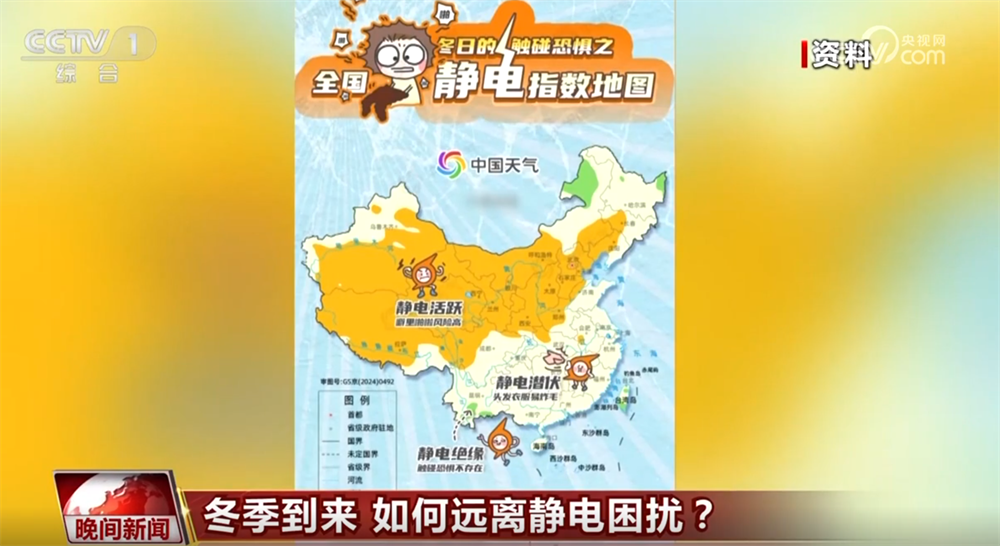
“噼里啪啦”“怒发冲冠”“电光火石”……全国静电指数地图来了↓
Yang Shi Wang· 2025-11-20 07:29
Group 1 - The core viewpoint of the article highlights the increased risk of static electricity across more than 15 provinces in China due to dry weather conditions, with a significant focus on the period from November 20 to 22 [2][5][7] - The static electricity index is notably high in various regions, including the Beijing-Tianjin-Hebei area, with relative humidity dropping below 30% in many places, leading to heightened static electricity activity [5][7] - The article explains that static electricity is generated through friction during human activities, and dry air conditions exacerbate this phenomenon, making it more prevalent in autumn and winter [10][8] Group 2 - Static electricity can reach voltages of several thousand volts, with noticeable sensations occurring at 2000 volts and sparks at 3000 volts, although the current is typically too low to cause harm to humans [11][13] - To mitigate static electricity risks, the article suggests two main strategies: preventing excessive static accumulation by increasing humidity and using non-static-prone materials, and timely discharge of accumulated static through methods like touching walls or using metal objects [14][19]