韩流文化出口

Search documents
四大“超级周期”与“制度改革”--韩国股市的涨幅才开始?
Hua Er Jie Jian Wen· 2025-10-14 08:28
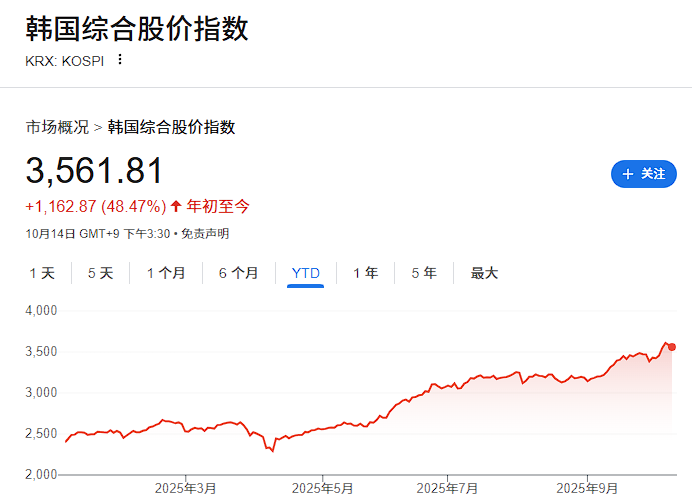
Core Viewpoint - The KOSPI index in South Korea has risen nearly 50% in 2025, with Morgan Stanley analysts suggesting this is just the beginning, driven by structural growth factors despite short-term trade tensions [1] Group 1: Market Performance - The KOSPI index has increased nearly 50% year-to-date, outperforming other Asian markets, with the MSCI Korea index up 65% compared to the 27% rise in the Asia-Pacific index [1] - Morgan Stanley has raised its KOSPI target from 3250 to 3800 points, with a bullish scenario suggesting it could reach 4200 points [4] Group 2: Sector Analysis - The technology sector is expected to benefit significantly from the AI expansion, with analysts noting that the storage chip industry is entering a new upcycle driven by AI, with supply constraints supporting price increases [5] - Major companies like Samsung Electronics and SK Hynix are projected to be the primary beneficiaries, with potential stock price increases contributing to a 5.3% rise in the KOSPI index [6] Group 3: Super Cycles Driving Growth - Morgan Stanley identifies four super cycles driving structural growth in the Korean economy: AI technology diffusion, defense industry, power infrastructure, and the Korean Wave culture [7] - The defense sector is experiencing increased demand due to geopolitical risks and modernization needs, with European countries committing to higher defense spending [7] - The power infrastructure sector is expanding globally, with Korean manufacturers gaining orders in major projects due to competitive costs and advanced technology [7] - The Korean Wave culture, particularly in beauty products and instant noodles, is seeing significant growth, with beauty exports to Europe up 59% year-on-year [7] Group 4: Government Reforms - The execution of government reform agendas is becoming a focal point for the market, with expected reforms related to stock buyback rules and key tax reforms [8] - Proposed changes to the dividend tax rate are expected to be set below 30%, and stock buyback rule reforms are anticipated, though the timing remains uncertain [10]