国防工业

Search documents
普京:“海燕”和“波塞冬”两款武器装备可保数十年战略平衡
Xin Hua She· 2025-11-05 00:20
Core Points - Russian President Putin awarded developers of the "Zircon" nuclear-powered cruise missile and "Poseidon" unmanned underwater vehicle, stating these weapons will ensure security and strategic balance for decades to come [1] - The "Zircon" missile has successfully completed tests, boasting a range that exceeds all known missile systems and high accuracy, with a unique compact nuclear reactor that can start in seconds [1] - Russia has initiated the development of a new generation of nuclear-powered cruise missiles, potentially achieving speeds exceeding three times the speed of sound [1] - The "Poseidon" underwater vehicle utilizes advanced materials for underwater environments, allowing for high-speed travel and depths of up to 1,000 meters, and is faster than all modern surface vessels [1] - The "Poseidon" is equipped with a nuclear power system and can launch torpedoes with nuclear warheads [1] - The development of "Poseidon" and "Zircon" is interrelated, with technological innovations complementing each other, all utilizing domestically produced materials [1] Industry Applications - New technologies from these developments can be applied in small-scale nuclear energy utilization, Arctic power plant construction, deep space exploration, and powering heavy launch vehicles and future lunar stations [2] - These advancements can also benefit mining, underwater ocean exploration, power and heating for remote areas, shipbuilding, navigation, and the development of powerful computing systems and digital infrastructure [2] - Russia's plans for advanced weapon systems and modernization of its armed forces are progressing, with the "Hazel" medium-range missile entering mass production and deployment [2] - The "Sarmat" heavy intercontinental ballistic missile is set for combat testing this year and will officially enter service next year [2]
中方批G7“小圈子”破坏国际经贸秩序
Huan Qiu Shi Bao· 2025-10-30 22:40
Group 1 - Canada has led the formation of a critical minerals production alliance among the G7 to counter China's dominance in the market [1] - The alliance aims to ensure more reliable resource channels in sectors such as new energy, artificial intelligence, and defense [1] - G7 plans to announce several cooperation agreements related to investment in rare earth projects and establishing national reserve mechanisms [1] Group 2 - China has urged the G7 to stop undermining international economic and trade order with "small circle" rules [2] - China's export control measures are described as normal actions to maintain world peace and regional stability, not targeting specific countries [2] - Experts argue that China's advantages in critical minerals are the result of long-term innovation and experience, and that Western attempts to alter global supply chains may disrupt market rules [2]
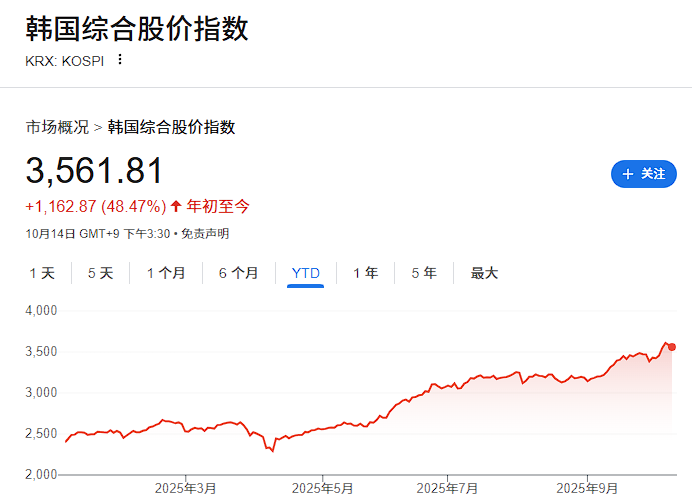
四大“超级周期”与“制度改革”--韩国股市的涨幅才开始?
Hua Er Jie Jian Wen· 2025-10-14 08:28
Core Viewpoint - The KOSPI index in South Korea has risen nearly 50% in 2025, with Morgan Stanley analysts suggesting this is just the beginning, driven by structural growth factors despite short-term trade tensions [1] Group 1: Market Performance - The KOSPI index has increased nearly 50% year-to-date, outperforming other Asian markets, with the MSCI Korea index up 65% compared to the 27% rise in the Asia-Pacific index [1] - Morgan Stanley has raised its KOSPI target from 3250 to 3800 points, with a bullish scenario suggesting it could reach 4200 points [4] Group 2: Sector Analysis - The technology sector is expected to benefit significantly from the AI expansion, with analysts noting that the storage chip industry is entering a new upcycle driven by AI, with supply constraints supporting price increases [5] - Major companies like Samsung Electronics and SK Hynix are projected to be the primary beneficiaries, with potential stock price increases contributing to a 5.3% rise in the KOSPI index [6] Group 3: Super Cycles Driving Growth - Morgan Stanley identifies four super cycles driving structural growth in the Korean economy: AI technology diffusion, defense industry, power infrastructure, and the Korean Wave culture [7] - The defense sector is experiencing increased demand due to geopolitical risks and modernization needs, with European countries committing to higher defense spending [7] - The power infrastructure sector is expanding globally, with Korean manufacturers gaining orders in major projects due to competitive costs and advanced technology [7] - The Korean Wave culture, particularly in beauty products and instant noodles, is seeing significant growth, with beauty exports to Europe up 59% year-on-year [7] Group 4: Government Reforms - The execution of government reform agendas is becoming a focal point for the market, with expected reforms related to stock buyback rules and key tax reforms [8] - Proposed changes to the dividend tax rate are expected to be set below 30%, and stock buyback rule reforms are anticipated, though the timing remains uncertain [10]