
颗粒力学

Search documents
颗粒力学揭示嫦娥六号月壤黏性之谜
仪器信息网· 2025-12-02 09:07
Core Viewpoint - The research team led by researcher Qi Shengwen from the Institute of Geology and Geophysics of the Chinese Academy of Sciences has revealed the physical mechanisms behind the high viscosity characteristics of lunar soil samples from the Chang'e 6 mission, providing a comprehensive explanation of why the lunar soil is so sticky [2][3]. Group 1: Research Findings - The study utilized high-resolution CT scanning at a scale of 1 micron to analyze over 290,000 lunar soil particles, comparing them with samples from the Chang'e 5 and Apollo missions [2]. - The D60 value of the Chang'e 6 lunar soil was found to be the smallest at 48.4 microns, indicating finer particles with more complex shapes and significantly lower sphericity [2]. - The presence of easily breakable feldspar minerals, which constitute approximately 32.6% of the sample, and the stronger space weathering effects on the far side of the moon are believed to contribute to the unique characteristics of the Chang'e 6 lunar soil [2]. Group 2: Implications for Future Research - This research provides crucial scientific evidence for future lunar exploration missions, aiding in the construction of lunar bases and the development of lunar resources [3]. - The findings are expected to support China's advancements in lunar scientific research and resource utilization, contributing to new breakthroughs in these fields [3].


【科技日报】嫦娥六号月壤“黏性”之谜揭开
Ke Ji Ri Bao· 2025-11-25 02:15
Core Insights - The latest research on the Chang'e 6 lunar soil reveals its unique "stickiness" due to specific particle interactions, which differ from the lunar soil samples collected by Chang'e 5 [1][2] Group 1: Research Findings - The Chang'e 6 lunar soil exhibits a higher repose angle, indicating greater stickiness compared to the lunar soil from the Chang'e 5 mission, which suggests different physical properties [1] - The research identified three key particle interactions—friction, van der Waals forces, and electrostatic forces—that contribute to the higher repose angle and thus the stickiness of the lunar soil [1][2] - The unique characteristics of the Chang'e 6 lunar soil, including its finer and more irregular particles, enhance the contributions of these forces, leading to its increased cohesiveness [2] Group 2: Implications for Future Missions - The findings provide critical scientific insights for future lunar exploration missions, particularly regarding the stability of landers and the potential for lunar dust dispersion during landing [2] - The research supports the development of lunar bases and resource utilization on the Moon, aligning with China's advancing deep space exploration initiatives [2]
嫦娥六号月壤“黏性”之谜揭开
Ke Ji Ri Bao· 2025-11-25 00:42
Core Insights - The latest research published in "Nature Astronomy" reveals the unique cohesive properties of lunar soil from the Chang'e 6 mission, highlighting its higher viscosity compared to samples from the lunar front [1][2]. Group 1: Research Findings - Researchers from the Chinese Academy of Sciences analyzed the Chang'e 6 lunar soil from a granular mechanics perspective, uncovering the scientific mechanisms behind its stickiness [1]. - The Chang'e 6 lunar soil exhibits a significantly higher repose angle than lunar front samples, indicating its flowability is closer to that of terrestrial clay [1]. - The increased stickiness is attributed to three microscopic inter-particle forces: friction, van der Waals forces, and electrostatic forces, which become more pronounced in finer particles [1][2]. Group 2: Unique Characteristics - High-precision CT scans revealed that the Chang'e 6 lunar soil particles are the finest yet exhibit irregular and non-spherical shapes, contrary to typical expectations [2]. - This "fine and rough" particle characteristic enhances the contributions of friction, van der Waals, and electrostatic forces, resulting in a higher repose angle and greater stickiness [2]. Group 3: Implications for Future Missions - The research provides crucial scientific foundations for future lunar exploration missions, as the flowability of lunar soil affects the stability of landers and the potential for lunar dust dispersion [2]. - The findings are expected to support advancements in lunar base construction and resource utilization, contributing to breakthroughs in lunar scientific research and resource management [2].
嫦娥六号月壤为何有些黏?中国科学家最新研究揭晓答案
Zhong Guo Xin Wen Wang· 2025-11-24 13:46
Core Viewpoint - The research conducted by the team from the Chinese Academy of Sciences reveals the physical mechanisms behind the higher viscosity of lunar soil samples collected by the Chang'e 6 mission, compared to those from the Chang'e 5 mission, providing insights into the unique properties of lunar regolith [1][4]. Group 1: Research Findings - The study published in the journal Nature Astronomy confirms that the lunar soil from the Chang'e 6 mission exhibits a significantly higher repose angle than samples from the lunar front, indicating its flow characteristics are closer to those of viscous soils on Earth [3][4]. - The research team identified that the increased repose angle is primarily influenced by the synergistic effects of friction, van der Waals forces, and electrostatic forces among particles, with friction being positively correlated with particle surface roughness [4][6]. - A critical "particle size threshold" was discovered, where the influence of van der Waals and electrostatic forces on the repose angle becomes significant when the D60 value (the particle size at which 60% of the total weight is below) is less than approximately 100 micrometers [6]. Group 2: Implications for Lunar Research - The team conducted high-resolution CT scans of the Chang'e 6 lunar soil samples, analyzing over 290,000 particles, and found that the D60 value is the smallest at 48.4 micrometers, indicating finer and more complex particle shapes compared to samples from Chang'e 5 and Apollo missions [7][9]. - The unique characteristics of the Chang'e 6 lunar soil, including its fine and rough particles, enhance the contributions of friction, van der Waals, and electrostatic forces, resulting in a higher repose angle and thus greater viscosity [7][9]. - This research provides a foundational scientific basis for future lunar exploration missions, including lunar base construction and resource utilization, contributing to advancements in lunar science and resource development [9].
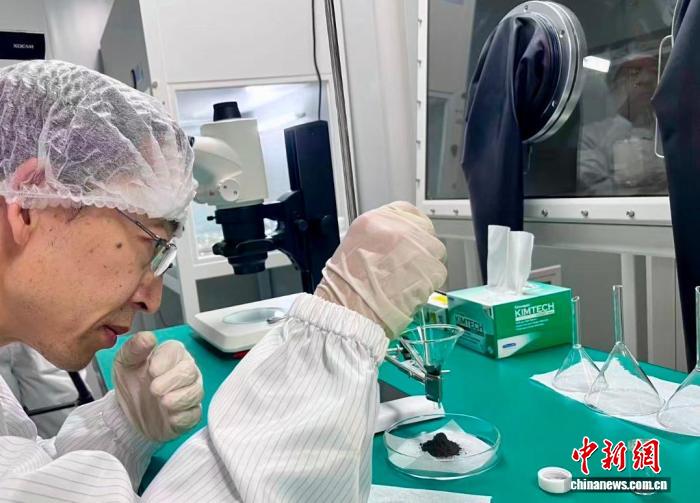
嫦娥六号月壤为什么这么黏?我国科研人员找到答案
Xin Jing Bao· 2025-11-24 10:19
Core Insights - The research team from the Institute of Geology and Geophysics of the Chinese Academy of Sciences has revealed the physical mechanism behind the high viscosity characteristics of lunar soil samples from the Chang'e 6 mission, addressing the scientific question of why the lunar soil is "so sticky" [1] Group 1: Research Findings - The Chang'e 6 lunar soil exhibits a significantly higher repose angle compared to samples from the lunar front, indicating its flow characteristics are more similar to viscous soil on Earth [1] - The increase in repose angle is primarily controlled by three inter-particle forces: friction, van der Waals forces, and electrostatic forces, with friction being positively correlated with particle surface roughness [2] - A critical "particle size threshold" was identified, where the influence of van der Waals and electrostatic forces becomes significant when the D60 value is below approximately 100 micrometers, leading to noticeable viscous characteristics in non-clay mineral particles [2] Group 2: Implications and Applications - The unique characteristics of the Chang'e 6 lunar soil, including its finer particle size (D60 value of 48.4 micrometers) and complex morphology, enhance the contributions of friction, van der Waals, and electrostatic forces, resulting in a higher repose angle and increased viscosity [3] - This research provides a systematic explanation of the unique cohesive behavior of lunar soil from a particle mechanics perspective, offering important scientific foundations for future lunar exploration missions [3] - The findings will support the construction of lunar bases and the development of lunar resources, contributing to advancements in lunar scientific research and resource utilization [3]