
嫦娥六号月壤

Search documents
中国航天上热搜,网友点赞“很硬核、有温度、有盼头”——中国航天值得更多期待
Ren Min Ri Bao Hai Wai Ban· 2025-12-08 10:03
Core Viewpoint - China's recent advancements in space exploration, including the successful launch of the Shenzhou-22 spacecraft and the introduction of new technologies in the Chinese space station, have generated significant public interest and excitement about the future of China's space endeavors [1][2][3]. Group 1: Shenzhou-22 Launch and Space Station Developments - The Shenzhou-22 spacecraft was successfully launched on November 25, 2023, and docked with the Tianhe core module of the Chinese space station [1]. - The Shenzhou-22 will serve as the return vehicle for the crew of Shenzhou-21, following a series of recent space missions that have included the successful return of the Shenzhou-20 crew [1][5]. - The Shenzhou-22 mission is notable for being China's first emergency launch, executed within 16 days due to an incident involving the Shenzhou-20 spacecraft [3][4]. Group 2: Innovations in Space Cooking - The introduction of a new "space oven" on the Chinese space station allows astronauts to cook and bake food in orbit, marking a significant enhancement in the quality of life for astronauts [2][3]. - The space oven operates without smoke, adhering to the space station's emission standards, and has been tested for reliability [3]. - The variety of food available to astronauts has expanded to over 190 types, with a 10-day meal cycle that includes fresh vegetables and meats [3]. Group 3: Lunar Research and Findings - The Chang'e-6 mission has revealed that lunar soil on the far side of the moon exhibits unique properties, including increased stickiness compared to samples from the near side [6]. - Research indicates that the stickiness is due to specific particle interactions, including friction, van der Waals forces, and electrostatic forces, which enhance the cohesive properties of the lunar soil [6]. - This research provides critical insights for future lunar exploration missions, particularly regarding landing stability and dust management [6]. Group 4: Future Space Exploration Plans - During the 14th Five-Year Plan, China aims to launch four scientific satellites focused on exploring fundamental questions about the universe, including the origins of life and the search for habitable exoplanets [7][8]. - The planned satellites include the "Hongmeng Project," which will investigate the early universe, and the "Kua Fu II," which will study the sun from unique vantage points [8]. - These missions are expected to contribute significantly to humanity's understanding of cosmic phenomena and the potential for finding a "second Earth" [8].
【科技日报】嫦娥六号月壤“黏性”之谜揭开
Ke Ji Ri Bao· 2025-11-25 02:15
Core Insights - The latest research on the Chang'e 6 lunar soil reveals its unique "stickiness" due to specific particle interactions, which differ from the lunar soil samples collected by Chang'e 5 [1][2] Group 1: Research Findings - The Chang'e 6 lunar soil exhibits a higher repose angle, indicating greater stickiness compared to the lunar soil from the Chang'e 5 mission, which suggests different physical properties [1] - The research identified three key particle interactions—friction, van der Waals forces, and electrostatic forces—that contribute to the higher repose angle and thus the stickiness of the lunar soil [1][2] - The unique characteristics of the Chang'e 6 lunar soil, including its finer and more irregular particles, enhance the contributions of these forces, leading to its increased cohesiveness [2] Group 2: Implications for Future Missions - The findings provide critical scientific insights for future lunar exploration missions, particularly regarding the stability of landers and the potential for lunar dust dispersion during landing [2] - The research supports the development of lunar bases and resource utilization on the Moon, aligning with China's advancing deep space exploration initiatives [2]
嫦娥六号月壤“黏性”之谜揭开
Ke Ji Ri Bao· 2025-11-25 00:42
Core Insights - The latest research published in "Nature Astronomy" reveals the unique cohesive properties of lunar soil from the Chang'e 6 mission, highlighting its higher viscosity compared to samples from the lunar front [1][2]. Group 1: Research Findings - Researchers from the Chinese Academy of Sciences analyzed the Chang'e 6 lunar soil from a granular mechanics perspective, uncovering the scientific mechanisms behind its stickiness [1]. - The Chang'e 6 lunar soil exhibits a significantly higher repose angle than lunar front samples, indicating its flowability is closer to that of terrestrial clay [1]. - The increased stickiness is attributed to three microscopic inter-particle forces: friction, van der Waals forces, and electrostatic forces, which become more pronounced in finer particles [1][2]. Group 2: Unique Characteristics - High-precision CT scans revealed that the Chang'e 6 lunar soil particles are the finest yet exhibit irregular and non-spherical shapes, contrary to typical expectations [2]. - This "fine and rough" particle characteristic enhances the contributions of friction, van der Waals, and electrostatic forces, resulting in a higher repose angle and greater stickiness [2]. Group 3: Implications for Future Missions - The research provides crucial scientific foundations for future lunar exploration missions, as the flowability of lunar soil affects the stability of landers and the potential for lunar dust dispersion [2]. - The findings are expected to support advancements in lunar base construction and resource utilization, contributing to breakthroughs in lunar scientific research and resource management [2].
嫦娥六号月壤为何有些黏?中国科学家最新研究揭晓答案
Zhong Guo Xin Wen Wang· 2025-11-24 13:46
Core Viewpoint - The research conducted by the team from the Chinese Academy of Sciences reveals the physical mechanisms behind the higher viscosity of lunar soil samples collected by the Chang'e 6 mission, compared to those from the Chang'e 5 mission, providing insights into the unique properties of lunar regolith [1][4]. Group 1: Research Findings - The study published in the journal Nature Astronomy confirms that the lunar soil from the Chang'e 6 mission exhibits a significantly higher repose angle than samples from the lunar front, indicating its flow characteristics are closer to those of viscous soils on Earth [3][4]. - The research team identified that the increased repose angle is primarily influenced by the synergistic effects of friction, van der Waals forces, and electrostatic forces among particles, with friction being positively correlated with particle surface roughness [4][6]. - A critical "particle size threshold" was discovered, where the influence of van der Waals and electrostatic forces on the repose angle becomes significant when the D60 value (the particle size at which 60% of the total weight is below) is less than approximately 100 micrometers [6]. Group 2: Implications for Lunar Research - The team conducted high-resolution CT scans of the Chang'e 6 lunar soil samples, analyzing over 290,000 particles, and found that the D60 value is the smallest at 48.4 micrometers, indicating finer and more complex particle shapes compared to samples from Chang'e 5 and Apollo missions [7][9]. - The unique characteristics of the Chang'e 6 lunar soil, including its fine and rough particles, enhance the contributions of friction, van der Waals, and electrostatic forces, resulting in a higher repose angle and thus greater viscosity [7][9]. - This research provides a foundational scientific basis for future lunar exploration missions, including lunar base construction and resource utilization, contributing to advancements in lunar science and resource development [9].

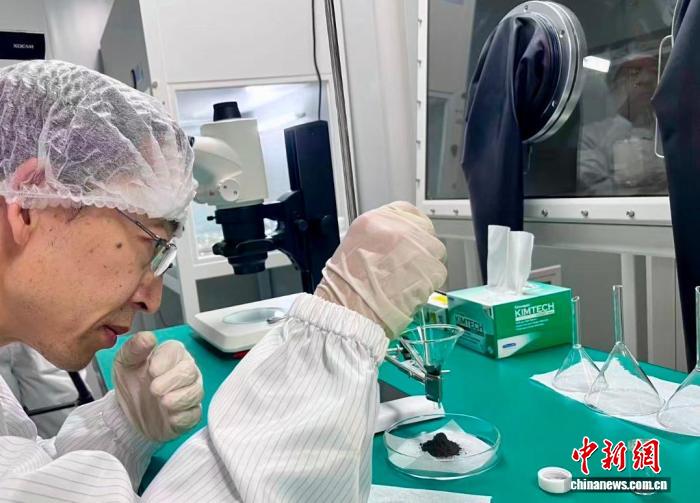
科研人员揭开嫦娥六号月壤黏性之谜
Xin Hua She· 2025-11-24 10:26
Group 1 - The research team from the Chinese Academy of Sciences has revealed the physical mechanisms behind the high viscosity characteristics of lunar soil samples from the Chang'e 6 mission, published in the journal Nature Astronomy [1] - The team conducted fixed funnel and drum experiments to measure the repose angle of the lunar soil, finding it significantly higher than that of lunar samples from the front side, indicating flow characteristics closer to viscous soils on Earth [1] - The unique particle characteristics of the Chang'e 6 lunar soil, including a high content of easily breakable feldspar minerals (approximately 32.6%), contribute to its higher viscosity due to increased friction, van der Waals forces, and electrostatic forces [1] Group 2 - The research findings will provide a critical theoretical foundation for lunar base construction and resource utilization, supporting advancements in lunar scientific research and resource development [2]

嫦娥六号月壤为什么这么黏?我国科研人员找到答案
Xin Jing Bao· 2025-11-24 10:19
Core Insights - The research team from the Institute of Geology and Geophysics of the Chinese Academy of Sciences has revealed the physical mechanism behind the high viscosity characteristics of lunar soil samples from the Chang'e 6 mission, addressing the scientific question of why the lunar soil is "so sticky" [1] Group 1: Research Findings - The Chang'e 6 lunar soil exhibits a significantly higher repose angle compared to samples from the lunar front, indicating its flow characteristics are more similar to viscous soil on Earth [1] - The increase in repose angle is primarily controlled by three inter-particle forces: friction, van der Waals forces, and electrostatic forces, with friction being positively correlated with particle surface roughness [2] - A critical "particle size threshold" was identified, where the influence of van der Waals and electrostatic forces becomes significant when the D60 value is below approximately 100 micrometers, leading to noticeable viscous characteristics in non-clay mineral particles [2] Group 2: Implications and Applications - The unique characteristics of the Chang'e 6 lunar soil, including its finer particle size (D60 value of 48.4 micrometers) and complex morphology, enhance the contributions of friction, van der Waals, and electrostatic forces, resulting in a higher repose angle and increased viscosity [3] - This research provides a systematic explanation of the unique cohesive behavior of lunar soil from a particle mechanics perspective, offering important scientific foundations for future lunar exploration missions [3] - The findings will support the construction of lunar bases and the development of lunar resources, contributing to advancements in lunar scientific research and resource utilization [3]
第八届进博会丨中国馆精彩亮相
Ren Min Wang· 2025-11-05 15:41
Core Insights - The 8th China International Import Expo (CIIE) opened in Shanghai on November 5, showcasing China's achievements in deepening reforms and promoting high-level openness during the 14th Five-Year Plan period [2][4][6][8][10][12][14] Group 1 - The China Pavilion at the expo highlighted numerous technological achievements that attracted significant attention [2][4][6] - Exhibits included advanced models such as the TSI double-decker train and light magnetic levitation train, demonstrating China's progress in transportation technology [6] - Notable displays featured lunar soil samples from the Chang'e 5 and Chang'e 6 missions, emphasizing China's advancements in space exploration [8] Group 2 - The event also showcased innovative robotics, including non-invasive brain-machine interface robots and robots performing traditional calligraphy, reflecting the integration of technology in cultural practices [12][14] - The expo serves as a platform for international exhibitors, fostering global trade and cooperation, as evidenced by interactions between exhibitors and attendees [10]

【科技日报】院士眼中的创新关键词
Ke Ji Ri Bao· 2025-11-04 03:02
Group 1: Core Views - The core focus of the article is on the importance of technological innovation in driving China's modernization and economic development, as emphasized in the "15th Five-Year Plan" proposal [1][3][11] - The proposal highlights the need for a strong emphasis on basic research and original innovation to enhance China's technological self-reliance and productivity [3][4][11] Group 2: Basic Research - The "15th Five-Year Plan" aims to significantly enhance basic research and original innovation capabilities, with a strategic focus on increasing investment in foundational studies [3][4] - Basic research is identified as the primary source of original innovation, and neglecting it is equated to stifling future advancements [3][4] - China's investment in basic research has seen substantial growth, with funding reaching 249.7 billion yuan in 2024, a 70% increase from 2020 [4] Group 3: Key Technologies - The article discusses the advancements in key core technologies, particularly in the semiconductor industry, where domestic products are achieving international standards [6][7] - The "14th Five-Year Plan" has led to the establishment of 33 national manufacturing innovation centers and significant progress in critical common technologies [6][7] Group 4: Integration of Innovation and Industry - The proposal emphasizes the deep integration of technological innovation and industrial innovation as a pathway to enhance economic and social development [11][12] - The article notes that the integration of technology and industry has led to significant growth in technology contract transactions, projected to reach 6.8 trillion yuan in 2024 [11][12] Group 5: Recommendations for Future Development - Experts suggest establishing stable funding for long-term basic research and encouraging free exploration to enhance original innovation capabilities [4][5] - There is a call for a modern innovation system that prioritizes enterprise involvement and market orientation, fostering collaboration between academia and industry [8][12]