
嫦娥五号月壤

Search documents
【科技日报】嫦娥五号月壤揭示太阳风如何在月球“留痕”
Ke Ji Ri Bao· 2025-12-03 03:20
Core Insights - The research conducted by scientists from the Chinese Academy of Sciences reveals the key mechanisms of solar wind interaction with the lunar surface, providing new insights into the distribution of volatile elements on the Moon and the evolution of the Sun [1][2]. Group 1: Research Findings - The lunar soil samples from the Chang'e 5 mission contain high-purity plagioclase particles that preserve solar wind signals closer to their original state compared to Apollo lunar samples, although differences still exist [1]. - The differences in composition between the solar wind and the lunar soil are primarily attributed to the dynamics of the injection process rather than post-modification of the lunar surface [1]. Group 2: Proposed Model - A three-stage model has been proposed to explain the behavior of rare gases on the lunar surface, which includes solar wind and cosmic ray injection, local thermal diffusion, and re-irradiation [2]. - The model indicates that the processes of solar wind injection and gas escape are interconnected, with some light elements being released due to mineral micro-damage during impacts, and further diffusion caused by micrometeorite impacts and temperature variations [2]. Group 3: Implications - The findings clarify how solar wind shapes the lunar exosphere and the distribution of volatiles, suggesting that corrections for fractionation effects are necessary when reconstructing solar wind history to accurately trace solar evolution [2]. - This research provides a new framework for understanding the interaction between airless celestial bodies and solar wind, opening new perspectives for exploring the origins of planetary volatiles [2].
嫦娥五号月壤揭示太阳风如何在月球“留痕”
Ke Ji Ri Bao· 2025-12-03 01:04
Core Insights - The research conducted on lunar soil samples from the Chang'e 5 mission reveals key mechanisms of solar wind interaction with the lunar surface, providing new insights into the distribution of volatile elements on the Moon and the evolution of the Sun [1][2] Group 1: Research Findings - Scientists analyzed 36 high-purity plagioclase particles from Chang'e 5 lunar soil, finding that the solar wind signals preserved in these samples are closer to their original state compared to Apollo lunar samples, although differences still exist [2] - The differences in solar wind composition are primarily attributed to the dynamics of the injection process rather than later modifications to the lunar surface [2] Group 2: Proposed Model - A three-stage model was proposed to explain the behavior of rare gases on the lunar surface, which includes solar wind and cosmic ray injection, local thermal diffusion, and re-irradiation [2] - The model indicates that the processes of solar wind injection and gas escape are interconnected, with some light elements being released instantly due to mineral micro-damage during impacts, and further gas escape facilitated by micrometeorite impacts and temperature variations [2] Group 3: Implications - The findings clarify how solar wind shapes the lunar exosphere and the distribution of volatiles, suggesting that corrections for fractionation effects are necessary when reconstructing solar wind history to accurately trace solar evolution [2] - This research provides a new framework for understanding the interaction between airless celestial bodies and solar wind, opening new perspectives for exploring the origins of planetary volatiles [2]
嫦娥六号月壤“黏性”之谜揭开
Ke Ji Ri Bao· 2025-11-25 00:42
Core Insights - The latest research published in "Nature Astronomy" reveals the unique cohesive properties of lunar soil from the Chang'e 6 mission, highlighting its higher viscosity compared to samples from the lunar front [1][2]. Group 1: Research Findings - Researchers from the Chinese Academy of Sciences analyzed the Chang'e 6 lunar soil from a granular mechanics perspective, uncovering the scientific mechanisms behind its stickiness [1]. - The Chang'e 6 lunar soil exhibits a significantly higher repose angle than lunar front samples, indicating its flowability is closer to that of terrestrial clay [1]. - The increased stickiness is attributed to three microscopic inter-particle forces: friction, van der Waals forces, and electrostatic forces, which become more pronounced in finer particles [1][2]. Group 2: Unique Characteristics - High-precision CT scans revealed that the Chang'e 6 lunar soil particles are the finest yet exhibit irregular and non-spherical shapes, contrary to typical expectations [2]. - This "fine and rough" particle characteristic enhances the contributions of friction, van der Waals, and electrostatic forces, resulting in a higher repose angle and greater stickiness [2]. Group 3: Implications for Future Missions - The research provides crucial scientific foundations for future lunar exploration missions, as the flowability of lunar soil affects the stability of landers and the potential for lunar dust dispersion [2]. - The findings are expected to support advancements in lunar base construction and resource utilization, contributing to breakthroughs in lunar scientific research and resource management [2].
嫦娥六号月壤为何有些黏?中国科学家最新研究揭晓答案
Zhong Guo Xin Wen Wang· 2025-11-24 13:46
Core Viewpoint - The research conducted by the team from the Chinese Academy of Sciences reveals the physical mechanisms behind the higher viscosity of lunar soil samples collected by the Chang'e 6 mission, compared to those from the Chang'e 5 mission, providing insights into the unique properties of lunar regolith [1][4]. Group 1: Research Findings - The study published in the journal Nature Astronomy confirms that the lunar soil from the Chang'e 6 mission exhibits a significantly higher repose angle than samples from the lunar front, indicating its flow characteristics are closer to those of viscous soils on Earth [3][4]. - The research team identified that the increased repose angle is primarily influenced by the synergistic effects of friction, van der Waals forces, and electrostatic forces among particles, with friction being positively correlated with particle surface roughness [4][6]. - A critical "particle size threshold" was discovered, where the influence of van der Waals and electrostatic forces on the repose angle becomes significant when the D60 value (the particle size at which 60% of the total weight is below) is less than approximately 100 micrometers [6]. Group 2: Implications for Lunar Research - The team conducted high-resolution CT scans of the Chang'e 6 lunar soil samples, analyzing over 290,000 particles, and found that the D60 value is the smallest at 48.4 micrometers, indicating finer and more complex particle shapes compared to samples from Chang'e 5 and Apollo missions [7][9]. - The unique characteristics of the Chang'e 6 lunar soil, including its fine and rough particles, enhance the contributions of friction, van der Waals, and electrostatic forces, resulting in a higher repose angle and thus greater viscosity [7][9]. - This research provides a foundational scientific basis for future lunar exploration missions, including lunar base construction and resource utilization, contributing to advancements in lunar science and resource development [9].

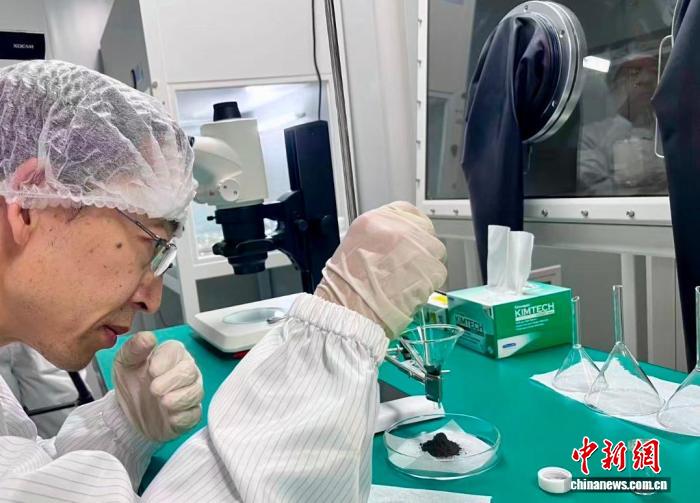
嫦娥六号月壤为什么这么黏?我国科研人员找到答案
Xin Jing Bao· 2025-11-24 10:19
Core Insights - The research team from the Institute of Geology and Geophysics of the Chinese Academy of Sciences has revealed the physical mechanism behind the high viscosity characteristics of lunar soil samples from the Chang'e 6 mission, addressing the scientific question of why the lunar soil is "so sticky" [1] Group 1: Research Findings - The Chang'e 6 lunar soil exhibits a significantly higher repose angle compared to samples from the lunar front, indicating its flow characteristics are more similar to viscous soil on Earth [1] - The increase in repose angle is primarily controlled by three inter-particle forces: friction, van der Waals forces, and electrostatic forces, with friction being positively correlated with particle surface roughness [2] - A critical "particle size threshold" was identified, where the influence of van der Waals and electrostatic forces becomes significant when the D60 value is below approximately 100 micrometers, leading to noticeable viscous characteristics in non-clay mineral particles [2] Group 2: Implications and Applications - The unique characteristics of the Chang'e 6 lunar soil, including its finer particle size (D60 value of 48.4 micrometers) and complex morphology, enhance the contributions of friction, van der Waals, and electrostatic forces, resulting in a higher repose angle and increased viscosity [3] - This research provides a systematic explanation of the unique cohesive behavior of lunar soil from a particle mechanics perspective, offering important scientific foundations for future lunar exploration missions [3] - The findings will support the construction of lunar bases and the development of lunar resources, contributing to advancements in lunar scientific research and resource utilization [3]
第八届进博会丨中国馆精彩亮相
Ren Min Wang· 2025-11-05 15:41
Core Insights - The 8th China International Import Expo (CIIE) opened in Shanghai on November 5, showcasing China's achievements in deepening reforms and promoting high-level openness during the 14th Five-Year Plan period [2][4][6][8][10][12][14] Group 1 - The China Pavilion at the expo highlighted numerous technological achievements that attracted significant attention [2][4][6] - Exhibits included advanced models such as the TSI double-decker train and light magnetic levitation train, demonstrating China's progress in transportation technology [6] - Notable displays featured lunar soil samples from the Chang'e 5 and Chang'e 6 missions, emphasizing China's advancements in space exploration [8] Group 2 - The event also showcased innovative robotics, including non-invasive brain-machine interface robots and robots performing traditional calligraphy, reflecting the integration of technology in cultural practices [12][14] - The expo serves as a platform for international exhibitors, fostering global trade and cooperation, as evidenced by interactions between exhibitors and attendees [10]

我国科研人员围绕月表水演化有新发现
Huan Qiu Wang Zi Xun· 2025-08-27 14:48
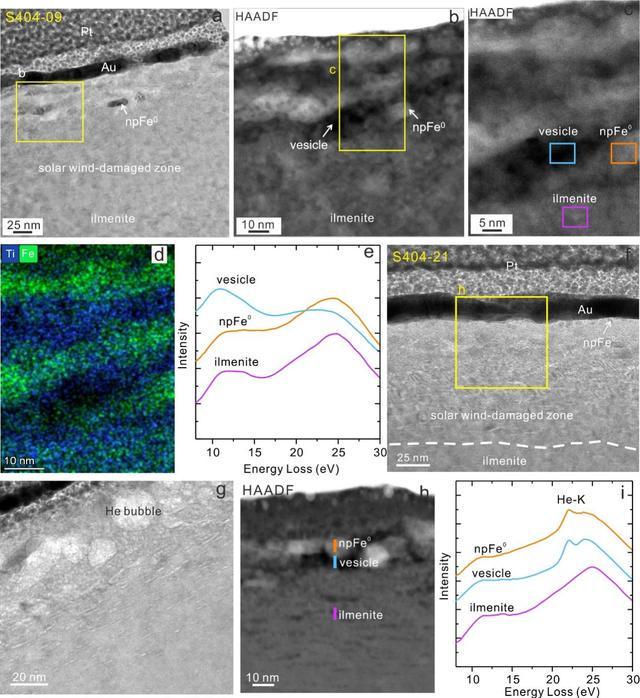
Core Insights - Understanding the distribution and storage mechanisms of water on the lunar surface is fundamental for comprehending the evolution of lunar materials, resource distribution, and future utilization [1] - The study conducted by a joint team from the National Space Science Center and the Institute of Geology and Geophysics of the Chinese Academy of Sciences analyzed the water content and hydrogen isotopes in titanium iron ore particles from the Chang'e 5 lunar soil [1] - The research reveals the dual role of titanium iron ore in the distribution and storage of lunar water, highlighting its ability to convert solar wind hydrogen into water while also facing limitations in long-term water stability due to its crystal structure [1] Research Findings - The study provides a possible mineralogical mechanism to explain the significant diurnal variations of water observed in the titanium-rich regions of the moon [1] - The findings offer important scientific evidence for future in-situ resource development on the moon, focusing on titanium iron ore as a primary target [1] - The research results were published in the international academic journal "Nature Communications" [1]
嫦娥五号月壤已与6国共享研究
news flash· 2025-07-09 03:34
Group 1 - The Chang'e 5 lunar soil has been shared for research with six countries [1] - The Zuchongzhi 3 quantum computing prototype leads the world in speed [1]