
高铁服务优化

Search documents
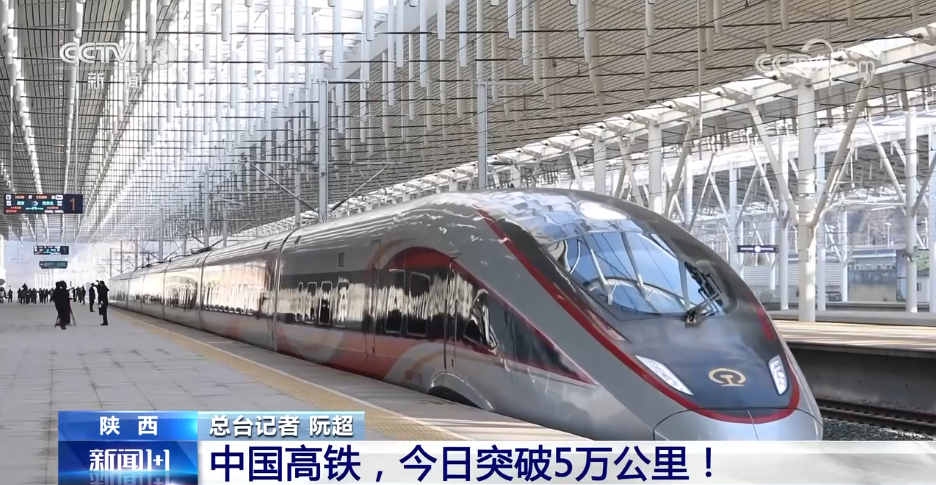
突破5万公里!中国高铁持续升级
Xin Lang Cai Jing· 2025-12-27 16:37
Core Insights - The opening of the Xiyan High-Speed Railway marks the entry of the Shaanbei revolutionary area into the "high-speed rail era," contributing to China's high-speed rail network exceeding 50,000 kilometers, showcasing significant advancements in scale, quality, and modernization of equipment [1] Group 1: Impact on Society and Economy - The expansion of the high-speed rail network enhances travel experiences for citizens, allowing for rapid access to major cities within a 500-kilometer radius in about two hours, and enabling same-day round trips between cities like Beijing and Shanghai [1] - The high-speed rail network significantly improves the investment environment in underdeveloped regions, facilitating economic exchanges and industrial collaboration, particularly benefiting areas that were previously less accessible [1] - The development of high-speed rail has led to the emergence of new business models, such as "high-speed rail + cultural tourism," which has boosted tourism in previously overlooked areas, resulting in increased visitor numbers and better market access for local products [1] Group 2: Industrial and Technological Advancements - High-speed rail is a capital-intensive industry with a long supply chain, positively influencing the optimization and upgrading of various sectors, including metallurgy, machinery, construction, and electronics [1] - Investment in high-speed rail generates substantial economic returns, with every 1 billion yuan invested creating approximately 10 billion yuan in output and over 600 jobs, highlighting the strategic importance of high-speed rail manufacturing in China's economy [1] Group 3: Future Developments and Improvements - Future high-speed rail initiatives aim to achieve speeds of 400 kilometers per hour, enhancing connectivity between urban clusters and promoting socio-economic development across vast distances [1] - There is a need for better spatial distribution and integration of high-speed rail with other forms of transportation, such as urban rail and subways, to create a seamless travel experience [1] - Enhancements in service quality are anticipated, focusing on more personalized and ecological service offerings, such as diverse dining options and themed carriages, to improve passenger satisfaction [1]
突破5万公里!中国高铁持续升级,接下来要追求的是什么?
Yang Shi Xin Wen· 2025-12-27 03:08
Core Insights - The opening of the Xiyan High-Speed Railway marks the entry of the Shaanbei revolutionary area into the "high-speed rail era," contributing to China's high-speed rail network exceeding 50,000 kilometers, showcasing a significant leap in both scale and quality since the first high-speed rail line in 2008 [1][2] Group 1: Impact on Society and Economy - The expansion of the high-speed rail network enhances transportation efficiency, allowing for travel within a 500-kilometer radius in about two hours, and enabling same-day round trips between major cities like Beijing and Shanghai [2][3] - The high-speed rail development aims to improve the quality of life for citizens, particularly in economically underdeveloped and poverty-stricken areas, by significantly reducing travel times and creating a one-hour transportation circle [3][4] - The network has improved investment environments in various regions, facilitating better allocation of production and consumption factors, and fostering economic exchanges and industrial collaboration [3][4] Group 2: Industrial Benefits - High-speed rail is a capital-intensive industry with a long supply chain, positively impacting various sectors such as metallurgy, construction, and machinery, and driving technological advancements [4] - For every 1 billion yuan invested in high-speed rail, it can generate 10 billion yuan in output across related industries and create over 600 jobs, highlighting its role as a strategic emerging industry with international competitive advantages [4] Group 3: Future Developments - Future high-speed rail projects aim to achieve speeds of 400 kilometers per hour, enhancing connectivity between urban clusters and promoting socio-economic development across vast distances [5][6] - There is a need for better spatial distribution and integration of high-speed rail with other forms of transportation, such as urban rail and subways, to address last-mile connectivity issues [6] Group 4: Service Quality Enhancements - Future improvements in high-speed rail services will focus on creating more scenario-based services and enhancing ecological aspects, such as expanding dining options and integrating local culinary experiences into the travel experience [7]
新闻1+1丨突破5万公里!中国高铁持续升级
Yang Shi Wang· 2025-12-26 22:12
Core Viewpoint - The opening of the Xiyan High-Speed Railway marks a significant milestone as China's high-speed rail network surpasses 50,000 kilometers, enhancing transportation efficiency and contributing to regional economic development [1][3]. Group 1: Impact on Transportation and Daily Life - The expansion of the high-speed rail network allows for improved travel times, creating a one-hour transportation circle along the Xiyan route, connecting key areas and significantly enhancing the travel experience for citizens [5]. - High-speed rail has become a national symbol and a representation of China's modernization, with phrases like "High-speed rail creates a better life" gaining widespread acceptance [3]. Group 2: Economic and Industrial Benefits - The development of high-speed rail has a substantial impact on various industries, driving technological advancements and optimizing the industrial structure across sectors such as metallurgy, machinery, and construction [7]. - For every 1 billion yuan invested in high-speed rail, it can generate 10 billion yuan in output across related industries and create over 600 jobs, highlighting its role as a strategic emerging industry with international competitive advantages [7]. Group 3: Future Development Goals - The pursuit of higher speeds, such as the development of 400 km/h trains, is essential for enhancing connectivity between urban clusters, which is crucial given China's vast geographical expanse [9]. - Future high-speed rail development should focus on optimizing spatial layout and integrating various forms of transportation, including urban and suburban rail systems, to address last-mile connectivity issues [9]. Group 4: Service Quality Enhancements - There is a need for improved service quality in high-speed rail, emphasizing more scenario-based services and ecological practices to align with national high-quality development goals [11]. - Future enhancements could include expanding dining options and creating themed carriages to enrich the travel experience, transforming high-speed rail into a more interactive and engaging environment for passengers [12].

“雪具便利行”服务更暖心
Jing Ji Ri Bao· 2025-12-11 00:10
Core Viewpoint - The introduction of the "Snow Equipment Convenience Service" on the Beijing-Zhangjiakou high-speed railway aims to enhance the travel experience for passengers carrying ski equipment, making it easier and more convenient to travel to ski resorts [1] Group 1: Service Implementation - Starting from December 7 until the end of the 2026 snow season, the railway department will offer the "Snow Equipment Convenience Service" on G trains running between Beijing North and Chongli [1] - Passengers can now book online through the 12306 app to carry their ski equipment, which will be stored in designated areas on the train [1] Group 2: Additional Services - The Beijing-Zhangjiakou high-speed railway will continue to provide "Snow Equipment Express Delivery" services at certain stations, facilitating easier access to skiing [1] - The initiative aims to promote the convenience of traveling to ski resorts by high-speed rail [1] Group 3: Coordination and Collaboration - To maximize the service's effectiveness, multiple parties need to collaborate, including the railway department and ski resorts [1] - Passengers must make advance reservations and confirm size regulations through the 12306 app [1] - The railway department will optimize storage space and clarify service processes, pricing standards, and safety responsibilities while enhancing on-site guidance [1] - Ski resorts and commercial entities along the route should actively engage with the increased passenger flow from the high-speed rail and improve services such as transfers and storage from the station to the ski resorts [1]