高铁网络

Search documents
5万公里高铁织就中国发展新经纬
Yang Zi Wan Bao Wang· 2026-01-20 04:27
Core Insights - The article highlights the significant milestone of China's high-speed rail (HSR) network reaching over 50,000 kilometers, marking a new phase in connectivity for regions like Yan'an, a historical revolutionary area [1] - The development of the HSR network is portrayed as a transformative force for regional economic growth, social welfare, and innovation, serving as a vital link for various sectors [2][3] Group 1: HSR Network Development - The HSR network has evolved from a framework of "Four Verticals and Four Horizontals" to "Eight Verticals and Eight Horizontals," achieving rapid expansion and establishing a comprehensive and efficient transportation network across the country [1] - The HSR has drastically reduced travel times, enabling same-day travel across vast distances, thus facilitating urban commuting and regional integration [1] Group 2: Economic and Social Impact - The HSR acts as a catalyst for economic growth, enhancing the distribution of local agricultural products and boosting tourism in areas like Yan'an, where local specialties can now reach major markets [2] - In regions such as the Yangtze River Delta, the HSR fosters collaboration in high-end manufacturing and technological innovation, creating competitive industrial clusters [3] Group 3: Technological Advancements - The success of China's HSR is attributed to continuous technological breakthroughs and innovation, transitioning from reliance on foreign technology to independent research and development [4] - Advanced technologies such as CR450 trainsets and smart construction methods have improved the safety, speed, and comfort of HSR services, establishing a global reputation for Chinese high-speed rail [4] Group 4: Future Prospects - The article emphasizes that the HSR will continue to play a crucial role in promoting high-quality economic development and enhancing connectivity between urban and rural areas, as well as domestic and international markets [4]
雄商石济“牵手”,济南1.5小时到雄安
Qi Lu Wan Bao· 2025-11-02 18:04
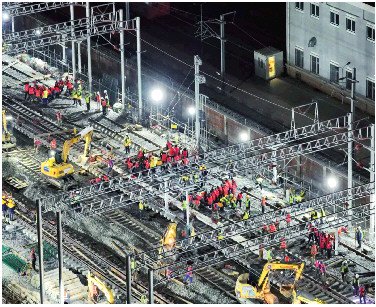
Core Viewpoint - The interconnection of the Xiongshang High-Speed Railway and the Shijiazhuang-Jinan High-Speed Railway enhances transportation efficiency and connectivity in the region, transforming Jinan into a crucial transportation hub between North China and Central China [2][4][9]. Group 1: Impact on Transportation Network - The Xiongshang High-Speed Railway, which spans 552.5 kilometers, connects Xiong'an Station to Shangqiu City, while the Shijiazhuang-Jinan line is 298 kilometers long and has been operational since 2019 [3]. - The new connection allows for a direct route from Jinan to Beijing, reducing travel time to approximately 1 hour and 50 minutes, which is comparable to the existing Beijing-Shanghai High-Speed Railway [4][6]. - The integration of these railways creates a more resilient "grid-like" high-speed rail network for Jinan, alleviating congestion on the Beijing-Shanghai route during peak travel times [4][9]. Group 2: Economic and Industrial Implications - The new high-speed rail link is expected to strengthen industrial ties between Jinan and Xiong'an, with travel time reduced to 1.5 hours, facilitating easier business interactions [6][7]. - Jinan's strategic position will allow it to serve as a bridge connecting the Yellow River Economic Belt with the Beijing-Tianjin-Hebei region, enhancing resource exchange and market access [10]. - The high-speed rail will enable Jinan to evolve from a "provincial center" to a "cross-regional engine," improving its influence over surrounding areas and fostering economic collaboration [9]. Group 3: Future Development and Strategic Importance - The interconnection is aligned with national strategies, positioning Jinan as a key node in connecting the Yellow River region's resources with the markets and technologies of the Beijing-Tianjin-Hebei area [10]. - The potential for increased passenger flow on the Shijiazhuang-Jinan line may lead to discussions on speed upgrades, enhancing overall service quality [5][6]. - Jinan's existing industrial strengths in sectors like satellite manufacturing and robotics can be leveraged to support regional industrial upgrades through improved transportation links [9].