黄金圈法则

Search documents
三小时品牌塑造冲刺方法ppt
3 6 Ke· 2026-01-15 01:26
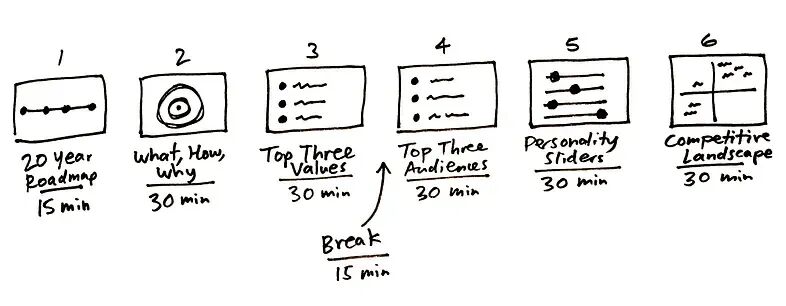
我们利用短短三个小时来帮助团队应对产品和营销方面的挑战。我们决定将品牌练习融入到类似冲刺的流程中,以便任何团队都能使。我们认为时间长短 并不一定意味着效果更好。而且由于流程快速高效,您可以让真正需要参与的人员加入。 需要说明的是,这些理念和练习并非我们首创。相反,"品牌冲刺"借鉴了众多品牌塑造领域伟大思想家的智慧。劳拉最喜欢的例子包括史蒂夫·乔布斯 的……1997 年苹果公司内部会议,斯图尔特·巴特菲尔德的文章《我们这里不卖马鞍》、西蒙·西内克的TED演讲《伟大的领导者如何激励行动》、菲尔·奈 特的耐克回忆录《鞋狗》,以及优秀的品牌形象设计公司Hello Monday的作品。如果说这些是精选集锦,那么"品牌冲刺"就是我们的混音带。 品牌冲刺包含六项练习。首先,你需要思考公司的动机: 接下来,您需要添加详细信息: 最重要的三大价值观能让你的理由更加具体。 前三大受众群体可帮助您确定品牌的目标优先顺序。 最后,你需要将你的品牌定位在其他品牌中: 房间必备物品: 首席执行官 至少满足以下条件之一: 个性滑块定义了您品牌的态度和风格。 竞争格局分析将您的品牌与其他公司进行比较。 这篇文章是一份自助指南。你可以和自己的 ...

惊人的“黄金圈法则”:你什么思维,什么命
洞见· 2025-11-23 12:34
Core Insights - The article emphasizes the importance of understanding the "why" behind actions, as proposed by Simon Sinek's "Golden Circle" theory, which suggests that successful individuals start with the purpose (why), then the process (how), and finally the outcome (what) [5][20][38] Group 1: The Importance of Thinking - Ordinary individuals often approach problems from the outside in (what → how → why), leading to ineffective efforts and stagnation [5][7] - High achievers, on the other hand, reverse this order, starting with the purpose, which allows them to address the essence of issues and achieve growth [5][20] - The concept of "pseudo-diligence" is introduced, where individuals work hard without understanding the value or purpose of their tasks, resulting in unproductive busyness [7][14] Group 2: Real-Life Examples - A friend's experience with job insecurity illustrates the consequences of merely following orders without questioning the purpose behind his work, leading to unexpected job loss [9][12] - Warren Buffett's investment strategy is highlighted, where he emphasizes understanding the reasons behind investment decisions, which contributes to his success in the stock market [22][24][26] - Steve Jobs' approach to innovation with the iPhone showcases the significance of questioning the purpose of a product before its development, leading to groundbreaking results [29][31] Group 3: The Power of Purpose - The article argues that life-changing moments stem from understanding the "why" behind actions rather than merely changing what one does [38] - Yuval Noah Harari's shift in research focus from military history to broader historical narratives exemplifies how questioning the relevance of one's work can lead to significant breakthroughs [37] - The conclusion stresses that continuous questioning and deep thinking are essential for personal growth and success, as highlighted by various philosophical perspectives [38][39]

惊人的“黄金圈法则”:你什么思维,什么命
洞见· 2025-06-08 10:38
Core Insights - The article emphasizes the importance of understanding the "why" behind actions, suggesting that successful individuals approach problems from an internal perspective (Why → How → What), while ordinary individuals often start from the external (What → How → Why) [6][7][10]. Group 1: Ordinary Thinking - Ordinary individuals tend to engage in "pseudo-diligence," focusing on tasks without questioning their purpose, leading to ineffective efforts [12][13][21]. - A personal anecdote illustrates that merely completing assigned tasks without understanding their significance can result in negative outcomes, such as job loss [16][20]. - The article warns against falling into a cycle of "ineffective busyness," where individuals work hard but fail to achieve meaningful progress [22][23]. Group 2: Expert Thinking - Successful individuals, like Warren Buffett, analyze the underlying reasons for their investment decisions, focusing on the potential of companies rather than just their current performance [28][30][32]. - The article highlights Steve Jobs' approach to innovation, where he questioned the purpose of creating new products, leading to groundbreaking developments like the iPhone [35][38]. - The depth of one's thinking is posited as a determinant of life success, with the ability to see the essence of situations being crucial for achieving significant outcomes [39][40]. Group 3: The Importance of "Why" - The narrative of Yuval Noah Harari illustrates the necessity of understanding the relevance of one's research, which led to a shift from a narrow focus on military history to broader historical narratives [44][50]. - The article concludes that life-changing insights come from asking "why," which guides individuals toward meaningful actions and decisions [54][56]. - It stresses that without a clear understanding of "why," efforts may lead to aimless pursuits, akin to a ship without a compass [57][58].