AI+儿童教育

Search documents
2025年教育行业融资风向报告,创投圈的钱都去哪了?
3 6 Ke· 2026-01-27 08:15
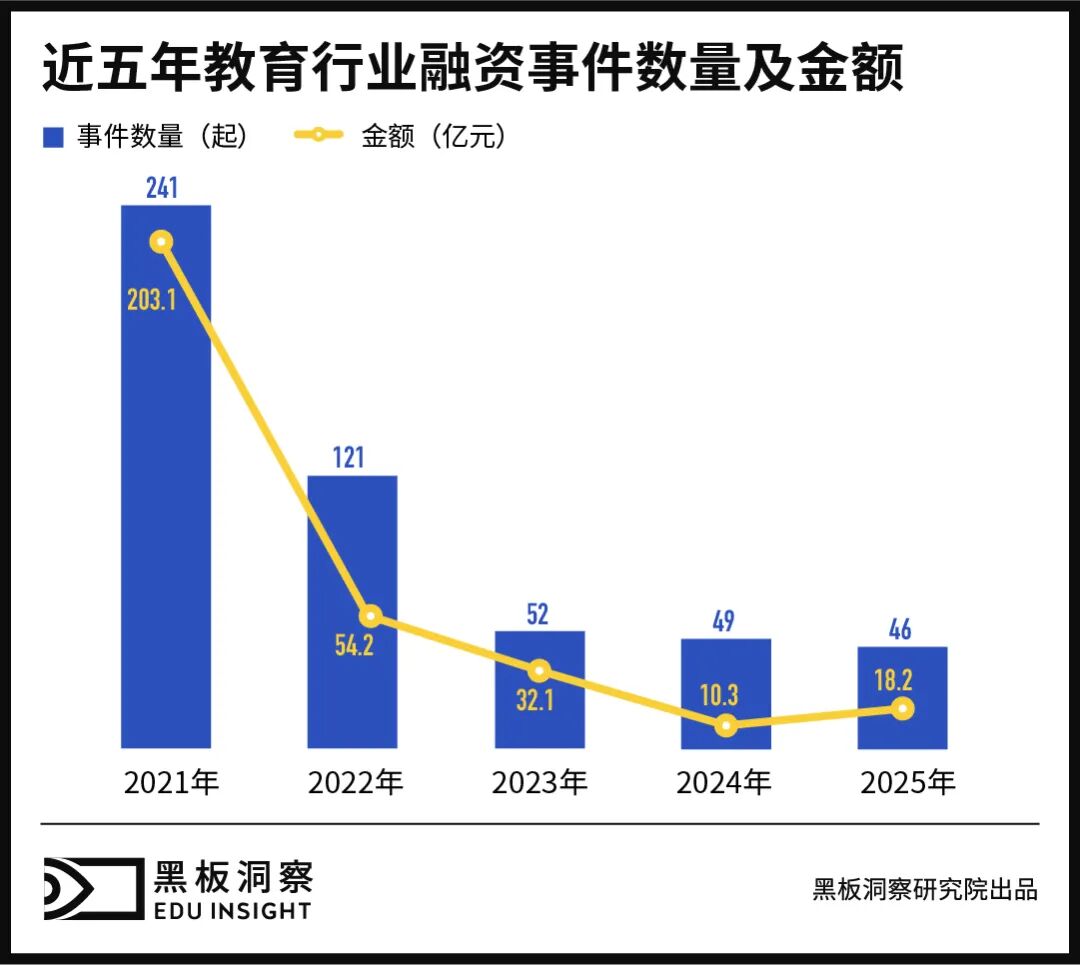
Core Insights - The education industry in 2025 is experiencing a unique situation of "declining quantity but rising prices" after significant adjustments, with total financing amount rebounding despite a slight decrease in the number of financing events [1][2] - The capital market remains cautious but is increasingly focused on high-quality assets and sectors aligned with national strategies, such as vocational skills training and early childhood education [1] Group 1: Overall Industry Overview - The financing events in the education sector over the past five years (2021-2025) show a typical "L-shaped" trend, with a peak in 2021 at 241 events and over 20 billion yuan, followed by a decline due to policy impacts and macroeconomic conditions, reaching a low in 2024 with 49 events and 1.03 billion yuan [1] - In 2025, the number of financing events slightly decreased to 46, but the total financing amount increased to 1.817 billion yuan, marking an almost 80% year-on-year growth, indicating a shift towards a "quality improvement and efficiency enhancement" phase [2] Group 2: Monthly Financing Overview - June saw the highest financing amount of the year due to a significant acquisition by Tianyu Fei Training, exceeding 800 million yuan, while April was the most active month with 8 financing events [4] Group 3: Financing Round Distribution - In 2025, angel rounds (including seed rounds) accounted for 56.5% of financing events (26 events), a significant increase from 34.7% in 2024, indicating a new wave of entrepreneurial incubation in sectors like AIGC education applications and new vocational skills training [6] - A rounds (including Pre-A) maintained a steady share of about 30%, while later-stage projects (B rounds and beyond) were scarce, reflecting ongoing exit or transformation pressures for mature enterprises [6] Group 4: Regional Financing Distribution - Beijing remains the dominant center for education venture capital with 9 financing events, followed by Shanghai and Guangdong with 6 each, indicating a concentration of resources in first-tier cities and economically developed regions [9] Group 5: Financing Amount Distribution - Financing amounts show that deals in the tens of millions are the mainstream, with 20 events in this range, accounting for nearly 45% of total events, while 12 events were in the millions, primarily in early-stage angel projects [12] - Notably, there were 5 large financing events of 100 million yuan or more, contributing significantly to the total amount, highlighting a "heavy bet" strategy on a few top projects [12] Group 6: Top Financing Events - The top five financing events accounted for approximately 1.43 billion yuan, nearly 80% of the total financing amount for the year [15] Group 7: Sector-Specific Financing Trends - Vocational education emerged as the clear leader in financing, with 18 events totaling 949 million yuan, benefiting from ongoing policy support for vocational skills training [17] - The corporate services sector (including education informatization) ranked second with 11 events but saw a decline in total amount to 277 million yuan, indicating challenges in the B2B service market [17] - K12 education saw only 3 small financing events, indicating its marginalization in the current landscape [17] Conclusion - The education investment and financing market in 2025 signals the end of the "flood irrigation" era, transitioning to "precise drip irrigation" and "stock integration" as the new norm [19] - Although the total number of financing events did not show a significant rebound, the substantial increase in total amounts indicates a reassessment of industry value, with a strong rise in vocational education validating the importance of aligning with market trends [19]

2025年春天还没来,第一批儿童AI硬件已经死了|焦点分析
36氪· 2025-03-18 09:35
Core Viewpoint - The article discusses the challenges and opportunities in the children's smart hardware market, emphasizing the need for products that align with children's cognitive logic rather than adult expectations [2][4][15]. Group 1: Market Overview - The demand for AI in children's education has been validated, with various smart hardware products flooding the market, including smartwatches, early education robots, and interactive storybooks [4][5]. - The children's smart hardware market in China reached a scale of 52.2 billion yuan in 2023, but the growth rate has declined from 35% in 2019 to 12%, indicating a shift from enthusiasm to rational competition [6][9]. Group 2: Successful Case Studies - The Xiaotian Genius smartwatch, under the BBK Electronics brand, has sold over 20 million units in its first seven years and is now present in over 100 countries, dominating the market for users under 14 years old [4][5]. - The product's success is attributed to its basic functionalities and competitive pricing, which allows it to compete with higher-end products like the Apple Watch SE [4][12]. Group 3: Challenges in Product Development - Many children's smart hardware products fail due to high costs and lack of engaging content, with examples like the Moxie emotional robot, which faced a low repurchase rate and high production costs [5][6]. - A significant gap exists between parents' educational needs and children's entertainment preferences, leading to dissatisfaction with current products [9][10]. Group 4: Technological Limitations - Voice recognition technology, crucial for children's smart devices, has a lower accuracy rate for children compared to adults, which hampers user experience [10][11]. - The complexity of children's cognitive development makes it challenging to design products that effectively meet their needs, often resulting in products that do not resonate with their behavior and preferences [11][12]. Group 5: Future Directions - Companies are encouraged to focus on simple, direct functionalities that address children's social and educational needs rather than overcomplicating products with unnecessary features [7][15]. - The market may see innovations such as multimodal interactions and screenless designs, but the core focus should remain on understanding children's cognitive logic [14][15].